
Reliable Heat for Cuyahoga County's Lake-Effect Winters.
From Cleveland's West Side to Lakewood, Parma, Euclid, and Strongsville, natural gas service reaches nearly every block in the county. Find the right gas fireplace or insert and connect with a trusted local dealer.
Every Project Starts From One of These Five Situations
Dense neighborhoods, near-universal gas service.
Cuyahoga County packs more than 2.5 million residents into roughly 460 square miles along Lake Erie's southern shore, spread across 59 cities, villages, and townships. Winters here run cold and gray—a 5A climate zone, 5,513 heating degree days a year, and winter lows averaging 24°F, with lake-effect snow bands off Lake Erie adding raw, damp cold that lingers into March. It's a heating-degree-day total in the same neighborhood as Buffalo, NY, another Great Lakes city that knows what a long heating season feels like. In a county this dense, with tight urban lots and older housing stock in neighborhoods like Ohio City, Tremont, and Lakewood, wood heat has largely faded from practical use—most Cuyahoga County homeowners look to gas instead.
Dominion Energy Ohio (the successor to East Ohio Gas) provides natural gas to nearly every corner of the county, from Cleveland's older streetcar suburbs to newer construction in Solon, Strongsville, and North Olmsted. That near-universal access is exactly why direct-vent gas inserts and fireplaces have become the default upgrade for the region's countless pre-1950 masonry fireplaces—install a stainless liner, run the gas line, and a drafty old firebox becomes a real, thermostatically controlled heat source. For homes without an existing chimney, a built-in direct-vent fireplace or freestanding gas stove works just as well, and either option gives you instant heat without hauling firewood in a county where storing and burning cordwood has become the exception rather than the rule.
Three steps. No salesperson until you're ready.
Tell us about your project
Your zip code, your situation, and the fuel you're leaning toward—or let the answers point you to one.
See what's actually available
The brands dealers within 100 miles genuinely carry—real options, never a catalog mirage.
Get your dealer & Project Guide
A trusted local dealer, plus the free Project Guide & Parts List that names every component of the job.
Frequently Asked Questions
How much does a gas fireplace installation cost in Cuyahoga County?
Most direct-vent gas insert and fireplace installations across Cuyahoga County run roughly $4,000 to $10,000, depending on the unit, the venting path, and whether new gas line work is needed. Converting an existing masonry fireplace in an older Cleveland-area bungalow or colonial—common in neighborhoods like Old Brooklyn, Parma, and Cleveland Heights—tends to land on the lower to middle end if a gas line already serves the house. New construction or a fireplace installed where no chimney exists costs more once framing, venting, and a fresh gas line run are factored in. Local dealers will give you a firm number after seeing the space in person.
Can I convert my existing wood-burning fireplace to gas?
Yes, and it's one of the most common projects in the county's older housing stock. Cuyahoga County has thousands of pre-1950 homes with masonry fireplaces—in Shaker Heights, Lakewood, Cleveland Heights, and the city of Cleveland itself—and most are good candidates for a gas insert with a stainless steel liner run through the existing chimney. The conversion keeps the look of the original fireplace while adding thermostatic control and eliminating the ash and creosote upkeep that comes with wood. Homes already served by Dominion Energy Ohio, which is most of the county, typically see lower costs since a gas connection is often already nearby.
Is natural gas available throughout Cuyahoga County, or will I need propane?
Dominion Energy Ohio serves the vast majority of Cuyahoga County, including Cleveland and essentially all of its suburbs, so natural gas is the default fuel for gas fireplace installations here. Propane is uncommon and generally only comes up for a specific supplemental unit, an outbuilding, or a rare pocket without gas main access. If your home already has a gas furnace or gas water heater, adding a fireplace to that same line is usually straightforward for a licensed installer.
Will my gas fireplace still work if the power goes out?
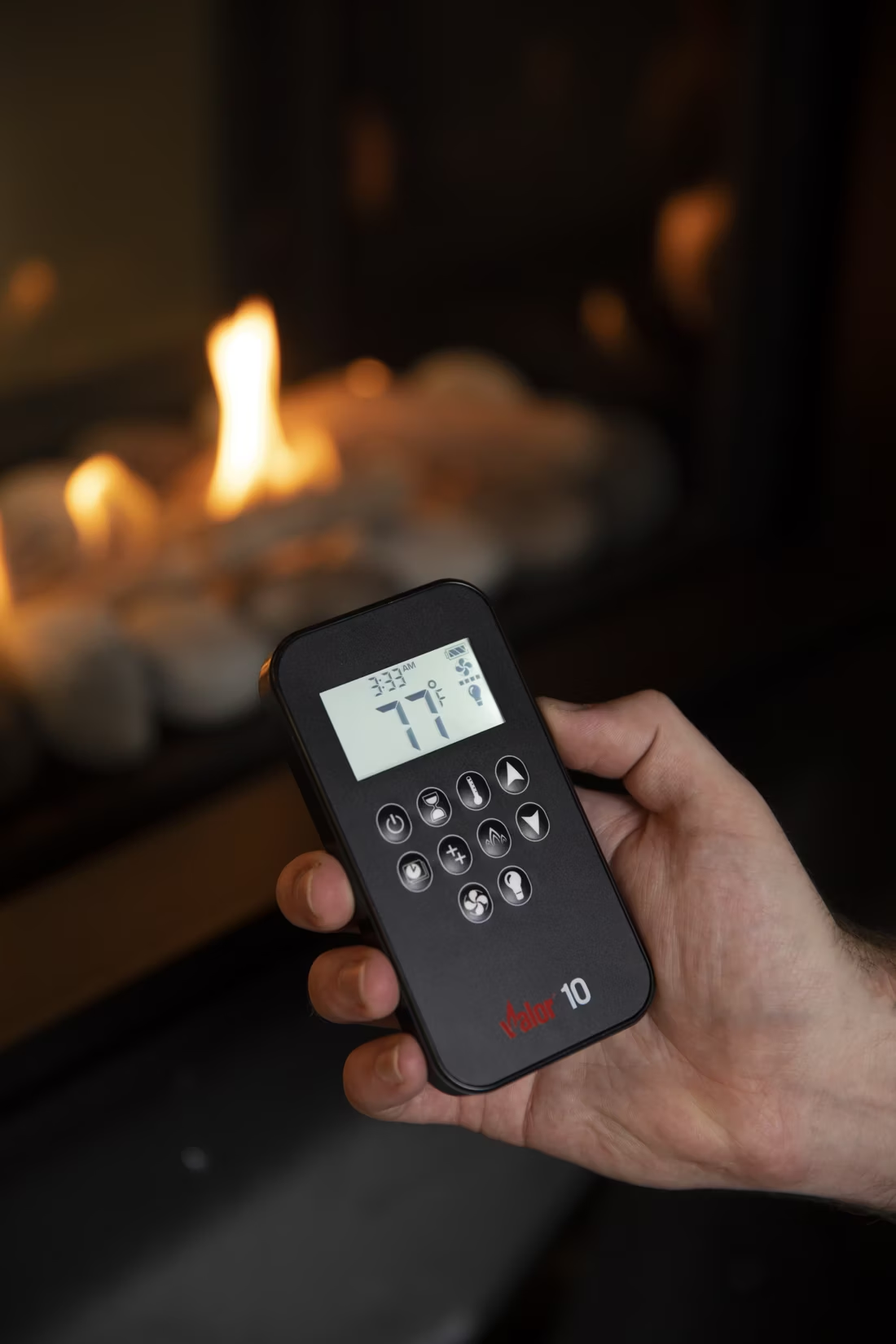
Most gas fireplaces with intermittent pilot ignition (IPI) include a battery backup that keeps the unit operating during an outage—worth having in a county where lake-effect squalls off Lake Erie can knock out power along the shoreline and in older neighborhoods with aging overhead lines. Valor fireplaces take a different approach: their pilot assembly generates its own electricity through the thermocouple, so the fireplace runs with no batteries required at all. Either way, ask your local dealer which ignition system a given model uses before you decide.
What's the difference between a gas fireplace, gas insert, and gas stove?
A gas fireplace is a fully built-in unit, framed into a wall—the right call for new construction or a remodel without an existing chimney. A gas insert slides into an existing masonry firebox and uses the chimney as its vent path, which fits the older housing stock found throughout Cleveland, Parma, and Euclid. A gas stove is freestanding, sitting on the floor like a wood stove but burning gas, and works well in a room with no fireplace at all. For most Cuyahoga County homeowners with an existing fireplace, an insert is the straightforward upgrade.
Do I need a permit to install a gas fireplace in Cuyahoga County?
Almost certainly, though the specific process depends on which of the county's 59 municipalities you're in—Cleveland, Parma, Lakewood, Euclid, and the rest each run their own building department, and each requires a building permit and a gas line permit for new gas fireplace work. A licensed gas-fitter has to handle the actual line connection regardless of city. Most established hearth dealers in the area coordinate all of this—permits, gas line, venting, and inspection—as part of the installation, so you're not left tracking down separate trades and separate city offices yourself.
Should I choose a vented or vent-free gas fireplace?
Vented (direct-vent) gas fireplaces pull combustion air from outside and exhaust the byproducts back outside through a sealed pipe—they're the cleanest, safest option and produce real heat output. Vent-free units burn without any outside venting and release some combustion byproducts into the room; Ohio permits them but with strict room-sizing and ventilation rules. For a 5A climate with a heating season as long as Cuyahoga County's, direct-vent units are the far more common recommendation from local dealers—they don't ask you to trade off indoor air quality for a heat source you'll be running for six months of the year.
How often does a gas fireplace need servicing?
Plan on an annual inspection, ideally before the heating season ramps up in the fall. A technician checks the burner, pilot assembly, venting, and gas connections, and cleans the glass and interior. It's a much smaller job than chimney sweeping for a wood-burning unit, but skipping it is how pilot and ignition problems go unnoticed until the coldest week of a Cleveland winter. Gas appliance service in the area typically runs $150 to $250 for a standard inspection.
Gas vs. electric fireplace—which makes more sense for my home?
For most houses across Cuyahoga County, gas wins on real heat output—a direct-vent gas insert or fireplace can meaningfully offset a furnace's workload during a 5,500-heating-degree-day winter. Electric fireplaces don't produce comparable heat, but they install anywhere with no venting or gas line at all, which makes them the practical choice for condos, apartments, and high-rise units in Cleveland and Lakewood where running a flue simply isn't possible. Wood-burning options, by contrast, are genuinely uncommon in this county—tight urban lots, limited firewood storage, and the density of the housing stock mean very few local dealers stock wood stoves at all. If you have a chimney and want real heat, gas is the default answer here; if you don't, electric fills the gap.
Can I put a TV above my fireplace?
Yes—with an asterisk. Fireplaces are hot and TVs don't like heat. Either put a mantel between them to deflect rising warmth, or choose a fireplace with heat-management technology that creates a cool zone on the wall above—the wall stays around 125 degrees, barely warm, while the room still gets full heat. If you like clean lines and don't want a mantel, heat management is the answer.
Is my gas fireplace wasting gas?
If it was installed more than 15 years ago, probably. Older gas fireplaces keep a standing pilot light burning all the time, and that little flame can cost a couple hundred dollars a year. Newer models use pilot-on-demand ignition—the pilot lights only when you use the fireplace and goes out when you turn it off.
Can I install a fireplace myself?
If you're putting a fire in your house on purpose, it's best to work with an expert. Unless you're genuinely experienced in framing, gas line, vent pipe, and the national code on clearances to combustibles, have a professional do it—and ideally the same company that sells you the fireplace, so warranty, service, and liability all live under one roof.
Can a fireplace actually lower my heating bill?
Yes—by creating a comfort zone. A furnace heats every square foot of the house just to warm the one room you're in; a gas fireplace on low burns roughly a sixth of the gas a typical furnace does. Set the furnace around 55–60 degrees as a baseline, then heat the rooms your family actually uses. Families who heat this way commonly save $20–$60 a month.
Stove and Fireplace Dealers in Cuyahoga County
Find your gas fireplace in Cuyahoga County.
Tell us about your home and we'll match you with a trusted local Cuyahoga County dealer and send over a free Project Guide & Parts List—the exact parts, including the vent kit, for your gas fireplace or insert project.
Find Your Fireplace →