
Reliable Warmth for Cuyahoga County's Cold Months.
Instant, low-maintenance heat for a village where most homes and businesses already run on natural gas. Find the right unit and connect with a trusted local dealer.
Every Project Starts From One of These Five Situations
Dependable heat without the hassle of firewood.
Brooklyn Heights is a small village of roughly 1,500 residents tucked between I-480 and I-77 in Cuyahoga County, with more industrial and commercial acreage than wooded residential lots. Winters here average lows around 24°F with a solid five-month heating season—cold enough to run supplemental heat from November through March, though not the brutal, sub-zero stretches you'd see in Fargo, ND or International Falls, MN. It's a climate where a stove needs to work, but doesn't need to be over-built for extreme lows.
With so little forested land inside village limits, wood and pellet stoves are rare here—most Brooklyn Heights homeowners heat with natural gas or electric resistance, and a gas fireplace or insert is the natural upgrade for anyone wanting real flame and zone heat without splitting logs or feeding a hopper. Electric service in the zip 44131 area splits between Cleveland Electric Illuminating Co. and City of Cleveland's municipal utility depending on exactly where you sit, so a homeowner's electric rate—and the economics of gas versus electric heat—can vary block to block.
Three steps. No salesperson until you're ready.
Tell us about your project
Your zip code, your situation, and the fuel you're leaning toward—or let the answers point you to one.
See what's actually available
The brands dealers within 100 miles genuinely carry—real options, never a catalog mirage.
Get your dealer & Project Guide
A trusted local dealer, plus the free Project Guide & Parts List that names every component of the job.
Frequently Asked Questions
How much does a gas fireplace installation cost in Brooklyn Heights?
Most gas fireplace and insert installations in the Brooklyn Heights area run between roughly $3,500 and $9,500. A direct-vent insert going into an existing masonry fireplace with a gas line already nearby sits at the lower end. A new built-in gas fireplace in a remodel—with framing, venting through an exterior wall, and a fresh gas line run from the meter—lands in the middle to upper range. Because so many Brooklyn Heights properties are older ranch and post-war homes built before central gas heat was standard, running a new gas line from the meter to a fireplace location is often the biggest swing factor in the final bid.
Is natural gas or propane more common for fireplaces in Brooklyn Heights?
Natural gas is the default here—the village is built out and well served, and the vast majority of homes already have a gas meter for their furnace and water heater, which makes adding a fireplace or insert a straightforward tap off the existing line. Propane shows up occasionally for detached structures, garages, or outbuildings where running a new gas line isn't practical, but for a primary living space in Brooklyn Heights, natural gas is almost always the simpler and cheaper route. Your local dealer will confirm line capacity during a home visit before recommending either.
Do I need a permit to install a gas fireplace in Brooklyn Heights?
Yes. New gas fireplace installations require a building permit and a gas-fitting permit, generally coordinated through the Village of Brooklyn Heights building department alongside Cuyahoga County code requirements. A licensed gas-fitter has to handle the actual line connection and pressure testing—this is one of the main reasons to go through an established hearth dealer rather than a general handyman, since they coordinate the gas trade, the venting inspection, and the final sign-off as one process instead of three separate headaches.
Will a gas fireplace still work if the power goes out?
Most will, with the right ignition system. Units with IPI (intermittent pilot ignition) run on a small battery backup that kicks in automatically when line power drops, so the fireplace still lights on demand during a Cleveland-area ice storm or downed-line outage. Valor fireplaces take a slightly different route—their pilot assembly generates its own electricity through the thermocouple, so there's no battery to remember to replace. Given that this part of Cuyahoga County sees occasional multi-day outages after major winter storms, it's worth asking your dealer specifically about the ignition system before you buy.
What's the difference between a gas fireplace, insert, and stove?
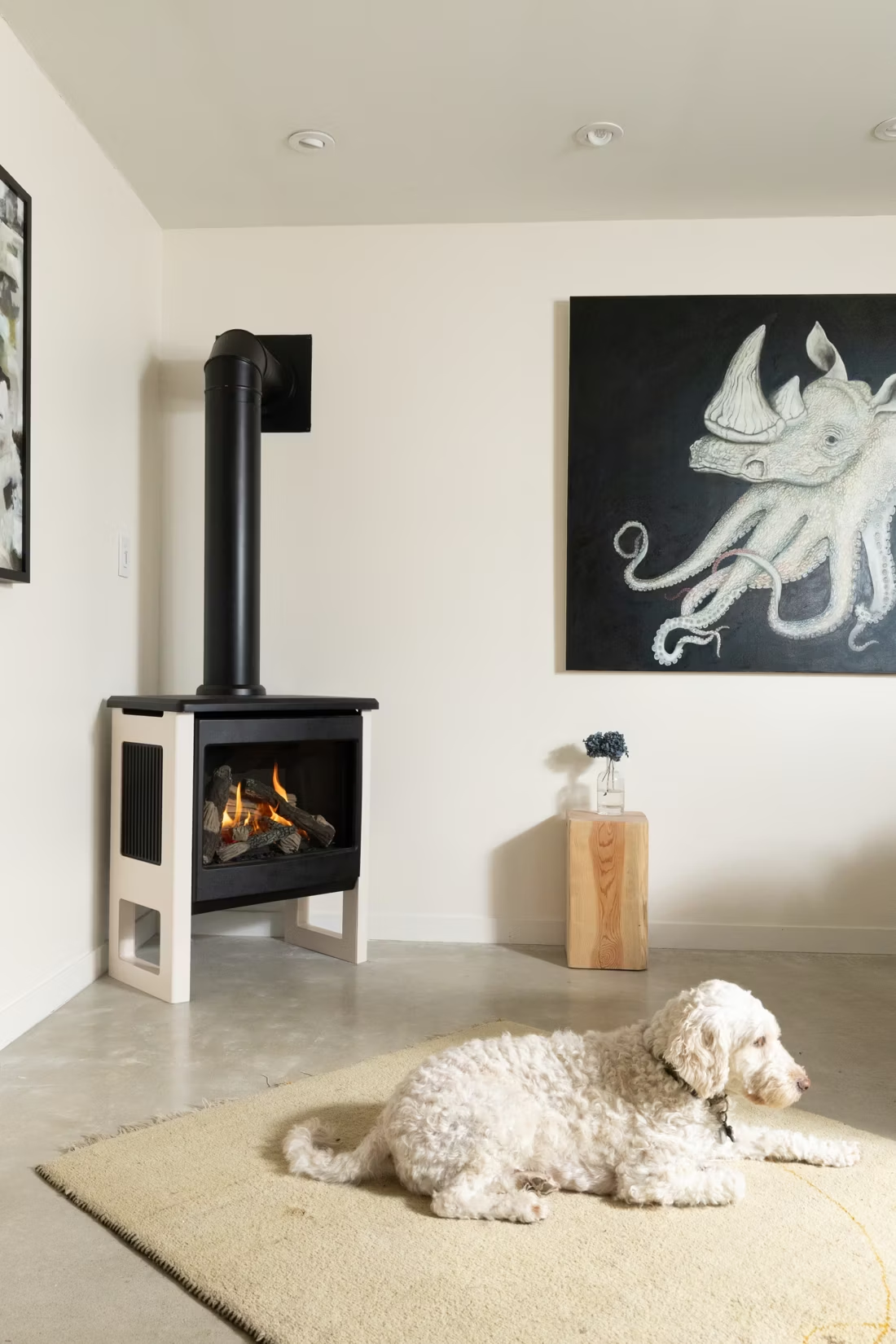
A gas fireplace is a fully built-in unit, framed into a wall—the usual choice for new construction or a full remodel. A gas insert slides into an existing masonry firebox and uses the chimney cavity (lined with a stainless liner) for venting, which is the common upgrade path for Brooklyn Heights' older homes with an existing but rarely-used wood fireplace. A gas stove is a freestanding cabinet unit, useful in a room with no existing chimney or fireplace opening at all. For most village homeowners converting an old open hearth, an insert is the simplest and most cost-effective option.
Should I choose a vented or vent-free gas fireplace?
Vented (direct-vent) units draw combustion air from outside and exhaust it back outside through sealed pipe—they're the safest option and the one nearly every local dealer will install by default. Vent-free units burn directly into the room and are legal in Ohio within specific room-size and ventilation limits, but they release moisture and small amounts of combustion byproducts indoors, which matters in a tightly sealed, well-insulated home built for a 5A climate. For Brooklyn Heights' housing stock—a mix of mid-century ranches and newer builds near the industrial park—direct-vent units are the more common and generally recommended choice.
How often does a gas fireplace need to be serviced?
Plan on an annual inspection, ideally in early fall before the heating season starts. A technician checks the burner, pilot or ignition system, venting, and gas connections, and cleans the glass and interior—a much smaller job than a wood chimney sweep, but still important since a dirty pilot or degraded gasket is the most common cause of a fireplace that won't stay lit through winter. Local gas appliance service providers typically charge $150 to $250 for this visit.
Gas vs. electric fireplace—which makes more sense in Brooklyn Heights?
It depends partly on which side of the village you're on. Cleveland Electric Illuminating Co. residential rates run around $0.094/kWh, while accounts served by the City of Cleveland's municipal utility run closer to $0.149/kWh—nearly 60% higher. At the lower rate, electric heat is reasonably cheap supplemental warmth for a single room; at the higher rate, gas becomes the clearly cheaper option for anything beyond occasional ambiance. Electric units also install for a fraction of the cost (often under $1,500, sometimes just a simple plug-in) and need no venting at all, so they're the easier retrofit if you're renting or don't want any construction. Gas wins on real heat output and the traditional flame look; electric wins on installation simplicity and upfront cost.
Why don't more homes in Brooklyn Heights use wood stoves?
Wood heat is genuinely uncommon here, and that's more about geography than preference—Brooklyn Heights is a small, heavily commercial and industrial village with very little wooded acreage, so there's neither the tree cover nor the storage space that makes wood heat practical the way it is in more rural parts of Northeast Ohio. A handful of homeowners still burn oak, hickory, or cherry in an existing fireplace for ambiance on cold nights, but almost nobody treats wood as a primary or backup heat source the way gas or electric functions here. If you already have a wood-burning fireplace, converting it to a gas insert is usually the more practical upgrade than sourcing and storing cordwood in a village this size.
Can I put a TV above my fireplace?
Yes—with an asterisk. Fireplaces are hot and TVs don't like heat. Either put a mantel between them to deflect rising warmth, or choose a fireplace with heat-management technology that creates a cool zone on the wall above—the wall stays around 125 degrees, barely warm, while the room still gets full heat. If you like clean lines and don't want a mantel, heat management is the answer.
What's the difference between an insert and a zero-clearance fireplace?
An insert is a fireplace that slides into a pre-existing wood-burning fireplace—if you don't have one, there's nothing to insert it into. A zero-clearance fireplace is built into a framed wall, which makes it the answer for remodels and new construction. Simple test: existing masonry fireplace means insert; blank or framed wall means zero-clearance.
Does a fireplace add value to my home?
On average, a fireplace adds back to the home about the same amount you spent installing it. Add the monthly savings from heating the rooms you actually use instead of the whole house—often hundreds of dollars a year—and the value case is strong before you even count what a fire does for how your family uses the room.
Can I install a fireplace myself?
If you're putting a fire in your house on purpose, it's best to work with an expert. Unless you're genuinely experienced in framing, gas line, vent pipe, and the national code on clearances to combustibles, have a professional do it—and ideally the same company that sells you the fireplace, so warranty, service, and liability all live under one roof.
Nearby Dealers
Hearth shops serving Brooklyn Heights and the surrounding area. Every listing shows whether it is a WhyFire partner, a dealer we have verified as authorized for the brands we recommend, or a local business carrying hearth products. No manufacturer pays for placement. How we verify dealers →
We’ve paused dealer listings for this connection today. Enter your zip or postal code above to find dealers near you, or come back tomorrow.
Popular Gas Brands
Where each brand came from, what's inside it today, and every current model. No brand pays to be here. Not every dealer carries every brand, so enter your zip code to see what's sold near Brooklyn Heights.
Kozy Heat
Kozy Heat was founded in 1976 by Dudley Hussong in Lakefield, Minnesota, and incorporated as Hussong Manufacturing Co., Inc. in 1978.
28 gas models →Fireplace Xtrordinair
Fireplace Xtrordinair, now often called FireplaceX, is the fireplace brand of Travis Industries, Inc., of Mukilteo, Washington.
25 gas models →Town & Country
Town & Country Fireplaces is the luxury gas fireplace brand of Pacific Energy Fireplace Products Ltd., of Duncan, British Columbia.
14 gas models →Lopi
Lopi is a wood, pellet, and gas stove brand founded by Kurt Rumens in Bellevue, Washington, in 1979.
7 gas models →Forge & Flame
Forge & Flame is the stove brand Hearth & Home Technologies introduced in August 2023 to bring Vermont Castings, Harman, and Quadra-Fire under one name.
6 gas models →Vermont Castings
Vermont Castings was founded in 1975 by Duncan Syme, the designer, and his brother-in-law Murray Howell, the business partner, in Randolph, Vermont.
6 gas models →Find your gas fireplace in Brooklyn Heights.
Tell us a bit about your home and we'll help you find the right gas fireplace, insert, or stove—plus a free Project Guide & Parts List and a trusted local Cuyahoga County dealer to install it.
Find Your Fireplace →