
Keep Your Family Warm and Safe—No Matter What
With 9,801 heating degree days and winter lows averaging -4°F, Pierce County is as cold as it gets in the Lower 48—but the open Drift Prairie around Rugby has never had the standing timber to make wood a primary fuel. We'll help you understand where wood heat actually fits here, and match you with a dealer who can install it right if it does.
Every Project Starts From One of These Five Situations
On the Drift Prairie, trees are the exception too.
Pierce County sits on North Dakota's glaciated Drift Prairie, with Rugby—home to the marked Geographical Center of North America—as the county seat and about 2,800 residents spread across mostly open farmland. Climate zone 7 and 9,801 heating degree days put Pierce County in the same company as International Falls, Minnesota, for sheer cold; winter lows average -4°F before wind chill, and stretches well below zero are routine. That's exactly the kind of climate where wood heat is a fixture in mountain and forested regions further west. But Pierce County isn't forested—it's prairie, and any local wood comes from hand-planted shelterbelts and scattered river-bottom stands of oak, cottonwood, and ash rather than public timberland.
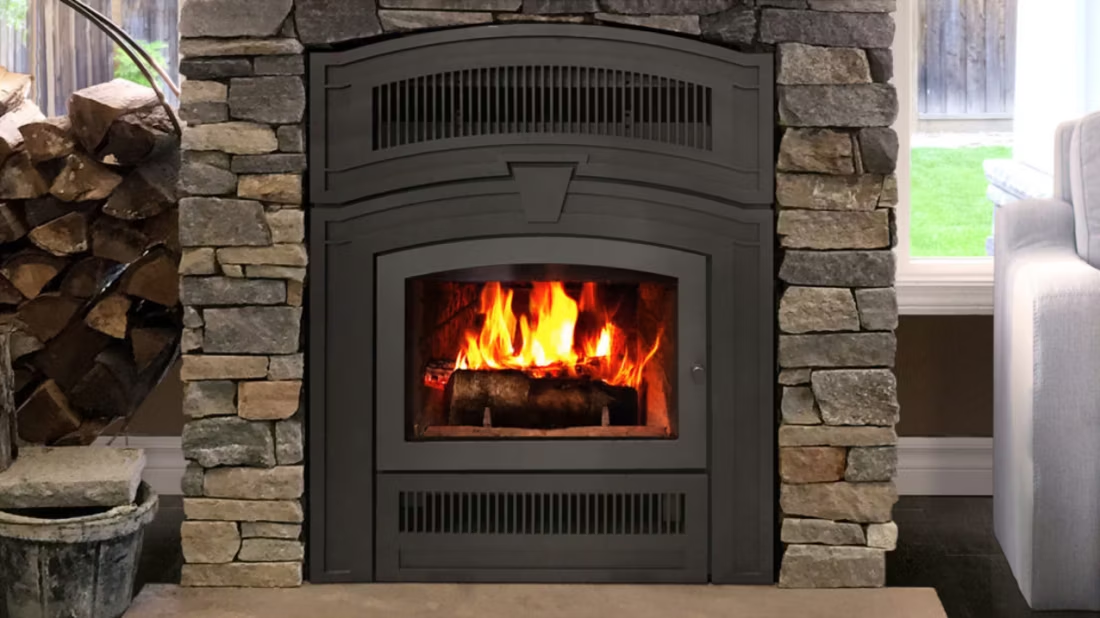
There's no national forest cutting permit office in Pierce County because there's no national forest here—firewood is sourced informally, from windbreak thinning, farmstead trees, or hauled in from wooded pockets like the Turtle Mountains to the north. That supply gap, not any smoke ordinance (air quality concerns here are listed as none), is the real reason propane and electric heat carry the county's brutal winters. Regional pellet brands like Lignetics and Indeck Energy Services do reach the area by delivery, but pellet heat is similarly uncommon for the same underlying reason: this is a county built around delivered fuel, not gathered wood. A small number of Pierce County homeowners still install wood stoves—for backup heat during rural power outages, in shops and hunting cabins, or simply for the ambiance—and a trusted local dealer can size and vent one correctly for a climate this severe.
Three steps. No salesperson until you're ready.
Tell us about your project
Your zip code, your situation, and the fuel you're leaning toward—or let the answers point you to one.
See what's actually available
The brands dealers within 100 miles genuinely carry—real options, never a catalog mirage.
Get your dealer & Project Guide
A trusted local dealer, plus the free Project Guide & Parts List that names every component of the job.
Frequently Asked Questions
How much does a wood stove installation cost in Pierce County?
Because wood stoves are installed far less often here than propane furnaces or electric systems, there isn't the same volume of local pricing data you'd find in a forested county. As a general range for rural north-central North Dakota, expect somewhere in the $3,000 to $7,000 range for a stove, hearth pad, and Class A chimney installation—on the higher end if the home has no existing masonry chimney to work with. Installers serving Pierce County typically travel from Minot or Devils Lake, so ask whether a trip charge applies before you commit.
Does wood heat even make sense given how cold Pierce County gets?
It can, but not as your only heat source. With 9,801 heating degree days and winter lows averaging -4°F—comparable to International Falls, Minnesota—a wood stove alone would demand a lot of firewood and constant tending through a Pierce County winter. Where wood heat earns its place here is as backup: a catalytic stove that can hold a fire overnight if propane delivery is delayed by a blizzard, or supplemental heat in a shop or outbuilding. Very few homes in the county run wood as their primary system.
Where does firewood actually come from if Pierce County doesn't have forest?
Most local firewood comes from shelterbelts—the rows of trees farmers planted generations ago as windbreaks—along with scattered stands near the Mouse River drainage and yard trees taken down for maintenance. Oak, ash, and cottonwood are the species you'll most often find split and stacked locally; oak and ash burn longer and hotter, while cottonwood is softer and better suited to quick, easy-lighting fires. There's no national forest cutting permit office in the county, so most wood is acquired through landowner arrangements rather than a formal permit system, or hauled in from wooded areas farther north like the Turtle Mountains.
Do I need a permit to install a wood stove in Pierce County?
Any new wood-burning appliance needs to meet current EPA 2020 NSPS emissions standards, and you should check with the Pierce County building office or the City of Rugby (if you're inside city limits) before installation, since permit requirements can vary by jurisdiction in a county this size. There are no local smoke ordinances or curtailment periods here—air quality concerns are listed as none for the county—so unlike wood-heavy inversion-prone areas out west, burning restrictions aren't a factor. The permit is about code compliance and safe venting, not air quality.
What size wood stove do I need for a home in a climate this cold?
Given Pierce County's 9,801 heating degree days, you generally want to size toward the upper end of a stove's rated range rather than the low end—undersized stoves struggle to keep up once temperatures drop well below zero, which happens often here. A catalytic stove from a brand like Blaze King, capable of holding a fire 20+ hours on a load, is worth considering for a home relying on wood for any meaningful share of its heat. But because most Pierce County homes use wood as backup or supplemental heat rather than a whole-house system, a mid-size stove sized to a single large room or main living area is more typical than a whole-home unit.
Wood vs. propane vs. electric—what's actually right for Pierce County?
Propane is the dominant heating fuel across rural Pierce County, and for good reason: it's delivered, reliable, and doesn't depend on a fuel supply the county's prairie landscape can't easily provide. Electric heat is also standard, though electric resistance heat runs expensive at climate zone 7 temperatures. Wood's real value here is as a hedge—a stove that can keep one room warm if a winter storm delays a propane delivery or knocks out power, which does happen on the open prairie. Very few homeowners choose wood as their sole heat source given how much cordwood a Pierce County winter would consume.
What wood species are best for heating in Pierce County?
Oak and ash, when you can source them from local shelterbelts or river-bottom trees, are the best options—dense, high-BTU wood that burns long and hot, which matters when you're trying to stretch a limited local supply through a cold snap. Cottonwood is more common but burns faster and cooler, so it works better mixed with denser wood or used for quick daytime fires rather than an all-night burn. Because Pierce County doesn't have commercial firewood operations the way forested regions do, expect to source wood through personal arrangements rather than a retail firewood yard.
Are wood stoves actually common in Pierce County?
No—wood stoves are uncommon in Pierce County, and it's worth being upfront about that. The county's population is small and spread across open prairie with propane and electric as the default heating fuels. The homeowners who do install a wood stove are typically doing it for backup heat during outages, for a shop or outbuilding, or simply because they enjoy having a fire—not because it's the area's primary heating method the way it is in forested parts of the country. If that's your situation, a trusted dealer can still get you a correctly sized, properly vented unit; there just isn't the density of installers you'd find in a wooded region.
How does Find My Fireplace help me find a wood stove dealer in a county where wood heat is rare?
I built this specifically for situations like Pierce County's—where the fuel you want isn't the local default, but a good option still exists if you know who to call. Rather than searching blind, tell us about your home and we'll match you with a trusted local dealer, likely serving Pierce County out of Minot or Devils Lake, who actually installs wood stoves in this climate and can size one correctly for -4°F average lows. You'll get a free Project Guide & Parts List—the specific stove, venting components, and installation plan for your home—before you ever talk price with anyone.
Why is a fireplace insert so efficient?
An insert does two things: it seals the chimney completely, so you stop losing air you already paid to heat, and it radiates warmth into the room through the firebox and glass. Most add a heat-exchange fan that pulls cool room air underneath, wraps it around the hot firebox, and pushes it back out warm. Your home is more efficient before you've even lit the first fire.
What's the difference between an insert and a zero-clearance fireplace?
An insert is a fireplace that slides into a pre-existing wood-burning fireplace—if you don't have one, there's nothing to insert it into. A zero-clearance fireplace is built into a framed wall, which makes it the answer for remodels and new construction. Simple test: existing masonry fireplace means insert; blank or framed wall means zero-clearance.
How much should I budget for a fireplace?
For an average home—covering the fireplace, the vent pipe, and basic installation—a budget between $3,900 and $5,500 gives you a lot of options across wood, gas, and pellet. By the time you add finish work, gas line, and electrical, the average complete installation lands between $5,000 and $12,000 all-in. In a remodel or new build, a good rule is to put about 2.5% of the total project cost toward the fireplace.
What is an in-home preview and do I need one?
It's a visit where a hearth professional measures your space, confirms the model you picked actually works in your home, and walks the specs—framing, gas line, venting, finish work—before anything is ordered. Some details you just can't know until you see the house. Never make a down payment without one; it's the single most-skipped step that burns buyers.
Find your wood stove in Pierce County.
Tell us about your home and we'll match you with a trusted local dealer and send you a free Project Guide & Parts List—the right stove, the venting it needs, and a plan built for Pierce County's cold.
Find Your Fireplace →