
Keep Your Family Warm and Safe—No Matter What
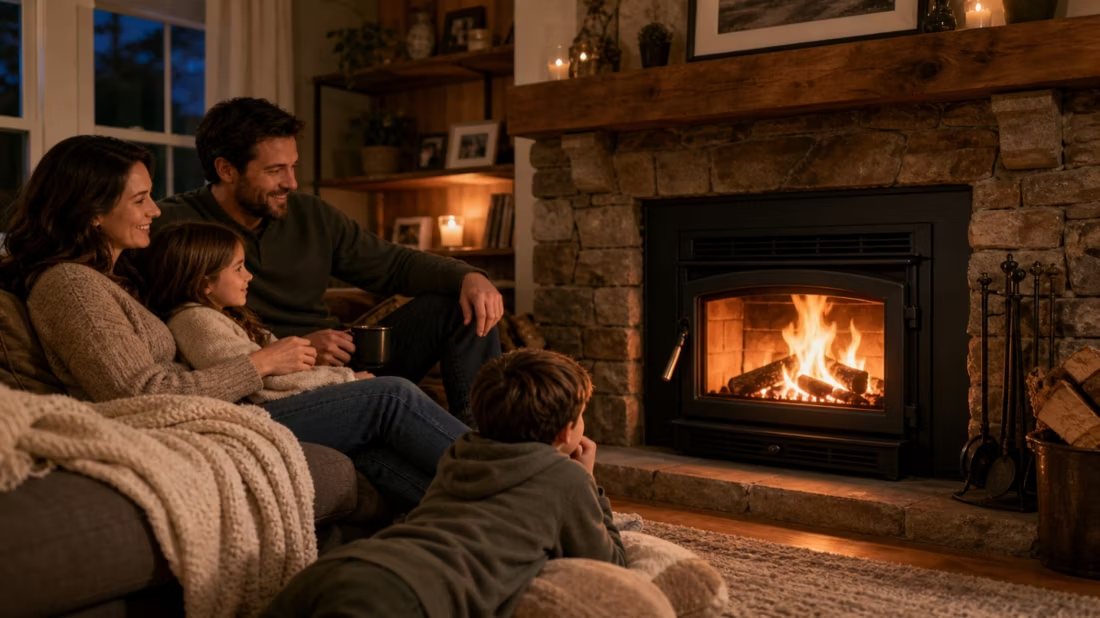
From the county seat in Meade to Fowler and Plains, wood heat has always been part of life on this stretch of southwest Kansas plains. Find the right stove or insert, and connect with a trusted local dealer.
Every Project Starts From One of These Five Situations
Firewood runs deep on the Kansas High Plains.
Meade County sits in the semi-arid southwest corner of Kansas along Crooked Creek, home to just over 3,000 people spread across the county seat of Meade, Fowler, and Plains. Winters here fall in climate zone 4A with a moderate winter heating load and an average winter low near 19°F—not the brutal double-digit-below cold of the Dakotas, but wind off the open plains cuts through drafty farmhouses fast, and single-digit nights show up more winters than not between December and February.
The county's most common firewood isn't hauled in from a national forest—it grows along fence lines. Osage orange, planted by the thousands as windbreaks and shelterbelts during the Dust Bowl-era Prairie States Forestry Project, has matured into one of the hottest-burning firewoods available anywhere, and it's abundant on private land throughout the county. Oak and hickory fill in along the Crooked Creek bottoms. Because Meade County has little public timberland, most firewood here comes from private-land clearing, hedge-row removal, or a local seller rather than a Forest Service permit—a different supply chain than mountain-west counties, but a reliable one. A properly sized wood stove keeps a farmhouse warm through wind-driven cold fronts and keeps the lights-out scenario from becoming a cold house, since ice storms and high wind events can knock out rural power lines here for a day or more at a stretch.
Three steps. No salesperson until you're ready.
Tell us about your project
Your zip code, your situation, and the fuel you're leaning toward—or let the answers point you to one.
See what's actually available
The brands dealers within 100 miles genuinely carry—real options, never a catalog mirage.
Get your dealer & Project Guide
A trusted local dealer, plus the free Project Guide & Parts List that names every component of the job.
Frequently Asked Questions
How much does a wood stove installation cost in Meade County?
A typical wood stove installation for a home in Meade County runs roughly $3,500 to $8,500, depending on the stove model, whether an existing chimney can be reused, and whether new Class A chimney pipe and a hearth pad are needed for code clearance. Because Meade County's population is small and there's no hearth showroom within the county itself, most installers travel from Dodge City or Liberal—expect a modest travel charge added to the estimate versus a job in a larger town. An in-home visit is the only way to get a firm number, since older farmhouses often need extra work to bring an existing chimney or hearth up to current clearance standards.
What size wood stove do I need for my home?
Sizing depends on square footage, ceiling height, insulation, and whether you're heating one room or an entire farmhouse. Many homes in Meade County are older, larger farmhouses with limited insulation, which pushes sizing toward the mid-to-large range even for moderate square footage. One local wrinkle: if you're burning osage orange, which puts out significantly more heat per load than softer woods, you generally don't need to size up as aggressively as you would with a lighter species—a mid-size stove loaded with hedge can outperform a larger stove burning cottonwood or pine. A local dealer sizing your home in person will factor in both your square footage and your likely wood source.
Where can I find certified wood stove installers near me?
Look for NFI (National Fireplace Institute) or CSIA (Chimney Safety Institute of America) certification regardless of where the installer is based. With Meade County's population under 3,500, there's no dedicated hearth retailer inside the county—most residents work with certified dealers out of Dodge City, roughly 30 miles east, or Liberal to the south. That travel distance is normal here and shouldn't be a red flag; what matters is that the installer is certified and stands behind the venting and clearance work, not just the sale of the stove.
What's the difference between a wood stove and a wood insert?
A wood stove is a freestanding unit on a hearth pad that vents through a chimney and can go almost anywhere with the right clearances. A wood insert slides into an existing masonry fireplace opening and turns a drafty open hearth into a sealed, high-efficiency heat source using the chimney you already have. Many older homes in and around Meade have an existing masonry fireplace that's more decorative than functional—an insert is usually the better upgrade there. Newer construction or rooms without an existing fireplace are better suited to a freestanding stove.
Do I need a permit to install a wood stove in Meade County?
New wood stove installations require a building permit, handled through the Meade County building department at the courthouse in Meade for anything outside city limits, or the applicable city office for in-town installs. Most certified installers handle the permit paperwork as part of the job. Unlike parts of the country with winter air quality curtailment programs, Meade County has no burn bans or inversion advisories affecting wood stove use—once your stove is installed and permitted, you can burn it as needed without seasonal restrictions.
What's the best wood stove for Meade County's climate?
Meade County's moderate winter heating load and 19°F average winter low are mild compared to somewhere like Bismarck, ND, but open-plains wind chill makes a home feel colder than the thermometer suggests. A mid-size, EPA-certified stove—catalytic or non-catalytic—handles most homes here well. Because osage orange burns so hot and dense, pay attention to firebox size and coal management rather than just BTU output on the spec sheet; a local dealer familiar with hedge-heavy wood supplies can steer you toward a stove that handles it without overfiring.
How often should my chimney be inspected and cleaned?
CSIA recommends an annual inspection for any wood-burning appliance, and that holds true in Meade County whether you're burning a stove or an insert. Many local chimneys are older masonry structures original to the farmhouse, which makes an annual Level 1 inspection especially important—liner condition and mortar joints deteriorate over decades and aren't always visible from the outside. Plan the sweep for late summer, ahead of the first cold fronts that typically arrive by October.
Where can I get firewood in Meade County?
Most firewood in Meade County comes from private land rather than public timber allotments, since the county has little public forest to permit against. Osage orange (hedge), planted extensively as windbreaks decades ago, is widely available from landowners clearing fence rows and shelterbelts, and it's some of the hottest-burning firewood you can put in a stove. Oak and hickory come out of the Crooked Creek bottoms. Local sellers and farm-country classifieds are the typical route to a cord, and prices run in line with the rest of rural Kansas—expect to pay less than you would in a market with tighter wood supply.
Wood stove vs. pellet stove—which is right for me?
Wood stoves burn cordwood, work without electricity, and pair naturally with the abundant local hedge, oak, and hickory supply—a real advantage in Meade County, where rural power lines can go down for a day or more during ice storms and high wind events. Pellet stoves, using bagged pellets from brands like Lignetics or Indeck Energy Services, are more convenient—load the hopper, set the thermostat, less ash—but the auger and blower need electricity, so they're not a fallback during an outage. For a county this rural, wood tends to be the more resilient choice; pellet works well as a secondary or convenience option for homes with reliable power.
What's the difference between an insert and a zero-clearance fireplace?
An insert is a fireplace that slides into a pre-existing wood-burning fireplace—if you don't have one, there's nothing to insert it into. A zero-clearance fireplace is built into a framed wall, which makes it the answer for remodels and new construction. Simple test: existing masonry fireplace means insert; blank or framed wall means zero-clearance.
Why is my open fireplace making my house colder?
Open fireplaces suck—literally. As the fire burns, it consumes air your furnace already paid to heat and pulls it out through the chimney, so the house is actually colder after the fire goes out than before you lit it. An insert fixes this: it seals the chimney, puts fixed glass across the front, and turns that hole in your house into a real heat source.
Does a fireplace add value to my home?
On average, a fireplace adds back to the home about the same amount you spent installing it. Add the monthly savings from heating the rooms you actually use instead of the whole house—often hundreds of dollars a year—and the value case is strong before you even count what a fire does for how your family uses the room.
Can a fireplace actually lower my heating bill?
Yes—by creating a comfort zone. A furnace heats every square foot of the house just to warm the one room you're in; a gas fireplace on low burns roughly a sixth of the gas a typical furnace does. Set the furnace around 55–60 degrees as a baseline, then heat the rooms your family actually uses. Families who heat this way commonly save $20–$60 a month.
Find your wood fireplace in Meade County.
Tell us a bit about your home and we'll match you with the right wood stove or insert for southwest Kansas winters—plus a free Project Guide & Parts List with your recommended local dealer.
Find Your Fireplace →