
Add real heat and ambiance to your Warren County home—no flue required.
From the historic rowhouses of downtown Front Royal to newer builds out toward Shenandoah Farms and Bentonville, electric fireplaces bring zone heat and a real flame look to rooms a wood or gas unit can't easily reach. Find the right unit and connect with a trusted local dealer.
Every Project Starts From One of These Five Situations
Zone heat for a valley of old chimneys and new additions.
Warren County sits in the northern Shenandoah Valley at the foot of the Blue Ridge, with Front Royal as the county seat and Skyline Drive marking the eastern edge of the county at the entrance to Shenandoah National Park. Climate zone 4A here means a real winter—a moderate winter heating season with average winter lows sit around 24°F—but it's a moderate cold compared to the mountains further west, not the kind of deep-freeze climate that demands a primary wood or gas system to survive January. That makes Warren County a good fit for electric as a supplemental option: enough cold to want extra heat in specific rooms, not so much that whole-home electric resistance heating makes financial sense as your only source.
A lot of the housing stock in and around Front Royal is older—brick rowhouses and farmhouses with chimneys that were never built for a modern insert, or additions and finished basements with no chimney at all. Electric fireplaces solve both problems: a plug-in unit needs nothing more than an outlet, and a hardwired built-in just needs a dedicated circuit run by an electrician. With no smoke, no venting, and no wood to season (oak, hickory, and maple are the local go-to species for those who do burn), electric units also sidestep any concern about local air quality restrictions—Warren County has none currently on the books, but electric never raises the question at all. For renters, condo owners, and anyone who wants fireplace ambiance in a room a flue will never reach, it's often the simplest path.
Three steps. No salesperson until you're ready.
Tell us about your project
Your zip code, your situation, and the fuel you're leaning toward—or let the answers point you to one.
See what's actually available
The brands dealers within 100 miles genuinely carry—real options, never a catalog mirage.
Get your dealer & Project Guide
A trusted local dealer, plus the free Project Guide & Parts List that names every component of the job.
Frequently Asked Questions
How much does an electric fireplace installation cost in Warren County?
Plug-in electric fireplaces and mantel packages are the cheapest path—often $300 to $1,000 for the unit itself, with no installation labor beyond mounting since they run off a standard outlet. Hardwired built-ins and larger linear units cost more, typically $1,000 to $2,500 including an electrician's time to run a dedicated 20-amp circuit, especially in older Front Royal homes where the electrical panel may need a spare breaker slot added. Cabinet-style mantel units with a built-in electric insert land in between. A local dealer can walk you through the tradeoffs during an in-home look at your space.
Will an electric fireplace actually heat my room, or is it just for looks?
Most electric fireplaces sold today have a real heating element alongside the flame effect—typically 1,500 watts, which is enough to noticeably warm a single room (roughly 400 to 1,000 square feet depending on ceiling height and insulation). Given Warren County's climate—average winter lows around 24°F and a moderate winter heating season—electric works well as supplemental heat for a home office, sunroom, or finished basement, letting you turn down the thermostat in that zone rather than running the whole-house furnace harder. It's not built to replace a furnace for the whole house, but as a room-by-room solution it holds its own.
Do I need a permit to install an electric fireplace in Warren County?
A plug-in unit that runs off an existing outlet doesn't require a permit—it's treated like any other appliance. A hardwired built-in or insert that needs new wiring or a dedicated circuit does typically require an electrical permit through the Warren County building department, since it involves work on the home's electrical system. Most licensed electricians and hearth dealers who handle these installs will pull the permit as part of the job, so it's rarely something you have to manage yourself.
What's the difference between an electric insert, a wall-mount unit, and a mantel package?
An electric insert is built to slot into an existing fireplace opening—a common choice for Front Royal homes with an old masonry fireplace that's no longer used for wood or was never converted to gas. A wall-mount (or linear) unit hangs flat against a wall like a large TV, popular in newer construction or additions with no fireplace opening at all. A mantel package pairs an electric insert with a surrounding cabinet or mantel shelf, giving you a freestanding, furniture-style fireplace that doesn't require any wall or fireplace opening—a good fit for renters or anyone who wants the look without permanent modification.
Electric vs. wood—which makes more sense for my Warren County home?
Wood heat has deep roots in this part of the Shenandoah Valley, with oak, hickory, and maple as the common local firewood species, and it keeps working during a power outage—a real advantage in a county with rural roads and occasional winter ice storms. Electric can't run without power, so it's not a backup-heat solution. Where electric wins is simplicity and reach: no chimney, no ash, no wood storage, and it can go into rooms a wood stove never could—a condo, a finished basement, a rental. Plenty of Warren County homes run both: wood or a wood insert for primary or backup heat, electric for a room that just needs a little extra warmth and some ambiance without the upkeep.
Does an electric fireplace work during a power outage?
No—electric fireplaces need household power to run both the flame effect and the heater, so they go dark along with everything else if the power drops. That's the main tradeoff against wood or gas in a county where winter storms occasionally knock out lines in the more rural stretches toward Linden and Bentonville. If backup heat during outages matters to you, pair an electric unit in one room with a wood stove or vented gas fireplace elsewhere in the house rather than relying on electric alone.
How much does it cost to run an electric fireplace?
Most electric fireplace heaters draw around 1,500 watts on the highest heat setting, which works out to roughly 15 to 20 cents an hour to run at typical residential electric rates—cheap enough to leave on for an evening without much thought. Running the flame effect alone, without the heater engaged, uses only a small fraction of that. Check your specific utility's per-kWh rate for an exact number, but for most Warren County households an electric fireplace used a few hours a night in one room adds up to a modest amount on the monthly bill compared to heating the whole house harder.
What's the best electric fireplace for a Warren County home?
For supplemental heat in a moderate-cold climate like this one, look for a unit with a real 1,500-watt heater, a thermostat (not just high/low settings), and a realistic flame technology—the newer LED and mist-based flame effects look far better than the older rotating-light models. If the room is small or well-insulated, a lower-wattage or flame-only unit may be plenty. For finished basements or additions without existing wiring, ask a local dealer about insert sizing relative to your fireplace opening, or a wall-mount unit sized to the room. A dealer walking your space can steer you toward the right wattage and format rather than guessing off a box at a big-box store.
Electric vs. pellet stove—which is right for me?
Pellet stoves burn compressed wood pellets—regional brands like Energex, Hamer Pellet Fuel, and Greene Team Pellet Fuel are commonly available in this part of Virginia—and they put out serious heat, enough to serve as a primary heat source for a home or large zone, but they need venting through an exterior wall or roof and still depend on electricity to run the auger and blower. Electric fireplaces need no venting at all and are simpler to install, but they can't match a pellet stove's total heat output for whole-home or large-area heating. If you're trying to meaningfully offset furnace use in a larger space, a pellet stove is the stronger tool; if you want ambiance and modest supplemental warmth in one room with the easiest possible install, electric is the better fit.
Can I put a TV above my fireplace?
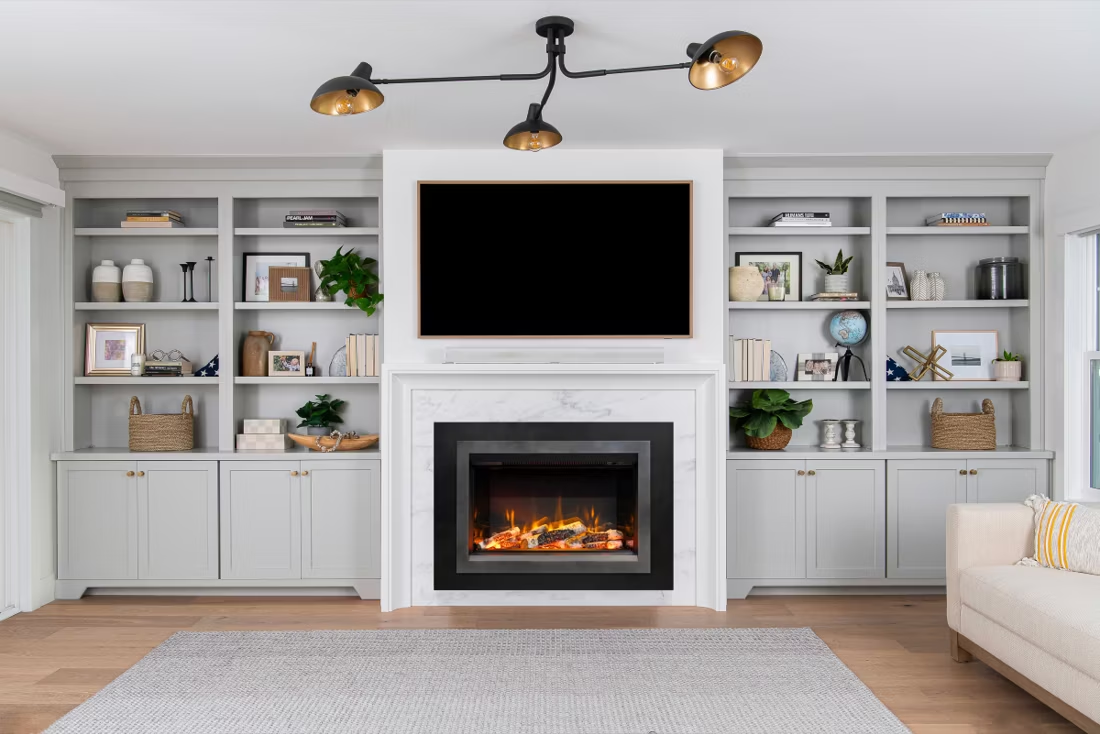
Yes—with an asterisk. Fireplaces are hot and TVs don't like heat. Either put a mantel between them to deflect rising warmth, or choose a fireplace with heat-management technology that creates a cool zone on the wall above—the wall stays around 125 degrees, barely warm, while the room still gets full heat. If you like clean lines and don't want a mantel, heat management is the answer.
Does an electric fireplace need a vent or chimney?
No—that's its superpower. An electric fireplace needs a wall and an outlet, period. No vent pipe, no gas line, no clearances to design around, which is why it works in bedrooms, offices, apartments, and walls where venting a gas or wood unit would be impractical or impossible. Installation is typically the simplest and least expensive of any fireplace type.
How much should I budget for a fireplace?
For an average home—covering the fireplace, the vent pipe, and basic installation—a budget between $3,900 and $5,500 gives you a lot of options across wood, gas, and pellet. By the time you add finish work, gas line, and electrical, the average complete installation lands between $5,000 and $12,000 all-in. In a remodel or new build, a good rule is to put about 2.5% of the total project cost toward the fireplace.
Does a fireplace add value to my home?
On average, a fireplace adds back to the home about the same amount you spent installing it. Add the monthly savings from heating the rooms you actually use instead of the whole house—often hundreds of dollars a year—and the value case is strong before you even count what a fire does for how your family uses the room.
Stove and Fireplace Dealers in Warren County
Listings include WhyFire partner dealers, dealers we have verified as authorized for the brands we recommend, and established local businesses that carry hearth products. Every listing shows which one it is. The ones marked Preferred run on WhyFire's software, so they can show you real pricing and book your appointment right here. No manufacturer pays for placement. How we verify dealers →
Area – Huntly, Va
Miller Ace Hardware
Holtzman Propane
Dmv Chimneys & Masonry Repair
Prouty's Chimney Sweep
Blossman Gas And Appliance
Amazing Flame
Costello's Hearth & Spa - Warrenton
Nova Fire Design
Find your electric fireplace in Warren County.
Tell us a bit about your home and we'll match you with the right electric fireplace, insert, or wall-mount unit—plus a free Project Guide & Parts List and a trusted local dealer to install it.
Find Your Fireplace →