
Add warmth to any room in Staunton—no chimney required.
Zone heat for Shenandoah Valley winters, without new venting, gas lines, or masonry work. Find the right unit and connect with a trusted local dealer.
Every Project Starts From One of These Five Situations
Reliable warmth without the retrofit.
Staunton sits in the Shenandoah Valley at about 1,400 feet, where winters are moderate by regional standards—average lows around 25°F and a heating season that adds up to a little over half the winter heating load of a place like Bozeman, MT. That milder profile is exactly why electric fireplaces do so well here: most Staunton homes don't need a heavy-duty primary heat source, they need targeted warmth in a specific room, and electric delivers that instantly without touching the HVAC system.
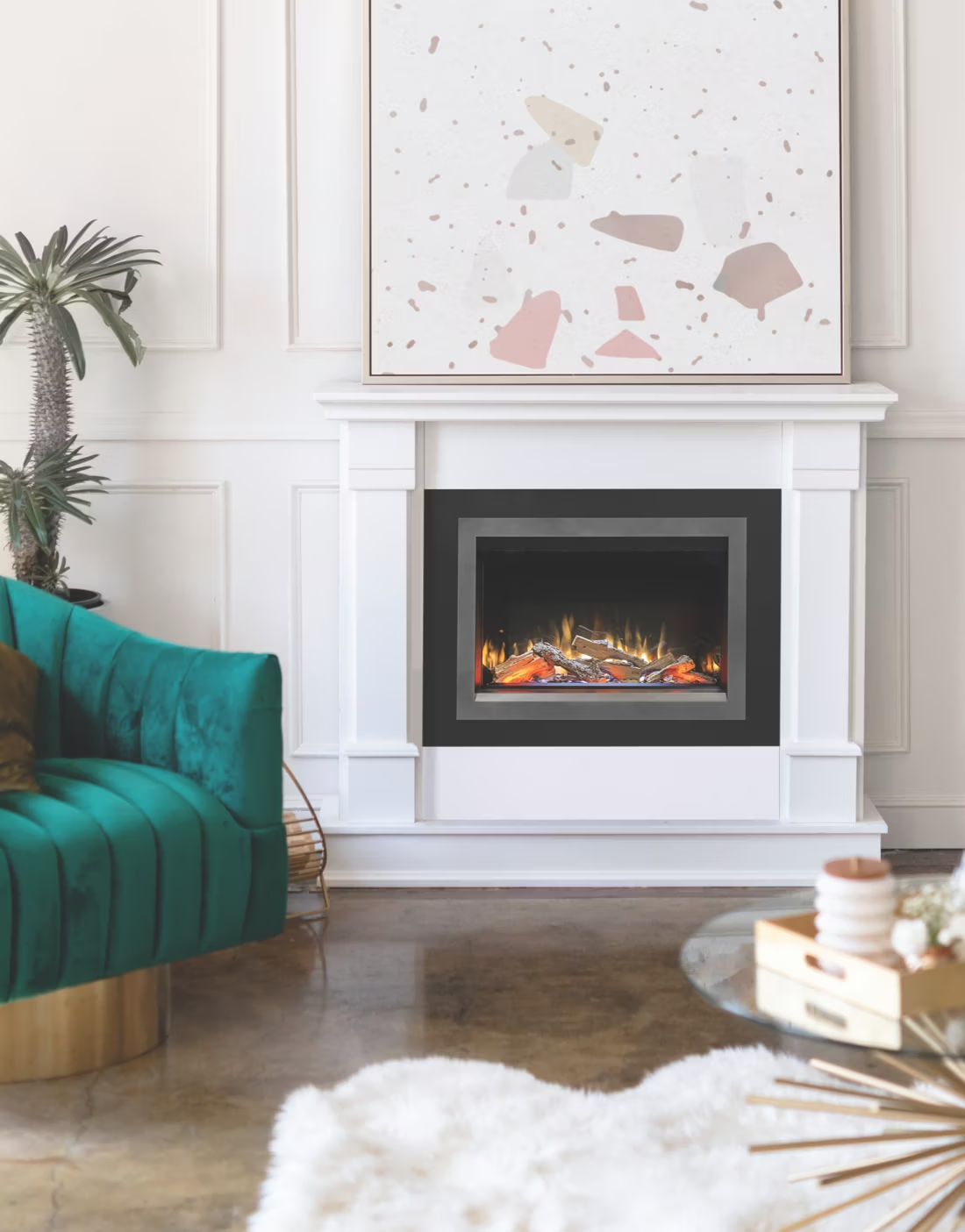
Staunton is also full of 19th-century homes in neighborhoods like the Wharf District and Gospel Hill—houses with decorative but non-functioning fireplaces, or additions and sunrooms that never had a chimney to begin with. Electric units solve both problems: an electric insert can go straight into an old masonry opening, and a wall-mounted or built-in unit can go anywhere there's an outlet or a dedicated circuit. Depending on your address, you'll be served by either Virginia Electric & Power Co. (Dominion) or Shenandoah Valley Electric Cooperative, with residential rates around 14.09 and 13.81 cents per kWh respectively—close enough that the choice of unit matters more than the utility.
Three steps. No salesperson until you're ready.
Tell us about your project
Your zip code, your situation, and the fuel you're leaning toward—or let the answers point you to one.
See what's actually available
The brands dealers within 100 miles genuinely carry—real options, never a catalog mirage.
Get your dealer & Project Guide
A trusted local dealer, plus the free Project Guide & Parts List that names every component of the job.
Frequently Asked Questions
How much does it cost to install an electric fireplace in Staunton?
Cost depends heavily on the type of unit. A plug-in electric insert or freestanding stove that uses an existing 120V outlet typically runs $150 to $800 for the unit itself, with no installation labor beyond setting it in place. A wall-mounted or built-in electric fireplace that needs a new dedicated circuit usually runs $1,000 to $3,000 installed, including an electrician's time to run the circuit. Built-ins with a custom mantel surround or a finished wall treatment can push toward $4,000 to $5,000 once carpentry is included. A local dealer can give you a firm number after seeing the room and the existing electrical panel capacity.
Do I need a permit for an electric fireplace in Staunton?
In most cases, no. Plug-in electric fireplaces, stoves, and smaller wall-mounted units under about 1,500 watts simply use an existing outlet and require no permit at all—there's no combustion, no chimney, and no gas line to inspect. If you're installing a larger built-in unit that needs a new dedicated 240V circuit, your electrician pulls a standard electrical permit through the City of Staunton's Permits & Inspections office, which is typically a quick approval. Either way, you'll never deal with the chimney or venting permits that wood and gas installs require.
Which electric utility serves my Staunton address, and does it change my costs?
Staunton has two providers depending on where you live. Much of the city itself is served by Virginia Electric & Power Co. (Dominion Energy), while homes on the rural edges of the city and into surrounding Augusta County are often served by Shenandoah Valley Electric Cooperative. Rates are close either way—about 14.09 cents per kWh for Dominion customers and 13.81 cents per kWh for Shenandoah Valley Electric Cooperative members—so a 1,500-watt electric fireplace on the heat setting costs roughly 19 to 21 cents an hour to run regardless of which utility serves your address.
How much does it cost to actually run an electric fireplace day to day?
At Staunton's residential rates, a typical 1,500-watt unit on the heat setting costs about 19 to 21 cents an hour to operate. Running it for four hours a winter evening in the living room adds roughly $0.80 to $0.85 a day, or around $25 a month if used nightly through the coldest stretch. Most units also run on a flame-only, no-heat setting that draws under 50 watts—useful for ambiance during Staunton's milder shoulder-season evenings without any real heating cost.
Electric vs. gas vs. wood—which makes sense for my Staunton home?
Wood is well suited to Staunton's older farmhouses and properties with access to abundant local oak, hickory, and maple, and it works during a power outage—a real plus in Shenandoah Valley ice storms. Gas offers instant, consistent heat and works in homes with an existing fireplace to convert, though it needs a gas line and venting. Electric is the simplest option by far: no fuel to source, no venting, no permit hassle for most units, and it fits into rooms—sunrooms, additions, apartments—that were never built with a chimney. For supplemental warmth in a single room, especially in Staunton's more moderate winter climate, electric is often the most practical choice.
What's the best type of electric fireplace for Staunton's older homes?
For the many Victorian and early-20th-century homes around downtown Staunton and the Wharf District that have a decorative but non-working masonry fireplace, an electric insert is usually the best fit—it slides into the existing firebox opening and instantly restores the look and heat of a working hearth without any chimney work. For additions, sunrooms, or rooms with no fireplace opening at all, a wall-mounted or freestanding electric unit gives you the same zone heating without needing to build anything around it. A local dealer can measure your existing firebox opening to confirm insert sizing.
Can an electric fireplace actually heat a room, or is it just for looks?
A quality electric fireplace with a 1,500-watt heater puts out roughly 5,100 BTU, which is enough to comfortably heat a single room of 300 to 400 square feet—plenty for a Staunton living room or bedroom on a 25°F winter night. It's not designed to replace central heat for the whole house, but as supplemental or zone heat, it lets you turn down the thermostat and warm only the room you're using, which is where most of the real savings come from.
I rent in Staunton—can I still install an electric fireplace?
Yes, and this is one of the main reasons electric units are popular in Staunton's rental and apartment market, including near Mary Baldwin University. A freestanding or plug-in electric fireplace needs no permanent modification—no chimney, no gas line, nothing that would need a landlord's sign-off beyond using an outlet. It can move with you when you leave. Even a wall-mounted unit can usually be installed with minimal wall anchoring that's easy to patch later, which is a much easier conversation with a landlord than a masonry or gas project.
Are electric fireplaces safe for homes with kids or pets in Staunton?
Electric fireplaces are one of the safest hearth options available—there's no real flame, no combustion byproducts, and most units have cool-touch glass fronts specifically designed for homes with children and pets. There's also no creosote buildup or chimney fire risk to manage, unlike wood-burning units, and no annual chimney sweep required. The main safety consideration is electrical: make sure a larger built-in unit is installed on its own dedicated circuit by a licensed electrician rather than daisy-chained off an existing outlet, which a local dealer will handle as part of installation.
Can I put a TV above my fireplace?
Yes—with an asterisk. Fireplaces are hot and TVs don't like heat. Either put a mantel between them to deflect rising warmth, or choose a fireplace with heat-management technology that creates a cool zone on the wall above—the wall stays around 125 degrees, barely warm, while the room still gets full heat. If you like clean lines and don't want a mantel, heat management is the answer.
Does an electric fireplace need a vent or chimney?
No—that's its superpower. An electric fireplace needs a wall and an outlet, period. No vent pipe, no gas line, no clearances to design around, which is why it works in bedrooms, offices, apartments, and walls where venting a gas or wood unit would be impractical or impossible. Installation is typically the simplest and least expensive of any fireplace type.
What is an in-home preview and do I need one?
It's a visit where a hearth professional measures your space, confirms the model you picked actually works in your home, and walks the specs—framing, gas line, venting, finish work—before anything is ordered. Some details you just can't know until you see the house. Never make a down payment without one; it's the single most-skipped step that burns buyers.
Can a fireplace actually lower my heating bill?
Yes—by creating a comfort zone. A furnace heats every square foot of the house just to warm the one room you're in; a gas fireplace on low burns roughly a sixth of the gas a typical furnace does. Set the furnace around 55–60 degrees as a baseline, then heat the rooms your family actually uses. Families who heat this way commonly save $20–$60 a month.
Nearby Dealers
Hearth shops serving Staunton and the surrounding area.
Electric Service in Staunton
An electric fireplace's heater draws about 1,500 watts—pennies per hour at local rates.
Virginia Electric & Power Co
Shenandoah Valley Elec Coop
Find your electric fireplace in Staunton.
Tell us a bit about your home and we'll put together a free Project Guide & Parts List—the right unit, the exact parts, and a trusted local Staunton dealer to install it.
Find Your Fireplace →