
Keep Your Family Warm and Safe—No Matter What
Salt Lake Valley inversions mean wood burning is heavily restricted most winters. For the households where it still makes sense, we'll connect you with a local dealer who knows the rules.
Every Project Starts From One of These Five Situations
Why wood stoves are the exception here.
Taylorsville sits at 4,350 feet in the Salt Lake Valley, boxed in by the Wasatch Range to the east and the Oquirrh Mountains to the west. That bowl-shaped geography is exactly why winter inversions settle over Salt Lake County so reliably—cold, stagnant air traps vehicle exhaust and wood smoke against the valley floor, and the Utah Division of Air Quality routinely records some of the worst PM2.5 readings in the country here during December and January. In direct response, the state enforces mandatory no-burn periods across Salt Lake County: on Red air quality action days, every solid-fuel burning device—certified or not—is prohibited unless the household can document that wood is its sole source of heat.
That's a very different situation than a mountain town at similar elevation with no inversion problem, and it's why wood isn't the default heating choice in Taylorsville the way it might be in Bozeman or Duluth. Most homeowners here who want a real fire lean toward gas or electric instead. Still, wood isn't off the table entirely—cabin owners with property up Big Cottonwood or Millcreek Canyon, rural sole-heat households, and off-grid backup setups still install stoves, often burning pinyon, juniper, or aspen cut under Forest Service permit from the Uinta-Wasatch-Cache National Forest ($5–$20 per cord, May through October season). If that's your situation, a local dealer can walk you through what's actually permitted and help you document sole-heat status correctly.
Firewood Cutting Permits Near Taylorsville
Three steps. No salesperson until you're ready.
Tell us about your project
Your zip code, your situation, and the fuel you're leaning toward—or let the answers point you to one.
See what's actually available
The brands dealers within 100 miles genuinely carry—real options, never a catalog mirage.
Get your dealer & Project Guide
A trusted local dealer, plus the free Project Guide & Parts List that names every component of the job.
Frequently Asked Questions
Can I legally install a wood stove in Taylorsville?
Yes, installation itself is legal and goes through Taylorsville's building department like any other solid-fuel appliance—the appliance must meet current EPA emissions standards. The catch isn't installation, it's operation: Salt Lake County enforces mandatory no-burn days during winter inversions, and on Red air quality days, burning is prohibited for everyone except households that can document wood as their sole source of heat. Before you install, it's worth understanding how those restrictions will affect the appliance's actual usefulness in your home.
Why are wood stoves restricted in Taylorsville?
Taylorsville sits low in the Salt Lake Valley, which traps cold air and pollution during winter temperature inversions—the same geography that gives the valley some of the country's worst PM2.5 spikes each January. The Utah Division of Air Quality regulates residential wood burning as part of its response, issuing Yellow (voluntary) and Red (mandatory) burn restriction days throughout the winter. It's a regional air quality issue tied to topography, not a Taylorsville-specific ordinance, but it applies here just as it does across Salt Lake, Davis, Utah, and Weber counties.
What is a mandatory no-burn day and how does it affect me?
On a Red air quality action day, the Utah Division of Air Quality prohibits burning in any solid-fuel device—wood stove, fireplace, or fire pit—unless it's registered as your home's sole source of heat, which requires documentation on file. On Yellow days, burning is discouraged but not banned outright. During a bad inversion stretch, Salt Lake County can see a string of consecutive Red days, which means a wood stove installed purely for ambiance or supplemental heat could sit unused for a week or more at the coldest point in winter.
Where can I get firewood near Taylorsville?
The closest public cutting permits come through the Uinta-Wasatch-Cache National Forest, running $5 to $20 per cord during the May-through-October season—permits aren't issued in winter, so plan your cutting trips well before burn season starts. Pinyon, juniper, and aspen are the common regional species; aspen burns fast and is better for kindling or shoulder-season fires, while pinyon and juniper are denser and hold coals longer overnight. Several firewood suppliers along the Wasatch Front also deliver seasoned cordwood if you'd rather skip the permit and cutting trip.
Is a wood stove installation still worth the cost in Taylorsville?
A wood stove installation typically runs $4,000 to $9,000 depending on the unit, chimney work, and hearth pad requirements—similar to install costs anywhere in the region. The question in Taylorsville isn't cost, it's usage: if you're installing purely for backup heat or ambiance, you may find the stove sits idle during the exact stretches of brutal cold when you'd want it most, because that's often when Red air quality days pile up. Sole-heat households and cabin properties outside the inversion zone get full value from a wood stove; a supplemental unit in a Taylorsville subdivision gets much less use than the same stove would in a place without burn restrictions.
Are EPA-certified stoves exempt from Utah's burn restrictions?
No—this is a common misconception. Utah's mandatory no-burn rule during Red air quality days applies to all solid-fuel devices, including EPA 2020 NSPS-certified stoves, unless the household has documented the stove as its sole source of heat. Certification affects your everyday emissions and efficiency, and it matters for the building permit, but it doesn't buy you an exemption from a mandatory action day the way it might in some other Western states. If sole-heat status applies to your home, your installer or Salt Lake County can direct you to the registration process.
Do people actually install wood stoves in Taylorsville?
Some do, but it's a niche choice rather than the default. The households we hear about most are rural or semi-rural properties where wood genuinely is the primary heat source, cabin owners with a second property up one of the Wasatch canyons where inversion rules don't apply the same way, and off-grid or emergency-backup setups where a battery-free heat source matters during a power outage. For a typical Taylorsville home already on natural gas or electric service, gas or electric fireplaces are far more common and don't carry the burn-day uncertainty.
What's a better alternative to wood heat in Taylorsville?
Given the inversion restrictions, most Taylorsville homeowners land on a direct-vent gas fireplace or insert, since natural gas service is standard throughout the city, or an electric fireplace served by PacifiCorp at a residential rate around 12.5 cents per kWh. Both options give you real, on-demand heat with zero burn-day restrictions and no smoke contribution to the valley's winter air quality problem—you can use them on the worst Red days of the year, which is exactly when a wood stove might be off-limits.
Wood vs. gas—which makes more sense in the Salt Lake Valley?
Wood offers a real flame, no electric dependence, and works well for households genuinely off natural gas or relying on wood as primary heat—but it comes with mandatory no-burn days during winter inversions that can sideline the stove for stretches at a time. Gas offers instant, restriction-free heat every day of the year, no smoke contribution to valley air quality, and simpler code compliance through Taylorsville's building department. For the vast majority of homes here, gas is the more practical daily-use choice; wood makes sense mainly for sole-heat rural properties or cabins outside the inversion zone.
What's the difference between an insert and a zero-clearance fireplace?
An insert is a fireplace that slides into a pre-existing wood-burning fireplace—if you don't have one, there's nothing to insert it into. A zero-clearance fireplace is built into a framed wall, which makes it the answer for remodels and new construction. Simple test: existing masonry fireplace means insert; blank or framed wall means zero-clearance.
Why is a fireplace insert so efficient?
An insert does two things: it seals the chimney completely, so you stop losing air you already paid to heat, and it radiates warmth into the room through the firebox and glass. Most add a heat-exchange fan that pulls cool room air underneath, wraps it around the hot firebox, and pushes it back out warm. Your home is more efficient before you've even lit the first fire.
Can a fireplace actually lower my heating bill?
Yes—by creating a comfort zone. A furnace heats every square foot of the house just to warm the one room you're in; a gas fireplace on low burns roughly a sixth of the gas a typical furnace does. Set the furnace around 55–60 degrees as a baseline, then heat the rooms your family actually uses. Families who heat this way commonly save $20–$60 a month.
Can I install a fireplace myself?
If you're putting a fire in your house on purpose, it's best to work with an expert. Unless you're genuinely experienced in framing, gas line, vent pipe, and the national code on clearances to combustibles, have a professional do it—and ideally the same company that sells you the fireplace, so warranty, service, and liability all live under one roof.
Nearby Dealers
Hearth shops serving Taylorsville and the surrounding area.
(Sugar House) Alpine Fireplaces (In Breezeway Next To Theatres)
Hearth & Home Distributors Of Utah - Salt Lake City
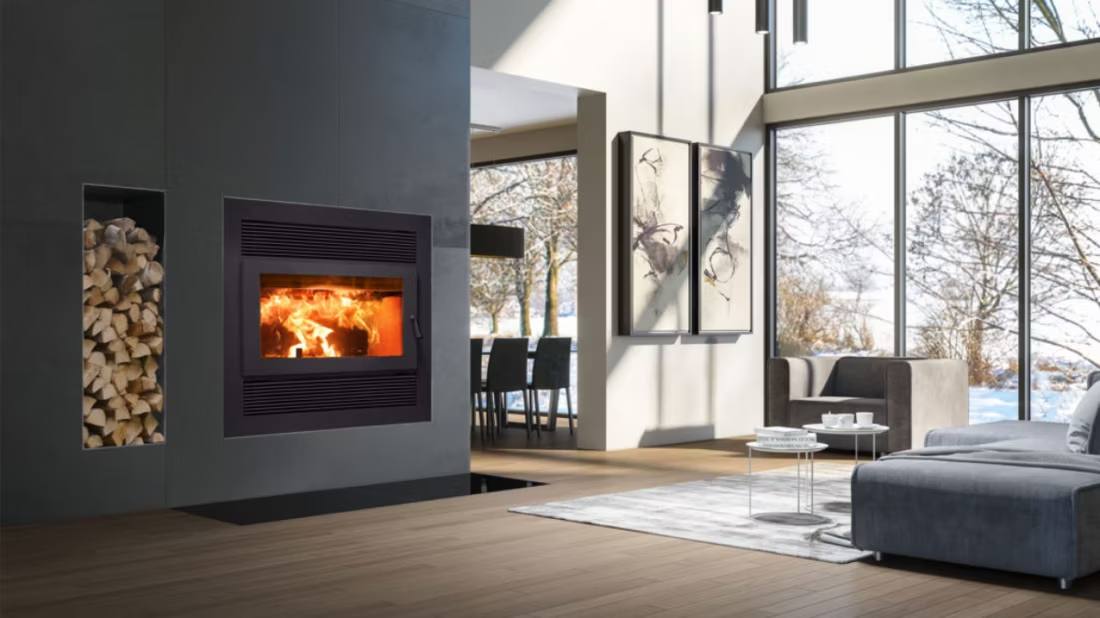
Find your wood fireplace in Taylorsville.
If wood heat genuinely fits your situation—sole-heat household, cabin property, or off-grid backup—tell us about your home and we'll match you with a local dealer who understands Utah's burn-day rules, plus a free Project Guide & Parts List with the exact parts and vent kit for your project.
Find Your Fireplace →