
Warm, clean heat for the highest county in Texas.
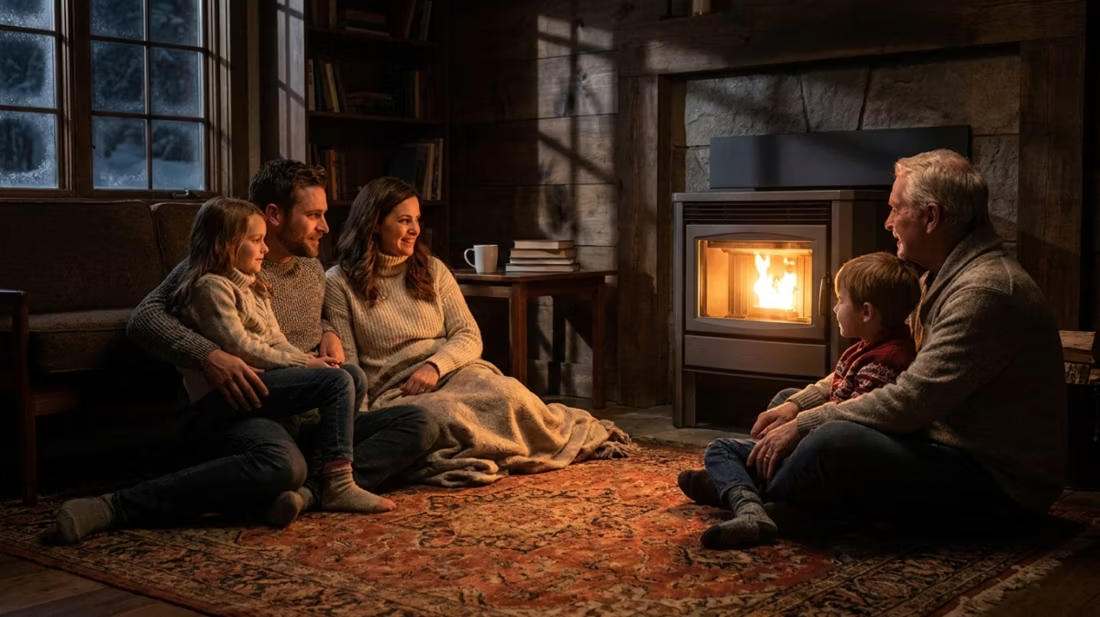
Fort Davis sits above 5,000 feet in the Davis Mountains, and nights up here get colder than most of Texas expects. A pellet stove delivers steady, low-smoke heat without a propane truck making the long haul out to your place—and we'll match you with a real local dealer who can size and install it right.
Every Project Starts From One of These Five Situations
Elevation changes everything here.
Jeff Davis County is one of the least populated counties in Texas—about 1,034 people spread across roughly 2,264 square miles of the Davis Mountains and surrounding high desert. Fort Davis, the county seat, sits near 5,050 feet, making it one of the highest towns in the state, while Valentine and the outlying ranch country to the west run lower and flatter. The county is officially classified climate zone 3B, which on paper reads mild, but that classification undersells what elevation does here: frost is common, nighttime lows drop well below what you'd expect from typical West Texas desert, and the Davis Mountains occasionally see a dusting of snow that catches visitors off guard.
This is also dark-sky country—McDonald Observatory sits just outside Fort Davis, and the region takes real pride in clean, unpolluted air. There are no air quality restrictions or burn bans on record for the county, which is one reason pellet stoves fit so comfortably here: they burn cleaner than cordwood with none of the smoke plume, and they don't require the natural gas hookups that simply don't exist in a county this remote. Most homes here already run on propane trucked in from Alpine or Fort Stockton, and a pellet stove gives ranch and town homeowners an independent heat source that only needs electricity and a stocked supply of hardwood pellets—brands like Forest Energy and Lignetics are the regional standards, though given the distances involved, most local homeowners order a season's worth at once rather than counting on last-minute delivery.
Three steps. No salesperson until you're ready.
Tell us about your project
Your zip code, your situation, and the fuel you're leaning toward—or let the answers point you to one.
See what's actually available
The brands dealers within 100 miles genuinely carry—real options, never a catalog mirage.
Get your dealer & Project Guide
A trusted local dealer, plus the free Project Guide & Parts List that names every component of the job.
Frequently Asked Questions
How much does a pellet stove installation cost in Jeff Davis County?
Most pellet stove installations run in the $3,000 to $6,000 range once you factor in the unit, the vent kit, and labor—on the higher end if a through-wall vent has to be cut into thick adobe or stone construction, which is common on older Fort Davis and ranch properties. Because Jeff Davis County has so few dealers of its own, installers frequently travel out from Alpine or the wider Big Bend area, so expect a modest trip charge built into quotes for anyone outside Fort Davis proper. Get a firm number from an in-home visit rather than a phone estimate—the vent path through a stone or adobe wall varies a lot from house to house here.
What size pellet stove do I need for a ranch house or older Fort Davis home?
Sizing depends more on how the house was built than on square footage alone. A lot of homes in Fort Davis and the surrounding ranch country are older adobe or stone construction with thick walls that hold heat differently than a standard stick-frame house, so a mid-size pellet stove (rated for roughly 1,500-2,200 sq ft) often ends up heating more square footage than the same-rated stove would in a typical suburban home. For larger ranch houses or homes used as primary residences through the winter shoulder months, a local dealer will want to walk the space and check insulation and ceiling height before recommending a specific model—a five-minute conversation that saves you from an undersized stove struggling on the coldest Davis Mountains nights.
Where can I buy pellets near Fort Davis or Valentine?
Forest Energy and Lignetics are the two brands most commonly stocked by dealers serving this part of West Texas, typically sold in 40-pound bags or by the ton. Because Jeff Davis County is so sparsely populated, there isn't a dedicated pellet retailer in Fort Davis or Valentine themselves—most homeowners either buy a season's supply in bulk from an Alpine-area dealer and have it delivered, or pick up bags during regular supply runs into town. Given how far pellets have to travel to get out here, ordering ahead of the first cold snap rather than waiting until you're low is the practical move most local burners make.
Do pellet stoves work during a power outage in the Davis Mountains?
Not without backup power—a pellet stove's auger and blower both run on electricity, so a standard unit goes cold the moment the power does. That matters in Jeff Davis County, where rural power lines running out to ranch properties can be slow to restore after a winter wind event or ice. Homeowners who want pellet heat as a true backup, not just a convenience, often pair the stove with a small battery backup or a generator sized to run the auger and blower. If uninterrupted heat during outages is the priority over convenience, a wood stove burning local oak or mesquite is worth discussing alongside pellet as a genuine backup option.
Do I need a permit to install a pellet stove in Jeff Davis County?
Jeff Davis County doesn't run a large-county-style building department, so permitting depends on where exactly you are. Inside Fort Davis city limits, check with the city before installing; on unincorporated ranch land, which covers most of the county, there typically isn't a formal permitting process the way there would be in a larger Texas county, though it's still worth a call to confirm since requirements can change. Either way, a dealer experienced in this region will know the local expectations and can tell you upfront whether paperwork is needed for your specific address.
How is pellet stove venting different from a wood stove or fireplace in an older adobe home?
Pellet stoves vent through a small-diameter pipe—typically 3 or 4 inches—that can run straight out through a side wall rather than requiring a full masonry chimney. That's a real advantage in a county full of thick-walled adobe and stone ranch houses, where cutting in a traditional Class A chimney chase would mean serious structural work. Most installers here simply core through the exterior wall at the stove location and run a short horizontal vent to the outside, which keeps the job faster and less invasive than converting an old wood fireplace.
Pellet stove vs. wood stove—which makes more sense out here?
Wood is genuinely abundant in this part of West Texas—oak, pecan, and mesquite are all common locally, and mesquite in particular burns hot and long, which appeals to ranch households used to cutting their own fuel. Wood also keeps working with zero electricity, which matters given how remote some Jeff Davis County power lines are. Pellet stoves trade that off for real convenience: no splitting or hauling, a cleaner burn with almost no visible smoke (a nice fit for a county proud of its dark, clean skies near the observatory), and more consistent, thermostat-controlled heat. For a primary residence in town, pellet is usually the easier day-to-day choice; for a remote ranch property where self-sufficiency during outages matters more, wood still has a strong case.
Which pellet brands and stove features work best for this climate?
Forest Energy and Lignetics both distribute into this part of West Texas and are the brands local dealers most commonly stock and recommend. Because the region is dry for most of the year, pellets store well here with minimal moisture concern—a real advantage over damper climates where bags have to be kept tightly sealed. Given the elevation-driven cold snaps that hit Fort Davis and the surrounding mountains, a stove with a larger hopper capacity is worth prioritizing so you're not refilling constantly during a multi-day cold stretch; your local dealer can match hopper size and BTU output to how you actually plan to use the stove.
Are there rebates or incentives for pellet stoves in Jeff Davis County?
There's no dedicated Texas state rebate program for pellet stoves the way some cold-climate states offer, and Jeff Davis County doesn't have local air-quality-driven incentive programs since the county has no air quality non-attainment designation or burn restrictions to offset. Some pellet stove models do qualify for the federal biomass stove tax credit if they meet the efficiency threshold, which is worth asking your dealer about directly—they'll know which current models on the floor qualify and can point you to the manufacturer paperwork you need for the credit.
What's the difference between an insert and a zero-clearance fireplace?
An insert is a fireplace that slides into a pre-existing wood-burning fireplace—if you don't have one, there's nothing to insert it into. A zero-clearance fireplace is built into a framed wall, which makes it the answer for remodels and new construction. Simple test: existing masonry fireplace means insert; blank or framed wall means zero-clearance.
Why is a fireplace insert so efficient?
An insert does two things: it seals the chimney completely, so you stop losing air you already paid to heat, and it radiates warmth into the room through the firebox and glass. Most add a heat-exchange fan that pulls cool room air underneath, wraps it around the hot firebox, and pushes it back out warm. Your home is more efficient before you've even lit the first fire.
Can a fireplace actually lower my heating bill?
Yes—by creating a comfort zone. A furnace heats every square foot of the house just to warm the one room you're in; a gas fireplace on low burns roughly a sixth of the gas a typical furnace does. Set the furnace around 55–60 degrees as a baseline, then heat the rooms your family actually uses. Families who heat this way commonly save $20–$60 a month.
Does a fireplace add value to my home?
On average, a fireplace adds back to the home about the same amount you spent installing it. Add the monthly savings from heating the rooms you actually use instead of the whole house—often hundreds of dollars a year—and the value case is strong before you even count what a fire does for how your family uses the room.
Pellet Brands Stocked Around Jeff Davis County
Manufacturers will point you to the nearest stocking dealer.
Find your pellet stove in Jeff Davis County.
Tell us a bit about your home in Fort Davis, Valentine, or the surrounding ranch country, and we'll put together a free Project Guide & Parts List—the exact stove, vent kit, and parts for your project—and match you with a trusted local dealer who actually serves the Davis Mountains area.
Find Your Fireplace →