
Pellet Heat Is Rare in Mount Vernon—Here's Why.
At roughly 4.4 square miles and over 70,000 residents, Mount Vernon is one of the most densely built cities in New York State—and that housing stock, not the winters, is what keeps pellet stoves uncommon here.
Every Project Starts From One of These Five Situations
Density, not demand, is what limits pellet heat here.
Mount Vernon sits just north of the Bronx in Westchester County, and its housing stock reflects that proximity to New York City—attached and semi-attached two-family homes, narrow lots, and multi-unit buildings make up most of the city. Winters here are moderate by Northeast standards: an average winter low near 27°F and about 4,583 heating degree days, a fraction of what a place like Burlington, VT sees in a typical season. There's real heating demand, but it's nowhere near the extreme cold that drives pellet-stove adoption in colder, more rural parts of the country.
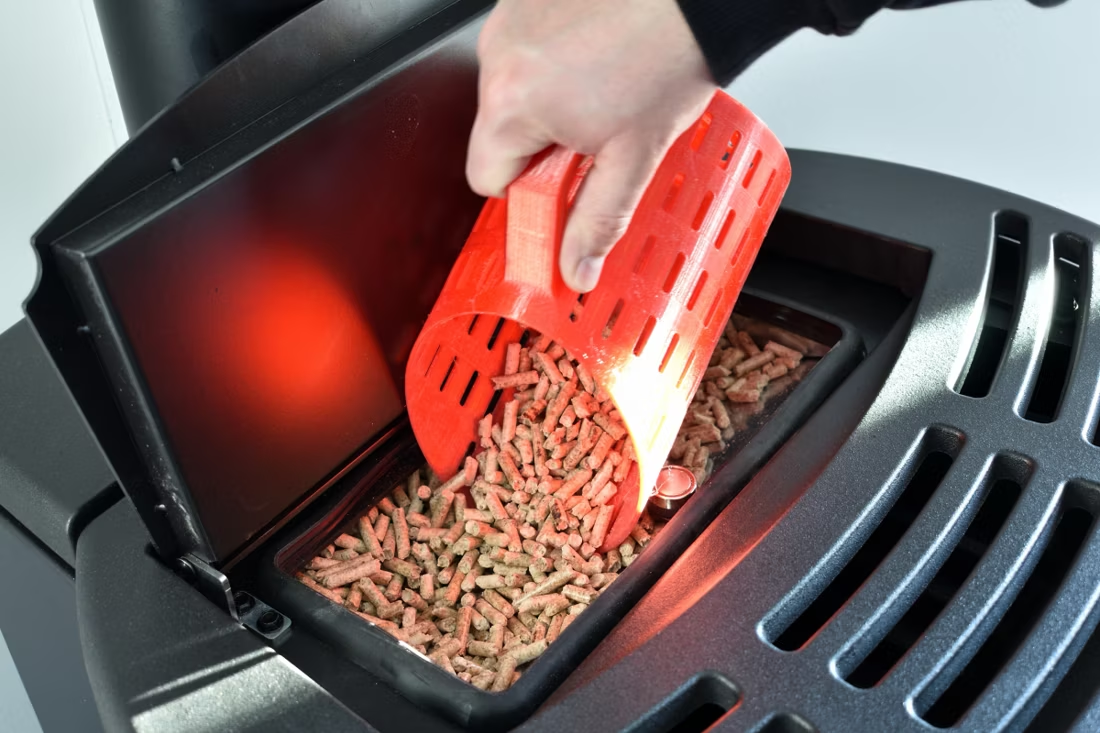
A pellet stove needs a dedicated exterior wall for direct venting, floor space for the unit itself, and dry storage for a ton or more of 40-pound bags—space that simply doesn't exist in most Mount Vernon rowhouses, two-family homes, or apartment buildings. Regional pellet brands like Energex, Hamer Pellet Fuel, and Greene Team Pellet Fuel do serve the wider Hudson Valley and lower Westchester market, so fuel supply isn't the obstacle. The obstacle is the house. That's why natural gas—widely available through Con Edison—and electric fireplaces and inserts are the standard heat upgrades in Mount Vernon, while pellet stoves stay a niche option for the small number of detached homes with a garage or basement to spare.
Three steps. No salesperson until you're ready.
Tell us about your project
Your zip code, your situation, and the fuel you're leaning toward—or let the answers point you to one.
See what's actually available
The brands dealers within 100 miles genuinely carry—real options, never a catalog mirage.
Get your dealer & Project Guide
A trusted local dealer, plus the free Project Guide & Parts List that names every component of the job.
Frequently Asked Questions
Are pellet stoves a realistic option for a Mount Vernon home?
For most of the city, not really—and it's worth being upfront about that. Mount Vernon's housing stock is dominated by attached and semi-attached two-family homes and multi-unit buildings, which don't offer the exterior wall clearance for direct venting or the dry, enclosed storage space a ton of pellets requires. The exception is the smaller share of detached single-family homes in the city, particularly ones with a garage, basement, or utility room that can be converted. If that describes your property, a pellet insert or freestanding stove is still installable—it's just not the default recommendation the way it would be in a rural upstate county with more square footage per lot.
If pellet heat isn't a good fit, what do most Mount Vernon homeowners install instead?
Gas is the dominant choice. Con Edison provides natural gas service throughout most of Mount Vernon, and a direct-vent gas insert or fireplace fits the city's row-house and two-family housing stock far more easily than a pellet stove—it vents through a small wall or roof penetration rather than needing bulk fuel storage. Electric fireplaces and inserts are the other common route, especially for supplemental heat or a fast, permit-light upgrade, though Con Edison's residential rate of roughly $0.34 per kWh—among the highest in the country—makes electric a better fit for zone heating and ambiance than for whole-home primary heat.
Why doesn't Mount Vernon's housing stock support pellet stoves the way other NY towns do?
It comes down to storage and venting, not local rules. A pellet stove burns through roughly a ton of fuel per heating season, and that's typically stored as forty-pound bags stacked in a dry garage, basement, or shed—space that's scarce in a city built mostly of attached two-family homes on narrow lots. Direct-vent pellet units also need a clear exterior wall, which is harder to arrange in row-house construction shared with a neighboring unit. Compare that to a detached home in a more spread-out Hudson Valley town, where a garage or basement solves both problems at once—that's the kind of property where pellet heat still makes sense.
Can I still get a pellet stove installed in Mount Vernon if I really want one?
Yes, if your home can physically support it. Fuel availability isn't the barrier—Energex, Hamer Pellet Fuel, and Greene Team Pellet Fuel all distribute into the lower Hudson Valley and Westchester market, so pellets themselves are easy to source. What matters is whether your property has a garage, basement, or utility space with an exterior wall for venting and room for a season's worth of bagged fuel. A trusted local dealer can walk your specific property and tell you honestly whether a pellet install is workable or whether a gas or electric unit will serve you better.
What's the difference between a pellet stove and a pellet insert, and does it matter here?
A pellet stove is a freestanding unit that sits on its own hearth pad and vents through a nearby wall—it needs open floor space. A pellet insert drops into an existing masonry fireplace and uses the chimney (with a liner) for venting, which saves floor space but still requires room nearby for the hopper and bagged fuel storage. In Mount Vernon, where usable square footage is often the limiting factor, an insert is the more space-efficient of the two options for a home that has an existing fireplace—but neither solves the underlying storage problem for a home without a garage or basement.
How does the cost of a pellet stove compare to gas or electric options in Mount Vernon?
Pellet installations generally involve more work than an electric insert but are comparable to or less than a full gas line and venting job, since pellet stoves vent through a wall rather than requiring new gas piping. That said, because pellet installers are less common in the New York City metro area than gas or electric specialists, sourcing a qualified installer can take more legwork and the quote may run higher than in a region where pellet heat is the norm. For most Mount Vernon homeowners, a direct-vent gas insert or an electric fireplace ends up being both the more practical and more competitively priced option, simply because more local contractors handle those installs regularly.
Is natural gas or propane available for a fireplace upgrade in Mount Vernon?
Natural gas service through Con Edison covers most of Mount Vernon, making a direct-vent gas fireplace or insert straightforward for homes that already have gas appliances like a furnace, water heater, or range. That existing gas infrastructure is a big part of why gas has become the default clean-heat upgrade here instead of pellet—there's no bulk fuel delivery or storage to plan around, just a gas line and a sealed vent through the wall or roof.
Does an electric fireplace make sense given Con Edison's electric rates?
It depends on how you plan to use it. At roughly $0.34 per kWh, Con Edison's residential electric rate is high enough that running an electric unit as a full-time primary heat source will show up on your bill. But most homeowners install electric fireplaces and inserts for supplemental zone heat and ambiance—a few hours in the evening in a living room or bedroom—rather than to replace central heat, and at that level of use the cost stays modest. Electric also has the advantage of no venting, no gas line, and minimal permitting, which makes it a popular fast upgrade for Mount Vernon's attached and multi-unit homes.
Pellet, gas, or electric—which is actually right for my Mount Vernon home?
For the majority of Mount Vernon properties—attached homes, two-family houses, and multi-unit buildings—a direct-vent gas fireplace or insert is the most practical primary upgrade, since Con Edison gas service is widely available and venting fits the housing stock. Electric fireplaces and inserts are the easiest add for supplemental heat or ambiance without any venting or gas work, with the tradeoff being a higher per-hour operating cost. Pellet stoves remain a good option only for the smaller share of detached homes with a garage, basement, or utility space that can handle bulk fuel storage and exterior venting. A trusted local dealer can look at your actual property and tell you which of the three genuinely fits, rather than defaulting to whichever is easiest to sell.
What's the difference between an insert and a zero-clearance fireplace?
An insert is a fireplace that slides into a pre-existing wood-burning fireplace—if you don't have one, there's nothing to insert it into. A zero-clearance fireplace is built into a framed wall, which makes it the answer for remodels and new construction. Simple test: existing masonry fireplace means insert; blank or framed wall means zero-clearance.
Why is a fireplace insert so efficient?
An insert does two things: it seals the chimney completely, so you stop losing air you already paid to heat, and it radiates warmth into the room through the firebox and glass. Most add a heat-exchange fan that pulls cool room air underneath, wraps it around the hot firebox, and pushes it back out warm. Your home is more efficient before you've even lit the first fire.
Can I install a fireplace myself?
If you're putting a fire in your house on purpose, it's best to work with an expert. Unless you're genuinely experienced in framing, gas line, vent pipe, and the national code on clearances to combustibles, have a professional do it—and ideally the same company that sells you the fireplace, so warranty, service, and liability all live under one roof.
How much should I budget for a fireplace?
For an average home—covering the fireplace, the vent pipe, and basic installation—a budget between $3,900 and $5,500 gives you a lot of options across wood, gas, and pellet. By the time you add finish work, gas line, and electrical, the average complete installation lands between $5,000 and $12,000 all-in. In a remodel or new build, a good rule is to put about 2.5% of the total project cost toward the fireplace.
Nearby Dealers
Hearth shops serving Mount Vernon and the surrounding area.
Pellet Brands Stocked Around Mount Vernon
Manufacturers will point you to the nearest stocking dealer.
See what actually fits your Mount Vernon home.
Tell us about your property and we'll give you an honest read on whether pellet heat works for your space—and if not, match you with a trusted local dealer and a free Project Guide & Parts List for the gas or electric option that actually fits.
Find Your Fireplace →