
Add warmth to your St. Helena Parish home—no chimney required.
Mild Zone 2A winters, no gas line, no wood to split—just plug-in or hardwired warmth for the cool snaps that roll through the parish. Find the right unit and connect with a trusted dealer who actually serves this stretch of Louisiana.
Every Project Starts From One of These Five Situations
Short winters, straightforward installs.
St. Helena Parish is one of Louisiana's smallest and most rural parishes—about 1,500 people spread across pine plantations, hardwood bottomland along the Amite and Tickfaw Rivers, and the small parish seat of Greensburg. Zone 2A means long, humid summers and winters that rarely bite hard: lows sit in the 40s most nights, with the occasional cold front pushing temperatures into the 20s for a night or two. That's not a climate that demands a whole-house wood-burning setup—it's a climate where a lot of homes already lean on a central heat pump and just want a supplemental heat source for the den, the sunroom, or a guest cabin on the property.
Electric fireplaces fit that need well: no flue, no propane tank, no cutting or hauling wood from the parish's own oak, pecan, and cypress stands. Most of St. Helena Parish is served by DEMCO (Dixie Electric Membership Corporation), the rural electric cooperative that covers this part of the Florida Parishes region—which matters for how you think about backup heat, since an electric fireplace is only as reliable as the grid feeding it. Because the parish has no big hearth retailers of its own, the real value here is getting matched with a trusted dealer from Baton Rouge, Hammond, or Denham Springs who will actually make the drive, size the circuit correctly, and stand behind the install.
Three steps. No salesperson until you're ready.
Tell us about your project
Your zip code, your situation, and the fuel you're leaning toward—or let the answers point you to one.
See what's actually available
The brands dealers within 100 miles genuinely carry—real options, never a catalog mirage.
Get your dealer & Project Guide
A trusted local dealer, plus the free Project Guide & Parts List that names every component of the job.
Frequently Asked Questions
How much does an electric fireplace installation cost in St. Helena Parish?
A freestanding or wall-mounted plug-in electric fireplace typically runs $300 to $900 for the unit itself, with no real installation cost beyond mounting hardware since it plugs into an existing standard outlet. A built-in electric fireplace or insert set into an existing masonry opening—the more common upgrade for St. Helena Parish's older farmhouses with existing brick fireplaces—runs $1,500 to $4,000 including the unit, framing, and a licensed electrician running a dedicated 20-amp circuit. Because most local electricians and hearth dealers are based out of Baton Rouge, Hammond, or Denham Springs, expect a modest travel charge folded into the quote for jobs out in the rural parts of the parish.
Will an electric fireplace actually heat a room in St. Helena Parish's climate?
For the handful of genuinely cold nights St. Helena Parish sees each winter—lows in the 20s during a hard cold front—a standard 1,500-watt electric fireplace will comfortably heat a 400 to 1,000 square foot room, which covers most dens, living rooms, or a guest cabin. It's not designed to replace a central heat pump for the whole house, and most parish homeowners don't need it to; Zone 2A winters are short enough that the electric fireplace ends up doing double duty as a supplemental heater on the coldest nights and pure ambiance the rest of the season.
Do I need a permit to install an electric fireplace in St. Helena Parish?
A plug-in, freestanding electric fireplace generally doesn't require any permit—it's treated like any other appliance you plug into an outlet. A built-in unit or insert that needs a new dedicated circuit typically requires an electrical permit, which in St. Helena Parish is handled through the parish's permitting process under the St. Helena Parish Police Jury. Since there's no combustion, no gas line, and no venting involved, electric fireplace installs are by far the simplest permitting path of any hearth fuel in the parish—most dealers can walk you through it in a single call.
Given how much oak, pecan, and cypress grows on parish land, why would anyone choose electric over wood?
Plenty of St. Helena Parish homeowners with acreage do still burn their own oak and pecan for heat and cooking, and that's not going away. But electric fireplaces fill a different niche—a guest cabin on the back forty, a sunroom addition, a den where nobody wants to deal with ash and creosote, or a second home that sits empty for stretches. For those spaces, electric means no chimney to maintain, no wood to split and stack, and instant heat at the flip of a switch—trade-offs that make sense for a supplemental space even in a parish surrounded by good firewood.
Can an electric insert go into my existing masonry fireplace?
Yes—this is one of the most common electric fireplace projects in St. Helena Parish, especially in older homes around Greensburg with a brick fireplace that hasn't been wood-burned regularly in years. An electric insert slides into the existing opening, and the damper above it should be closed and sealed to stop the old flue from pulling conditioned air out of the house. It's a straightforward retrofit that keeps the look of the original hearth while eliminating the draft and maintenance of an unused masonry chimney.
What happens to my electric fireplace during a power outage?
It goes dark, along with everything else in the house—electric fireplaces have no function without grid power, and DEMCO's rural lines through St. Helena Parish can go down for stretches during ice storms or severe thunderstorms. Homeowners who need heat during an outage typically keep a wood stove or a propane space heater as backup rather than relying on the electric unit for emergency warmth. Think of the electric fireplace as the everyday convenience option and, if outage resilience matters to your household, pair it with a non-electric backup heat source elsewhere in the home.
What should I look for in an electric fireplace for this climate?
Look for a model with an independent flame-only mode—one that lets you run the visual flame effect without the heater kicking on. Given how much of the year St. Helena Parish spends in warm, humid weather, most owners run their electric fireplace for ambiance far more often than for actual heat, and you don't want the unit forcing extra warmth into an already-warm room in June. For built-in wall units, ask your dealer about moisture-resistant construction, since Gulf South humidity is a factor for anything installed near an exterior wall.
Where do I find someone to actually install an electric fireplace near me?
With a population of under 1,500, St. Helena Parish doesn't have its own hearth showroom or big-box store—the nearest trusted dealers are typically based out of Baton Rouge, Hammond, or Denham Springs and travel into the parish for installs. That's exactly the gap Find My Fireplace is built to close: rather than guessing which regional company actually covers rural St. Helena Parish addresses, we match you with a dealer who does this work here regularly and knows the parish's permitting process.
Electric vs. propane—which makes more sense for a St. Helena Parish home?
Propane is the standard fallback fuel across most of rural St. Helena Parish, since natural gas lines don't reach far outside the larger towns. A propane fireplace or stove delivers more heat output and can often run without electricity—a real advantage during a DEMCO outage. Electric skips the tank, the delivery truck, and the annual propane contract entirely, but it's fully dependent on grid power and better suited to supplemental warmth than serious heating load. Many parish homeowners end up with propane as the workhorse and electric as the low-maintenance option for a secondary room.
Can I put a TV above my fireplace?
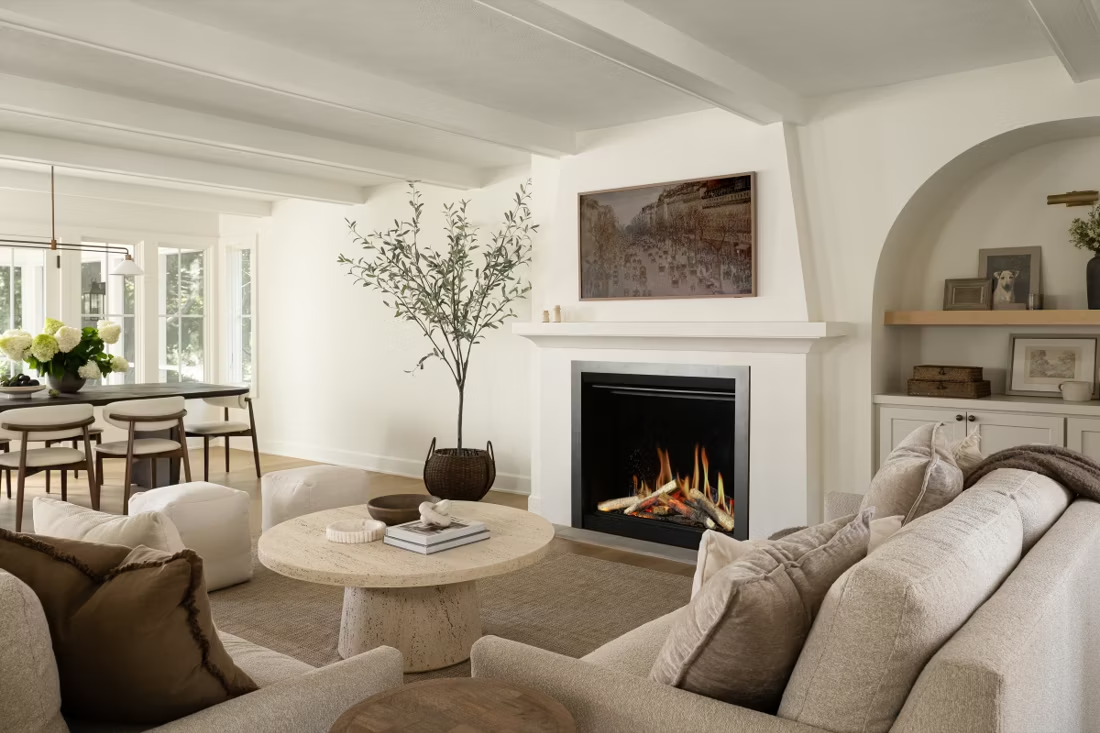
Yes—with an asterisk. Fireplaces are hot and TVs don't like heat. Either put a mantel between them to deflect rising warmth, or choose a fireplace with heat-management technology that creates a cool zone on the wall above—the wall stays around 125 degrees, barely warm, while the room still gets full heat. If you like clean lines and don't want a mantel, heat management is the answer.
Does an electric fireplace need a vent or chimney?
No—that's its superpower. An electric fireplace needs a wall and an outlet, period. No vent pipe, no gas line, no clearances to design around, which is why it works in bedrooms, offices, apartments, and walls where venting a gas or wood unit would be impractical or impossible. Installation is typically the simplest and least expensive of any fireplace type.
Does a fireplace add value to my home?
On average, a fireplace adds back to the home about the same amount you spent installing it. Add the monthly savings from heating the rooms you actually use instead of the whole house—often hundreds of dollars a year—and the value case is strong before you even count what a fire does for how your family uses the room.
Can a fireplace actually lower my heating bill?
Yes—by creating a comfort zone. A furnace heats every square foot of the house just to warm the one room you're in; a gas fireplace on low burns roughly a sixth of the gas a typical furnace does. Set the furnace around 55–60 degrees as a baseline, then heat the rooms your family actually uses. Families who heat this way commonly save $20–$60 a month.
Find your electric fireplace in St. Helena Parish.
Tell us a bit about your home and we'll match you with a trusted local or regional dealer, plus a free Project Guide & Parts List—the exact parts, including the vent kit if your unit needs one, mapped out for your St. Helena Parish install.=
Find Your Fireplace →