
Keep Your Family Warm and Safe—No Matter What
From Mound City to La Cygne to Pleasanton, rural Linn County has burned wood for generations—and a properly sized stove or insert still delivers real, dependable heat through eastern Kansas winters. Find the right unit and connect with a trusted local dealer.
Every Project Starts From One of These Five Situations
Hedgerow country runs on wood.
Linn County sits along the Marais des Cygnes River in eastern Kansas, a farming county of just over 5,600 residents spread across small towns and a lot of open acreage. Winters here are real but not extreme—climate zone 4A, average lows near 18°F, and a winter heating season serious enough to matter, though well short of what a place like Fargo, North Dakota logs each winter, where the heating season runs nearly twice as long and cold. That's still enough cold, for enough months, that a well-sized wood stove earns its place in a lot of Linn County homes.
The county's timber and fence rows make wood heat practical in a way it isn't everywhere: oak and hickory grow throughout the river bottoms, and osage orange—planted as living fencing across Kansas farmland since the 1800s and still locally called "hedge"—is dense, high-BTU, and often free for the cutting. There's no wood-smoke non-attainment designation or winter burn curtailment in Linn County, unlike parts of the Kansas City metro just to the north, so there's no local restriction on when you can run a stove. A properly installed unit means real backup heat when an ice storm takes down power on a rural line, and lower heating costs on a property where cut wood is already sitting in the windbreak.
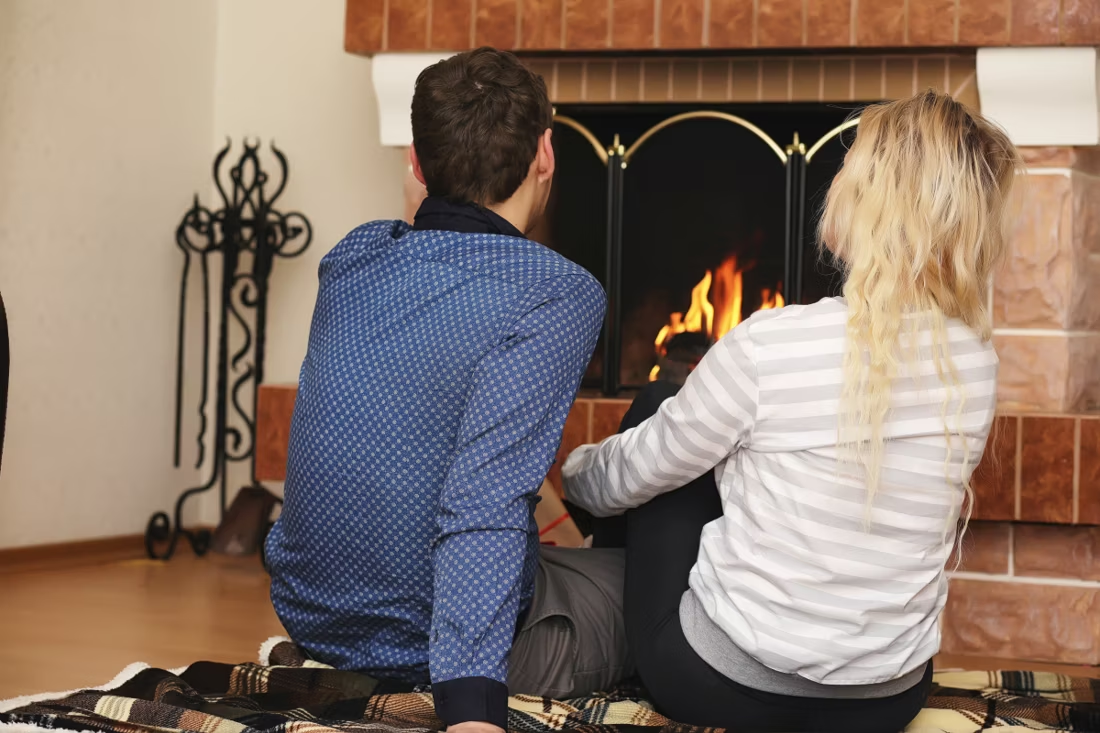
Three steps. No salesperson until you're ready.
Tell us about your project
Your zip code, your situation, and the fuel you're leaning toward—or let the answers point you to one.
See what's actually available
The brands dealers within 100 miles genuinely carry—real options, never a catalog mirage.
Get your dealer & Project Guide
A trusted local dealer, plus the free Project Guide & Parts List that names every component of the job.
Frequently Asked Questions
How much does a wood stove installation cost in Linn County?
In rural Linn County, a wood stove or insert installation typically runs $3,500 to $8,500 depending on the unit, whether it's going into an existing masonry fireplace or needs a full Class A chimney run, and how far the installer has to travel—most certified dealers serving Mound City, Pleasanton, and La Cygne are based out of the Kansas City metro or Fort Scott, so a trip charge for outlying acreages is common. Older farmhouses without an existing chimney, which describes a lot of housing stock in the county, tend to land toward the higher end once venting and a hearth pad are added in.
What size wood stove do I need for my Linn County home?
Sizing depends on square footage, ceiling height, and insulation, and Linn County has plenty of older farmhouses with high ceilings and modest insulation that need more stove than a comparable newer build. As a rough guide: small stoves (up to 1,000 sq ft) suit a single room or a cabin near the Marais des Cygnes bottoms, medium stoves (1,000-2,000 sq ft) cover most main living areas, and large stoves (2,000+ sq ft) can carry a whole farmhouse with a reliable wood supply. With winter lows averaging around 18°F and a solid but moderate winter heating season, the county needs a solidly built stove but not the extreme long-burn capacity designed for harsher northern climates. A local dealer will size the unit to your actual home during an in-home visit, since an oversized stove smolders and creosotes while an undersized one can't keep up on the coldest nights.
Where can I find certified wood stove installers near Linn County?
Look for NFI (National Fireplace Institute) or CSIA (Chimney Safety Institute of America) certification, which indicates real training in venting and clearances rather than general contracting experience. Because Linn County is rural—just over 5,600 residents countywide—most certified installers are based in the Kansas City metro, Fort Scott, or Pittsburg and cover the county as part of a wider service area, so expect a trip charge for acreages outside Mound City, Pleasanton, or La Cygne. Using the same company that sells the stove simplifies both the warranty and the clearance work, which matters more than usual on older farmhouses with non-standard chimney chases.
What's the difference between a wood stove and a wood insert?
A wood stove is freestanding and sits on a hearth pad, venting through a chimney built specifically for it—it can go almost anywhere in a home with the right clearances. A wood insert is built to slide into an existing masonry fireplace, which is common in the older brick farmhouses scattered throughout Linn County, and it converts a drafty open hearth into a sealed, high-efficiency heat source using the chimney already in place. If your home has a working fireplace, an insert is usually the more cost-effective route; homes without one are better suited to a freestanding stove.
Do I need a permit to install a wood stove in Linn County?
Most new wood stove installations require a building permit, handled through the county offices in Mound City for anything outside city limits, or through local city hall for installations inside Pleasanton, La Cygne, or Blue Mound. Unlike parts of the Kansas City metro just north of the county, Linn County has no wood-smoke non-attainment designation and no winter burn curtailment periods to navigate—there's no local restriction on when you can run a wood stove once it's installed. Most dealers handle the permit paperwork as part of the installation.
What's the best wood stove for Linn County's climate?
Linn County sits in climate zone 4A with a moderate winter heating season and winter lows averaging around 18°F—real cold, but nowhere near what a stove needs to handle in a place like Fargo, North Dakota, where the winter heating season runs nearly twice as long and cold. That means a mid-size non-catalytic stove is usually plenty for most homes here, without needing the extended 20-plus-hour catalytic burn times built for harsher northern climates. For homes burning osage orange or hickory—both dense, high-BTU woods common on Linn County properties—a firebox built for shorter, hotter burns rather than long smolders tends to get the most out of the fuel. A local dealer can match the model to your home's square footage and the wood you'll actually be feeding it.
How often should my chimney be inspected and cleaned?
The CSIA recommends an annual inspection for any wood-burning appliance, and that holds regardless of whether you're burning oak, hickory, or the dense osage orange common from cleared fence rows across Linn County. Plan on a sweep and inspection each late summer before the season's first fire. Homes burning a lot of osage orange should pay extra attention—its high heat output is great for the stove, but it burns hotter and faster than oak, which can change creosote buildup patterns if the stove isn't damped correctly. Rural properties should also factor in longer response times, since most sweeps serving Linn County also cover Fort Scott, Pittsburg, or the southern Kansas City suburbs.
Where can I get firewood in Linn County?
Firewood is genuinely abundant in Linn County—oak and hickory grow throughout the Marais des Cygnes River bottoms, and osage orange, planted as living fence lines across Kansas farmland since the 1800s and still often just called "hedge" locally, is everywhere. Many rural landowners sell or trade firewood informally, and it's common for county residents to cut their own from windbreak clearing or storm-damaged timber rather than buying delivered wood. Osage orange is prized for its exceptionally high BTU output, though it's dense enough that it's worth seasoning a full year before burning to cut down on excessive sparking.
Wood stove vs. pellet stove—which is right for my Linn County home?
Wood stoves run on cordwood—plentiful and often free or cheap in Linn County given the oak, hickory, and osage orange available from local land—and they keep working during a power outage, which matters on rural properties where outages can run longer than in town. Pellet stoves burn compressed pellets, with regional brands like Lignetics and Indeck Energy Services supplying this part of the Midwest, and they're easier to load and control and burn cleaner, but they need electricity to run the auger and blower, so they go dark in an outage unless paired with a battery backup. For most Linn County properties with a steady supply of cut wood and the occasional ice-storm outage to plan for, a wood stove is still the more resilient choice; pellet stoves tend to appeal more to in-town homeowners who value convenience over hands-on burning.
Why won't my new wood stove get going like my old one?
New wood stoves are 70%+ efficient, so far less heat goes up the flue—which also means less draft to get a fire established. The rule: build a genuinely hot fire for about 45 minutes before you choke it down. Skip that and you get smoke in the room, creosote in the chimney, and a fire that never takes off. Most performance complaints trace straight back to this.
What's the difference between an insert and a zero-clearance fireplace?
An insert is a fireplace that slides into a pre-existing wood-burning fireplace—if you don't have one, there's nothing to insert it into. A zero-clearance fireplace is built into a framed wall, which makes it the answer for remodels and new construction. Simple test: existing masonry fireplace means insert; blank or framed wall means zero-clearance.
How much should I budget for a fireplace?
For an average home—covering the fireplace, the vent pipe, and basic installation—a budget between $3,900 and $5,500 gives you a lot of options across wood, gas, and pellet. By the time you add finish work, gas line, and electrical, the average complete installation lands between $5,000 and $12,000 all-in. In a remodel or new build, a good rule is to put about 2.5% of the total project cost toward the fireplace.
Does a fireplace add value to my home?
On average, a fireplace adds back to the home about the same amount you spent installing it. Add the monthly savings from heating the rooms you actually use instead of the whole house—often hundreds of dollars a year—and the value case is strong before you even count what a fire does for how your family uses the room.
Find your wood stove or insert in Linn County.
Tell us a bit about your home in Linn County and we'll match you with a trusted local dealer and send over a free Project Guide & Parts List—the exact parts, including the vent kit, for your wood heat project.
Find Your Fireplace →