
Pellet stoves are uncommon in Linn County, but they still have a place.
With natural gas service covering most of Cedar Rapids, Marion, and Hiawatha, pellet stoves aren't the default heat source here—but they still solve real problems for rural acreages, sunrooms, and outbuildings across the county. We'll match you with a dealer who can tell you honestly whether it fits your home.
Every Project Starts From One of These Five Situations
Natural gas covers most of Linn County's heating needs—not pellets.
Linn County is Iowa's second-most-populous county, anchored by Cedar Rapids, Marion, and Hiawatha, with roughly 264,000 residents spread across a mix of dense urban neighborhoods, growing suburbs, and Cedar River farmland. Winters are genuinely cold—an average low near 11°F and a long, demanding heating season puts Linn County in climate zone 5A, on par with much of the Upper Midwest. But unlike counties where wood or pellets fill a gap left by unreliable or absent gas service, most of Linn County's population centers sit inside Alliant Energy's natural gas footprint. That single fact does more to explain the lack of pellet stoves here than climate ever could—plenty of oak, hickory, maple, and walnut grow in local woodlots, but the fuel-source decision in most Linn County homes was settled by a gas line, not a woodpile.
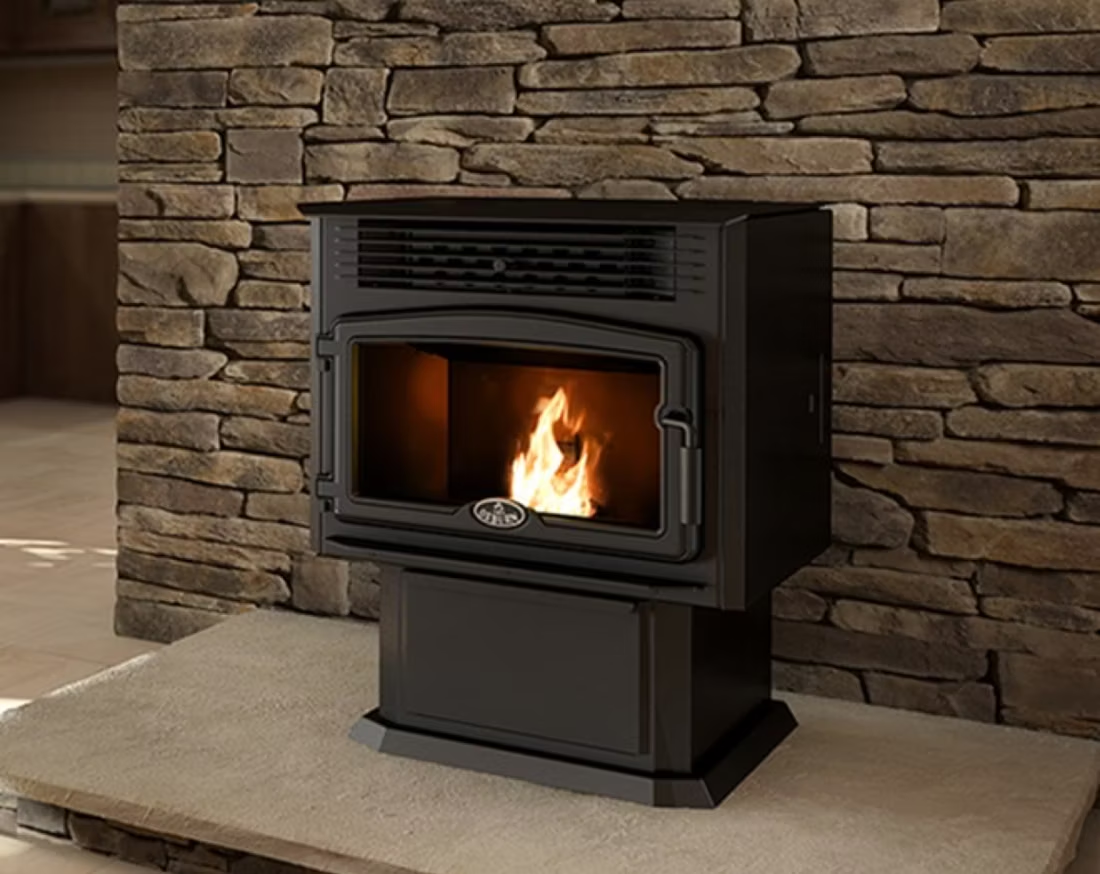
That said, pellet appliances aren't nonexistent—they just serve a smaller, more specific set of homeowners. Acreages and hobby farms outside city gas mains (around Central City, Coggon, Walker, or Ely) sometimes install a pellet stove because running a new gas line to an outbuilding or a home well off the main road costs more than the appliance itself. Others add one to a sunroom, a finished basement, or a three-season porch as supplemental heat rather than a primary system. Regional suppliers like Lignetics and Indeck Energy Services keep pellet fuel obtainable in the area, even though dedicated pellet retailers are thinner on the ground here than in wood-and-pellet-heavy regions further west. If a pellet stove is genuinely the right tool for your specific situation, we'll say so—and if gas or electric makes more sense for your address, we'll say that instead.
Three steps. No salesperson until you're ready.
Tell us about your project
Your zip code, your situation, and the fuel you're leaning toward—or let the answers point you to one.
See what's actually available
The brands dealers within 100 miles genuinely carry—real options, never a catalog mirage.
Get your dealer & Project Guide
A trusted local dealer, plus the free Project Guide & Parts List that names every component of the job.
Frequently Asked Questions
Are pellet stoves common in Linn County?
No. Most homes in Cedar Rapids, Marion, and Hiawatha heat with natural gas through Alliant Energy, and newer construction throughout the county increasingly uses electric heat pumps. Pellet stoves show up occasionally in rural pockets of the county, but they're a minority choice rather than a mainstream one—a homeowner searching for a pellet dealer here is usually solving a specific problem, not following the neighborhood norm.
Why don't more Linn County homes use pellet stoves?
Mostly infrastructure and cost. Natural gas service reaches most incorporated parts of the county at a lower ongoing fuel cost than bagged pellets, and Linn County doesn't face the winter inversions or non-attainment air quality rules that push some Western counties toward cleaner-burning pellet appliances instead of open wood fires. Without either of those pressures, there's less structural reason for pellets to compete with gas here.
Where does a pellet stove actually make sense in Linn County?
The clearest case is a property outside the natural gas service area—an acreage near Central City, Coggon, or Walker where extending a gas main would cost thousands more than a stove install. Beyond that, pellet stoves work well as zone heat for a finished basement, sunroom, or detached workshop where running new gas or electric baseboard isn't practical. It's rarely the right call for a primary residence already on the gas grid in Cedar Rapids or Marion.
How much does a pellet stove installation cost in Linn County?
Because pellet installs are uncommon here, pricing varies more than it would in a market with several dedicated pellet dealers—the total depends heavily on venting path, hearth pad requirements, and whether the appliance is going into an existing fireplace opening or a new location. Rather than quote a number that doesn't reflect your specific setup, we match you with a local dealer who will size the job and give you a firm estimate as part of your free Project Guide & Parts List.
What pellet brands are actually available near Linn County?
Lignetics and Indeck Energy Services are the two regional suppliers most likely to have pellet fuel moving through Iowa and the wider Midwest. Because pellet heat isn't a high-volume category here the way it is in the Pacific Northwest or Northeast, expect fewer dedicated pellet retailers and more appliance dealers who carry pellet stoves as one option among gas and electric units.
Will a pellet stove keep my Linn County home warm during a power outage?
No—and this is the detail people most often get wrong. Pellet stoves need electricity to run the hopper auger and combustion blower, so when the grid goes down, the stove goes down with it. Cedar Rapids residents who lived through the August 2020 derecho remember multi-day Alliant Energy outages firsthand; a pellet stove would have been just as dark as everything else in the house during that event. If backup heat during outages is the actual goal, that points toward a battery-free gas unit or a wood-burning appliance rather than pellet.
Do I need a permit to install a pellet stove in Linn County?
Generally yes. Inside city limits, permitting runs through the local building department—the City of Cedar Rapids Building Services Division for in-town projects, or the equivalent office in Marion or Hiawatha. In unincorporated parts of the county, Linn County's Planning and Development office handles permitting. Most dealers who install pellet appliances in this market are used to pulling permits as part of the job, since it's a less routine request than a furnace swap.
What size pellet stove do I need for my Linn County home?
Sizing follows square footage, insulation quality, and ceiling height, same as anywhere—small units suit a single room or three-season porch, medium units can carry a finished basement or addition, and larger units are rarely justified here since few homeowners are asking a pellet stove to heat an entire house that's already on natural gas. Given the county's long, demanding heating season and average winter lows near 11°F, undersizing a supplemental unit is the more common mistake than oversizing it—a local dealer can size it correctly during an in-home visit.
Pellet vs. gas—which is right for my Linn County home?
For most homes in Cedar Rapids, Marion, and Hiawatha, gas wins on convenience and running cost—it's instant-on, doesn't require hauling and storing pellet bags, and taps into infrastructure that's already at the curb via Alliant Energy. Pellet makes more sense specifically where a gas line isn't a realistic option—a rural acreage, a detached shop, or a home on the edge of the service territory. If you're unsure which category you fall into, that's exactly the kind of question a local dealer can answer honestly during a home visit rather than guessing from a spec sheet.
Why is a fireplace insert so efficient?
An insert does two things: it seals the chimney completely, so you stop losing air you already paid to heat, and it radiates warmth into the room through the firebox and glass. Most add a heat-exchange fan that pulls cool room air underneath, wraps it around the hot firebox, and pushes it back out warm. Your home is more efficient before you've even lit the first fire.
What's the difference between an insert and a zero-clearance fireplace?
An insert is a fireplace that slides into a pre-existing wood-burning fireplace—if you don't have one, there's nothing to insert it into. A zero-clearance fireplace is built into a framed wall, which makes it the answer for remodels and new construction. Simple test: existing masonry fireplace means insert; blank or framed wall means zero-clearance.
Can a fireplace actually lower my heating bill?
Yes—by creating a comfort zone. A furnace heats every square foot of the house just to warm the one room you're in; a gas fireplace on low burns roughly a sixth of the gas a typical furnace does. Set the furnace around 55–60 degrees as a baseline, then heat the rooms your family actually uses. Families who heat this way commonly save $20–$60 a month.
How much should I budget for a fireplace?
For an average home—covering the fireplace, the vent pipe, and basic installation—a budget between $3,900 and $5,500 gives you a lot of options across wood, gas, and pellet. By the time you add finish work, gas line, and electrical, the average complete installation lands between $5,000 and $12,000 all-in. In a remodel or new build, a good rule is to put about 2.5% of the total project cost toward the fireplace.
Stove and Fireplace Dealers in Linn County
Listings include WhyFire partner dealers, dealers we have verified as authorized for the brands we recommend, and established local businesses that carry hearth products. Every listing shows which one it is. The ones marked Preferred run on WhyFire's software, so they can show you real pricing and book your appointment right here. No manufacturer pays for placement. How we verify dealers →
Ferguson Home - Cedar Rapids
Stone Works - Marion Location
Spartan Heating, Cooling And Fireplaces
Ogden-Adams Building Solutions
Brick House Ops.
Hearth And Home Solutions
Brandt Heating And Air Conditioning
Pellet Brands Stocked Around Linn County
Manufacturers will point you to the nearest stocking dealer.
Find your pellet stove in Linn County.
Tell us about your home and where it sits relative to natural gas service, and we'll match you with a local dealer who installs pellet appliances in this market—plus a free Project Guide & Parts List with the exact parts, vent kit, and dealer recommendation for your project.
Find Your Fireplace →