
Instant Heat for Champaign County's Coldest Nights.
With winters comparable to Madison, Wisconsin and lows averaging 18°F, Urbana homes need dependable heat that starts at the flip of a switch. Find the right gas fireplace and connect with a trusted local dealer.
Every Project Starts From One of These Five Situations
Reliable warmth for a flat, cold prairie winter.
Urbana sits on the open Illinois prairie at just 730 feet of elevation, with no windbreaks to slow the wind that sweeps down from the plains. Winters here run cold and steady—a 5A climate zone with a winter heating load that puts Urbana closer to Madison, Wisconsin than to the milder parts of the Midwest, and average lows of 18°F mean a heating system has real work to do from November through March.
Ameren Illinois serves as the primary natural gas provider inside city limits, with residential electric rates around 11.76 cents per kWh, while homes in outlying Champaign County areas served by Eastern Illinois Electric Cooperative see a higher electric rate near 17.1 cents. That rate gap is part of why gas fireplaces and inserts are the standard choice for supplemental heat in and around Urbana—unlike the forested regions of the Pacific Northwest or northern New England, central Illinois has no public timberland for cutting permits and no local wood-heat culture, so gas fills the role that wood or pellet stoves play elsewhere. A direct-vent gas fireplace or insert gives Urbana homeowners immediate, thermostat-controlled heat without relying on a fuel supply that simply isn't part of the local landscape.
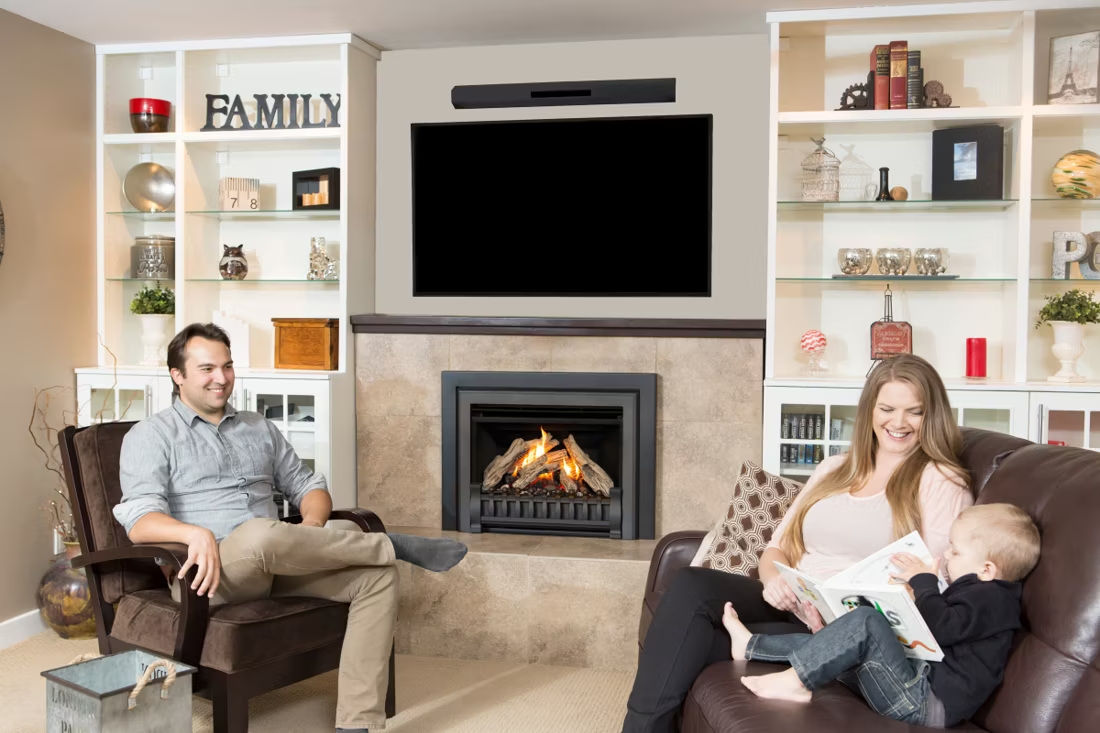
Three steps. No salesperson until you're ready.
Tell us about your project
Your zip code, your situation, and the fuel you're leaning toward—or let the answers point you to one.
See what's actually available
The brands dealers within 100 miles genuinely carry—real options, never a catalog mirage.
Get your dealer & Project Guide
A trusted local dealer, plus the free Project Guide & Parts List that names every component of the job.
Frequently Asked Questions
How much does a gas fireplace installation cost in Urbana?
Most gas fireplace and insert installations in Urbana run between roughly $4,500 and $10,000, depending on the unit, the venting path, and whether new gas line work is required. A direct-vent insert going into an existing masonry fireplace with a gas line already nearby tends to land on the lower end. A new built-in gas fireplace in a remodel or an addition—with framing, venting through an exterior wall, and a longer gas line run from the meter—pushes toward the higher end. Local dealers serving Champaign County will give you a firm number after seeing the space in person.
Can I convert my existing wood-burning fireplace to gas?
Yes, and it's one of the more common projects for older Urbana homes near downtown and the University of Illinois campus that were built with a traditional masonry fireplace. A gas insert typically slides into the existing firebox, using a stainless liner run up the original chimney for venting. Because Ameren Illinois natural gas service is already established throughout the city, most conversions only require a new gas line branch to the fireplace location rather than a full service upgrade, which keeps costs closer to the lower end of the local install range.
Is natural gas available everywhere in Urbana, or will I need propane?
Ameren Illinois provides natural gas service throughout most of Urbana, including the areas around downtown, the university, and the surrounding residential neighborhoods, so the majority of homes can tie a new fireplace into existing gas service. Homes further out in rural Champaign County—particularly areas served by Eastern Illinois Electric Cooperative for power—are more likely to be outside the natural gas footprint and rely on propane instead. Most gas fireplace models can be set up for either fuel; your installer simply configures the correct orifice and regulator.
Will a gas fireplace still work if the power goes out?
Most will. Units with an intermittent pilot ignition (IPI) system include a battery backup—usually a couple of AA batteries inside the unit—that takes over automatically when the power drops, so the fireplace still lights and runs on demand. Given central Illinois's exposure to ice storms and severe thunderstorms that can knock out power for a day or more, that backup matters. Valor fireplaces go a step further: their pilot assembly generates its own electricity through the thermocouple, so there are no batteries to maintain at all. Ask your local dealer which ignition system a given model uses before you buy.
What's the difference between a gas fireplace, gas insert, and gas stove?
A gas fireplace is a fully built-in unit framed into a wall, typically chosen for new construction or a major remodel. A gas insert is sized to slide into an existing masonry firebox, turning an old wood fireplace into a sealed, efficient heat source that vents through the existing chimney. A gas stove is a freestanding cabinet-style unit that sits on the floor, similar in footprint to a wood stove. For Urbana's older housing stock—plenty of it built with a traditional brick fireplace—an insert is usually the simplest upgrade. Newer construction or additions without an existing hearth are better suited to a built-in fireplace or a freestanding stove.
Do I need a permit to install a gas fireplace in Urbana?
Yes. The City of Urbana Building Safety Division requires a building permit for new gas fireplace or insert installations, and the gas line connection itself needs to be run or inspected by a licensed gas-fitter. Homes outside city limits in unincorporated Champaign County go through the county building department instead. Most established hearth dealers handle the permit application and schedule the inspection as part of the installation, so you're not coordinating separate trades yourself.
Should I get a vented or vent-free gas fireplace?
Vented gas fireplaces—direct-vent or B-vent—pull combustion air from outside and exhaust the byproducts back outside through a sealed pipe. Vent-free (ventless) units burn fuel directly into the room, without any exterior venting, and are legal in Illinois but subject to room-size and ventilation requirements, plus an oxygen depletion sensor. For a well-insulated Urbana home built to handle a 5A winter, a direct-vent unit is the more common and more comfortable choice: it delivers real heat output without adding humidity or combustion byproducts to a tightly sealed house. Vent-free units are worth discussing with a local dealer for supplemental use in a specific room, but they're rarely the right fit as a home's primary fireplace.
How often does a gas fireplace need to be serviced?
Plan on an annual inspection, ideally in early fall before the heating season starts. A technician checks the burner, pilot assembly, venting, and gas connections, and cleans the glass and interior—a much lighter job than a wood-stove chimney sweep, but just as important for safe operation. Local hearth dealers and HVAC contractors serving the Champaign-Urbana area typically charge in the $150 to $250 range for a standard annual service call.
Should I choose gas or electric heat for my fireplace?
Gas delivers real, sustained heat output—enough to noticeably warm a room during Urbana's cold snaps—plus the look and sound of a genuine flame, and most models keep working through a power outage on battery backup. Electric fireplaces cost far less to install (often $400 to $1,500 versus several thousand for gas), require no gas line or venting, and can go almost anywhere on a standard outlet, but they're producing warmth from resistance heating elements rather than combustion, so they're better suited to supplemental or ambiance-focused use than to serious heating load. With wood and pellet stoves largely absent from the local market here, most Urbana homeowners weighing a real heat source land on gas, while electric units are popular as a lower-cost second unit in a bedroom or den.
What's the difference between an insert and a zero-clearance fireplace?
An insert is a fireplace that slides into a pre-existing wood-burning fireplace—if you don't have one, there's nothing to insert it into. A zero-clearance fireplace is built into a framed wall, which makes it the answer for remodels and new construction. Simple test: existing masonry fireplace means insert; blank or framed wall means zero-clearance.
Why is my open fireplace making my house colder?
Open fireplaces suck—literally. As the fire burns, it consumes air your furnace already paid to heat and pulls it out through the chimney, so the house is actually colder after the fire goes out than before you lit it. An insert fixes this: it seals the chimney, puts fixed glass across the front, and turns that hole in your house into a real heat source.
How much should I budget for a fireplace?
For an average home—covering the fireplace, the vent pipe, and basic installation—a budget between $3,900 and $5,500 gives you a lot of options across wood, gas, and pellet. By the time you add finish work, gas line, and electrical, the average complete installation lands between $5,000 and $12,000 all-in. In a remodel or new build, a good rule is to put about 2.5% of the total project cost toward the fireplace.
Can I install a fireplace myself?
If you're putting a fire in your house on purpose, it's best to work with an expert. Unless you're genuinely experienced in framing, gas line, vent pipe, and the national code on clearances to combustibles, have a professional do it—and ideally the same company that sells you the fireplace, so warranty, service, and liability all live under one roof.
Nearby Dealers
Hearth shops serving Urbana and the surrounding area. Every listing shows whether it is a WhyFire partner, a dealer we have verified as authorized for the brands we recommend, or a local business carrying hearth products. No manufacturer pays for placement. How we verify dealers →
The Depot
Clayton Sales Company
Find your gas fireplace in Urbana.
Tell us a bit about your home and we'll match you with the right gas fireplace, insert, or stove—plus a free Project Guide & Parts List built for your Urbana project and a trusted local dealer to install it.
Find Your Fireplace →