
Pellet Heat is the Exception, Not the Rule, in Tazewell County.
Across Pekin, East Peoria, Morton, and the rest of Tazewell County, natural gas heats most homes—pellet stoves are a niche fit, not a mainstream one. If a pellet stove still makes sense for your workshop, sunroom, or rural property, we'll match you with a trusted local dealer who can tell you straight whether it's the right call.
Every Project Starts From One of These Five Situations
Tazewell County runs on natural gas, not pellets.
Tazewell County sits along the Illinois River in central Illinois, with roughly 108,000 residents spread across Pekin, East Peoria, Morton, Washington, and surrounding farm townships. Winters here are moderate by Midwest standards—a 5A climate zone, average winter lows around 18°F, and roughly 5,614 heating degree days a year. That's real cold, but it's nowhere near the extremes that drive off-grid pellet adoption in places like Duluth, MN or International Falls, MN. Combined with a natural gas network that reaches the great majority of homes in the county, the economic case for pellet heat as a primary system rarely holds up here.
There's an interesting wrinkle: Illinois is home to pellet producers like Indeck Energy Services and Somerset Pellet Fuel, along with regional supplier Lignetics, so pellet fuel itself isn't hard to source in the state. That manufacturing presence just hasn't translated into widespread residential demand within Tazewell County, where gas furnaces and gas fireplaces are the default. The homeowners who do install a pellet stove here tend to have a specific reason—a detached garage or workshop without a gas line, a three-season room addition, an older farmhouse on the edge of the county where extending gas service isn't practical, or simply a preference for solid-fuel ambiance without the wood-cutting and storage that a cordwood stove requires. If that's you, Find My Fireplace can still match you with a local dealer who carries pellet equipment and will size and install it correctly—we just won't pretend it's the obvious choice for every home in the county.
Three steps. No salesperson until you're ready.
Tell us about your project
Your zip code, your situation, and the fuel you're leaning toward—or let the answers point you to one.
See what's actually available
The brands dealers within 100 miles genuinely carry—real options, never a catalog mirage.
Get your dealer & Project Guide
A trusted local dealer, plus the free Project Guide & Parts List that names every component of the job.
Frequently Asked Questions
Are pellet stoves actually available in Tazewell County?
Yes, but they're a special-order category rather than a showroom staple. Because gas fireplaces and inserts make up the bulk of local hearth business, many dealers in the Pekin–East Peoria–Morton area carry one or two pellet models rather than a full lineup. That's not a reason to skip the idea—it just means working with a dealer who can order the right unit and vent kit for your home rather than walking in expecting shelf stock. Find My Fireplace matches you with a local dealer equipped to do exactly that.
Why aren't pellet stoves more common in Tazewell County?
Two things work against pellet stoves here. First, natural gas service reaches most of the county's population centers, and gas fireplaces deliver instant, thermostat-controlled heat without hauling fuel—a hard combination for pellet stoves to compete with on convenience. Second, at 5,614 heating degree days and average winter lows around 18°F, Tazewell County's winters are cold but not extreme enough to push homeowners toward supplemental solid-fuel heat the way harsher climates do. Where cordwood heating exists locally, it tends to draw on the county's abundant oak, hickory, walnut, and maple rather than bagged pellets.
Who actually installs a pellet stove in Tazewell County?
Mostly homeowners solving a specific problem: a detached garage, barn, or workshop that was never run with a gas line; a sunroom or addition where extending ductwork or gas piping is impractical; or a rural property outside city gas service where propane and pellets are both on the table. Some homeowners also simply prefer the auto-feed convenience of a pellet stove—set the hopper and thermostat rather than tend a fire—without wanting to install a full wood-burning system.
What's the difference between a pellet stove and a wood stove for a Tazewell County home?
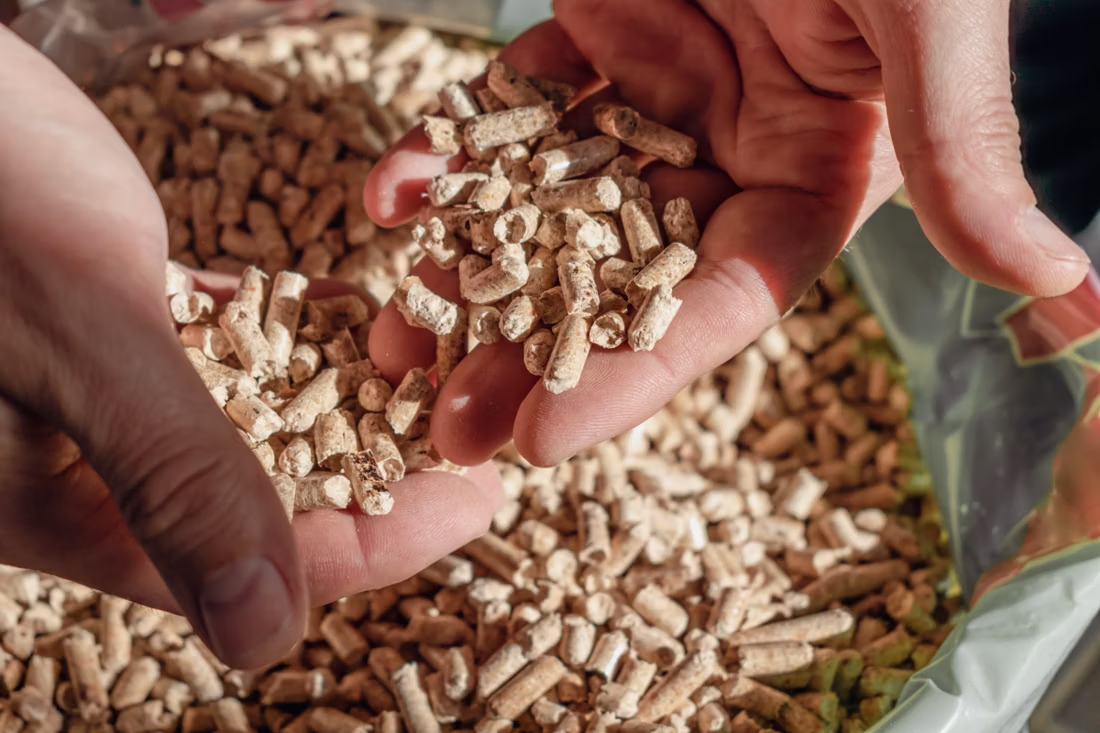
A wood stove burns cordwood and needs regular tending, but works with zero electricity—useful during outages. A pellet stove burns compressed hardwood pellets fed automatically from a hopper, producing steadier heat with far less daily effort, but it needs electricity to run the auger and blower. Wood stoves are also uncommon as a primary system in Tazewell County given how gas-served the area is, though some rural households with their own oak or hickory woodlots still burn cordwood for supplemental heat. If you're choosing between the two, think about whether convenience (pellet) or outage-proof simplicity (wood) matters more for your situation.
Where do I buy pellets in Tazewell County?
Because pellet stoves aren't mainstream locally, pellets aren't always sitting on the shelf at every hardware store the way they might be in a heavier pellet-heating region. Regional brands like Lignetics circulate through the Midwest, and Illinois-based producers such as Indeck Energy Services and Somerset Pellet Fuel supply the broader market. Plan on ordering a season's supply ahead of the first cold snap rather than assuming you can pick up a few bags on short notice in January—your installing dealer can usually point you to a reliable local or regional source.
Is pellet heat cost-effective compared to natural gas in Tazewell County?
For most homes here, no—natural gas is typically cheaper and more convenient where service is already available, since you're not buying, storing, and loading fuel by hand. Pellet stoves in Tazewell County tend to make sense for reasons other than raw fuel economics: heating a detached space without gas service, adding zone heat to one room, or wanting a visible flame with less hands-on effort than cordwood. If pure cost savings on an already-gas-heated home is the goal, a pellet stove usually isn't the answer.
Can a pellet stove serve as backup heat during a power outage?
Not reliably, and this is worth being direct about: pellet stoves depend on electricity to run the auger that feeds fuel and the blower that distributes heat, so they shut down in an outage just like a gas furnace does. If outage-proof heat is your priority in Tazewell County, a battery-backed inverter, a small generator to keep the stove's circuit running, or a traditional wood stove (which needs no power at all) are better fits than a pellet appliance.
Do I need a permit to install a pellet stove in Tazewell County?
Most jurisdictions in the county require a building permit for a new solid-fuel appliance, covering the venting termination clearances, hearth pad, and the dedicated electrical circuit a pellet stove needs for its auger and blower. Requirements can differ slightly between unincorporated Tazewell County and cities like Pekin or East Peoria, so check with your local building department before work starts. A reputable installing dealer will typically handle this paperwork as part of the job.
Pellet vs. gas—which is right for my Tazewell County home?
For the average home in Pekin, East Peoria, Morton, or the surrounding townships, a gas fireplace or insert is the more practical choice—it plugs into infrastructure that's already widely available, runs on demand, and needs no fuel storage. A pellet stove is worth considering when gas isn't a realistic option for the space (a detached workshop, a rural property without service) or when you specifically want the look and feel of a solid-fuel appliance with auto-feed convenience. There's no air-quality burn-ban pressure in Tazewell County pushing homeowners one way or the other, so the decision usually comes down to what fuel is actually available to the room you're heating.
How often does a pellet stove need cleaning?
A clean pellet stove is a happy pellet stove. Plan on cleaning the burn pot about once a week when you're burning regularly—ash and clinkers gum up the air holes just like a pellet barbecue. Most pellet stove problems trace back to skipped cleaning that nobody explained up front. Some designs make it easy with a trapdoor burn pot: pull a lever and the gunk drops into the ash pan.
What's the difference between an insert and a zero-clearance fireplace?
An insert is a fireplace that slides into a pre-existing wood-burning fireplace—if you don't have one, there's nothing to insert it into. A zero-clearance fireplace is built into a framed wall, which makes it the answer for remodels and new construction. Simple test: existing masonry fireplace means insert; blank or framed wall means zero-clearance.
Can a fireplace actually lower my heating bill?
Yes—by creating a comfort zone. A furnace heats every square foot of the house just to warm the one room you're in; a gas fireplace on low burns roughly a sixth of the gas a typical furnace does. Set the furnace around 55–60 degrees as a baseline, then heat the rooms your family actually uses. Families who heat this way commonly save $20–$60 a month.
Does a fireplace add value to my home?
On average, a fireplace adds back to the home about the same amount you spent installing it. Add the monthly savings from heating the rooms you actually use instead of the whole house—often hundreds of dollars a year—and the value case is strong before you even count what a fire does for how your family uses the room.
Stove and Fireplace Dealers in Tazewell County
Pellet Brands Stocked Around Tazewell County
Manufacturers will point you to the nearest stocking dealer.
Find your pellet stove fit in Tazewell County.
Tell us about your home, your space, and why gas isn't the right fit for it, and we'll match you with a local dealer who actually stocks and installs pellet equipment. You'll get a free Project Guide & Parts List—the vent kit and parts your project needs, plus your recommended local dealer.
Find Your Fireplace →