
Dependable gas heat for Clark County's long, hard winters.
With around 553 residents spread across ranch and dry-farm country between Dubois and the Centennial Mountains, Clark County runs almost entirely on propane, not piped natural gas. Find the right gas fireplace or insert and connect with a dealer who actually services this corner of Idaho.
Every Project Starts From One of These Five Situations
Clean heat for a county with no natural gas lines.
Clark County is one of the least populated counties in Idaho, and it shows in the infrastructure. Dubois, the county seat, sits near 5,970 feet along the I-15 corridor between Idaho Falls and the Montana border, with Kilgore and Spencer to the north toward the Centennial Mountains. The county falls in climate zone 6B—cold enough that winters here resemble what you'd expect in Bozeman or Helena, Montana, with long stretches of hard freeze and heavy snow load on ranch buildings and homes alike.
There's no municipal natural gas utility serving a county this size, so when people here say 'gas fireplace,' they mean propane—delivered by tank truck from suppliers based out of Idaho Falls or Rexburg, with a tank set on the property. Late-summer and fall wildfire smoke is a recurring concern in this part of eastern Idaho, and a propane insert or fireplace gives ranch homes and cabins a clean, smoke-free heat source that doesn't add to indoor air quality problems during a smoke advisory—while still delivering real, instant warmth on a January night when the wind is coming off the Centennials.
Three steps. No salesperson until you're ready.
Tell us about your project
Your zip code, your situation, and the fuel you're leaning toward—or let the answers point you to one.
See what's actually available
The brands dealers within 100 miles genuinely carry—real options, never a catalog mirage.
Get your dealer & Project Guide
A trusted local dealer, plus the free Project Guide & Parts List that names every component of the job.
Frequently Asked Questions
How much does a gas fireplace installation cost in Clark County?
Most propane fireplace or insert installations in Clark County run roughly $4,500 to $10,000, with the spread coming down to whether a propane tank is already in place, how far the gas line has to run from the tank to the appliance, and whether venting has to be added through an exterior wall or roof. Because there's no natural gas main to tie into, every install here is a propane job—which usually means either connecting to an existing whole-property tank shared with a furnace or range, or a dedicated smaller tank just for the fireplace. Rural properties outside Dubois, Kilgore, or Spencer should expect a trip charge from installers based out of Idaho Falls or Rexburg, since there's no hearth dealer physically located in the county itself.
Can I convert my existing wood fireplace to propane gas?
Yes, and it's a common upgrade on older ranch houses in Clark County that were built with a wood-burning masonry fireplace decades ago. A propane insert slides into the existing firebox, using a stainless liner run up the current chimney for venting, with a propane line run to a tank outside. Expect the project to land in the $4,500 to $9,000 range depending on the insert and how far the propane line has to travel from the tank. The conversion keeps the look of the original fireplace but trades hauling and splitting lodgepole pine or douglas fir for a switch and a thermostat.
Is there natural gas service in Clark County, or is it all propane?
It's propane. Clark County has no natural gas utility mains—at 553 residents spread across a large, rural footprint, there's never been the density to justify running gas lines. Every 'gas fireplace' installed in the county, whether in Dubois, Kilgore, Spencer, or on an outlying ranch, runs on propane from a tank on the property, filled by delivery trucks from suppliers out of Idaho Falls or Rexburg. Your installer will size the appliance's orifice and regulator for propane rather than natural gas—this isn't optional, it's how the unit is configured from the start.
Will my propane fireplace still work if the power goes out?
Most modern propane fireplaces will, which matters here—power lines serving rural Clark County can be down for hours after a winter storm rolls off the Centennials. Units with IPI (intermittent pilot ignition) run on battery backup, typically standard AA batteries built into the unit, so the fireplace still lights and runs the fan even with the grid down. Valor units go a step further: their pilot assembly generates its own electricity through the thermocouple, so there's no battery to remember or replace. For a county this remote, that self-sufficiency is worth asking your dealer about directly.
What's the difference between a gas fireplace, gas insert, and gas stove?
A gas fireplace is a fully built-in unit framed into a wall—the standard choice for new construction or a remodel on one of the newer homes going up around Dubois. A gas insert drops into an existing masonry firebox, using the current chimney as a venting path with a liner, which fits a lot of the older ranch houses scattered through the county. A gas stove is a freestanding cabinet-style unit that sits on the floor, useful in a shop, bunkhouse, or a room without any existing fireplace or chimney at all. Given how spread out properties are in Clark County, a freestanding stove is often the practical answer for outbuildings that need standalone heat.
Do I need a permit to install a propane fireplace in Clark County?
Yes—new gas appliance installations require a building permit through the Clark County Building Department in Dubois, along with sign-off on the propane line work, which needs to be done by a licensed gas-fitter. Propane tanks also have required setback distances from structures, property lines, and ignition sources, so tank placement gets checked as part of the permit. Most installers coordinate the permit, the tank setback, and the venting inspection together, which is worth confirming before you sign a contract—especially since there's no hearth shop headquartered in the county to fall back on if something's missed.
Should I get a vented or vent-free propane fireplace?
Vented (direct-vent) units draw combustion air from outside and exhaust it back outside through sealed venting—they're the safer, more universally recommended choice, especially at Clark County's elevation near 6,000 feet, where thinner air changes how vent-free units perform and how quickly their oxygen depletion sensors trip. Vent-free units burn directly into the room and are legal in Idaho, but they're a tighter fit for the well-sealed, tightly insulated farmhouses common in this climate zone, where indoor air exchange is already limited. For most Clark County homes, a direct-vent propane fireplace or insert is the more reliable long-term choice, particularly in a house that's occupied seasonally or left unattended for stretches, which isn't unusual on ranch properties out here.
How often should a propane fireplace be serviced?
Plan on an annual inspection—a technician checks the burner, pilot assembly, gas connections, and venting, and cleans the glass and interior. This matters more in Clark County than in a milder climate because propane fireplaces here often run daily for months at a stretch through the cold season, and because the nearest qualified technician is likely coming from Idaho Falls or Rexburg rather than down the road. Scheduling service in late summer, before the propane truck's fall delivery rush, tends to be easier than trying to book someone once the snow starts.
Propane fireplace vs. wood stove—which makes more sense out here?
Wood remains a serious option in Clark County—lodgepole pine, ponderosa pine, douglas fir, and larch are all available regionally, and a wood stove keeps burning with the power out, which counts for something on properties an hour from the nearest lineman. The tradeoff is wildfire smoke season, when air quality concerns make wood smoke less appealing even from your own chimney, and the ongoing work of splitting, hauling, and storing cordwood on a working ranch. Propane wins on convenience—flip a switch, get heat, no ash, no smoke—but it depends entirely on tank deliveries staying on schedule through winter. A lot of properties in the county end up with both: propane for the main living space, a wood stove in the shop or as backup heat when a storm closes the roads.
Can I put a TV above my fireplace?
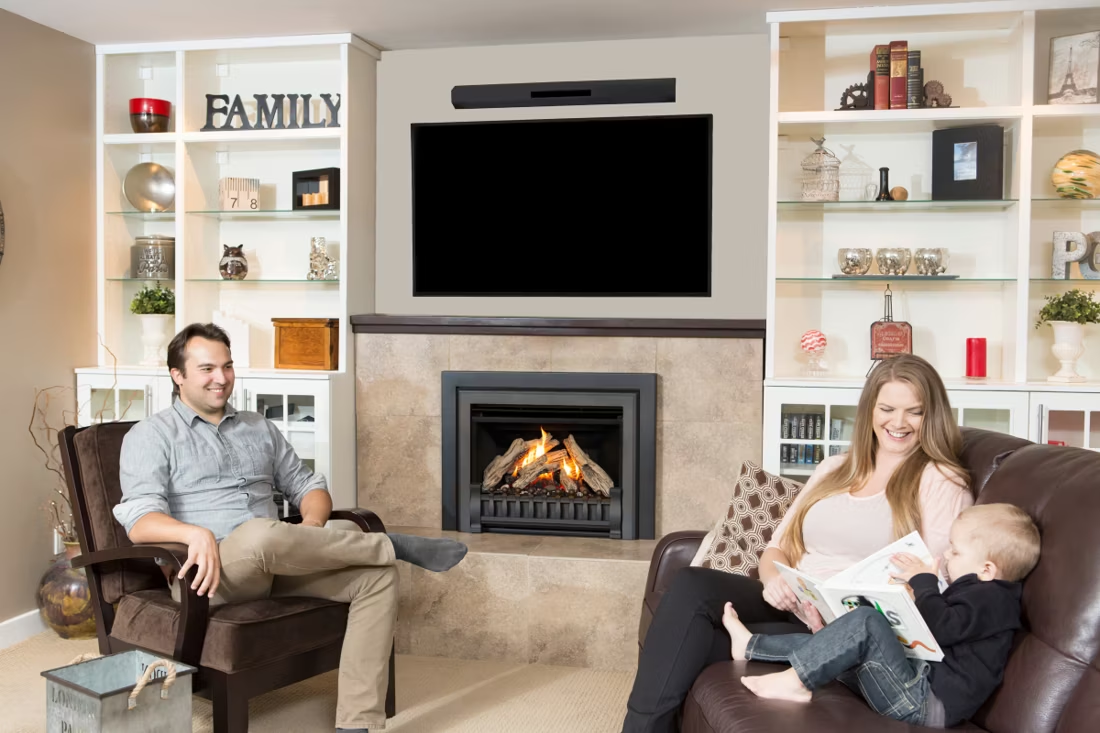
Yes—with an asterisk. Fireplaces are hot and TVs don't like heat. Either put a mantel between them to deflect rising warmth, or choose a fireplace with heat-management technology that creates a cool zone on the wall above—the wall stays around 125 degrees, barely warm, while the room still gets full heat. If you like clean lines and don't want a mantel, heat management is the answer.
What's the difference between an insert and a zero-clearance fireplace?
An insert is a fireplace that slides into a pre-existing wood-burning fireplace—if you don't have one, there's nothing to insert it into. A zero-clearance fireplace is built into a framed wall, which makes it the answer for remodels and new construction. Simple test: existing masonry fireplace means insert; blank or framed wall means zero-clearance.
How much should I budget for a fireplace?
For an average home—covering the fireplace, the vent pipe, and basic installation—a budget between $3,900 and $5,500 gives you a lot of options across wood, gas, and pellet. By the time you add finish work, gas line, and electrical, the average complete installation lands between $5,000 and $12,000 all-in. In a remodel or new build, a good rule is to put about 2.5% of the total project cost toward the fireplace.
Can a fireplace actually lower my heating bill?
Yes—by creating a comfort zone. A furnace heats every square foot of the house just to warm the one room you're in; a gas fireplace on low burns roughly a sixth of the gas a typical furnace does. Set the furnace around 55–60 degrees as a baseline, then heat the rooms your family actually uses. Families who heat this way commonly save $20–$60 a month.
Find your gas fireplace in Clark County.
Tell us about your home and your propane setup, and we'll match you with a local dealer who actually services Clark County—plus a free Project Guide & Parts List with the exact parts, including the vent kit, for your project.
Find Your Fireplace →