
Real warmth for Wheat Ridge living rooms, no chimney required.
At 5,348 feet with winter lows averaging 17°F and a winter heating season that runs long and cold, Wheat Ridge homes need real heat—but not every house has a flue or a gas line to spare. I'll match you with a trusted local dealer who can size and install an electric unit that actually works for your room.
Every Project Starts From One of These Five Situations
The option that doesn't add smoke on an inversion day.
Wheat Ridge sits in the Denver-Metro/North Front Range nonattainment area, and winter inversions here trap exhaust and particulate close to the ground for days at a stretch—the same brown-cloud pattern that shows up on Denver newscasts every January. Add wildfire smoke drifting in most summers, and it's easy to see why wood stoves and pellet stoves have basically disappeared from the local hearth market: most Wheat Ridge lots are too small for a cord of ponderosa pine or pinyon anyway, and Colorado's High Pollution Advisory program can restrict older uncertified wood devices on the exact cold, still days you'd want to burn them. A handful of homeowners still pull National Forest cutting permits from the Arapaho-Roosevelt National Forests at $5 to $20 a cord for a backyard fire pit, but almost nobody is running a wood insert as household heat inside city limits anymore.
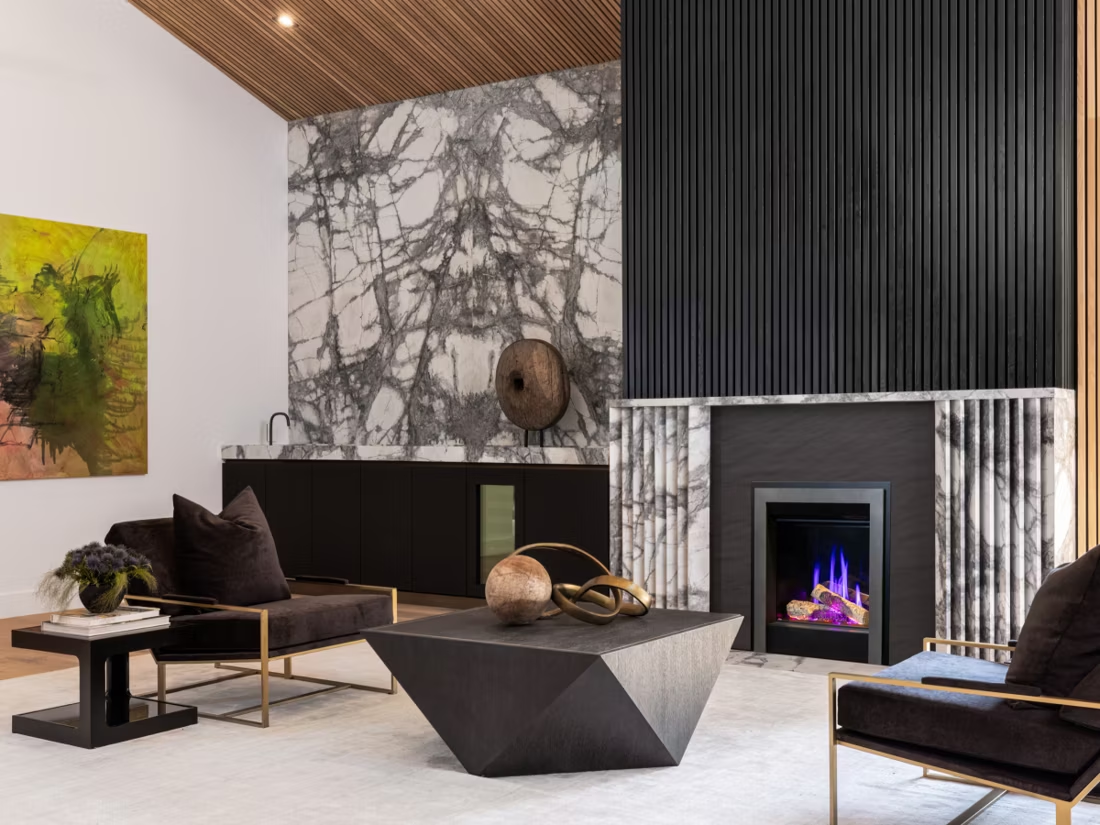
That's part of why electric fireplaces have real staying power in Wheat Ridge, alongside gas. Public Service Company of Colorado (Xcel Energy) serves electric here at a residential rate around 15 cents per kWh, which is enough that nobody's heating a whole 1950s ranch on resistance heat alone—but as a zone heater for a finished basement, a primary bedroom, or a living room retrofit into an old masonry firebox that's no longer worth burning wood in, an electric insert gives you real supplemental warmth with zero venting, zero combustion byproducts, and none of the inversion-day guilt that comes with a chimney.
Three steps. No salesperson until you're ready.
Tell us about your project
Your zip code, your situation, and the fuel you're leaning toward—or let the answers point you to one.
See what's actually available
The brands dealers within 100 miles genuinely carry—real options, never a catalog mirage.
Get your dealer & Project Guide
A trusted local dealer, plus the free Project Guide & Parts List that names every component of the job.
Frequently Asked Questions
How much does an electric fireplace installation cost in Wheat Ridge?
A plug-in insert or freestanding unit that just needs a standard outlet can run as little as $400 to $800 installed, including a hearth pad if you want one. A built-in linear electric fireplace set into a wall or existing masonry firebox—the more popular route for Wheat Ridge's older ranch and split-level homes—typically runs $1,500 to $3,500 once you factor in framing, trim, and an electrician running a dedicated 20-amp circuit, which most local codes require for a hardwired unit pulling 1,500 watts continuously.
Do I need a permit to install an electric fireplace in Wheat Ridge?
A simple plug-in unit generally doesn't need a permit. A built-in electric fireplace with new wiring does, since it involves an electrical permit through the City of Wheat Ridge's building division, plus a rough-in and final inspection on the dedicated circuit. If you're converting an existing wood-burning masonry firebox to hold the insert, most electricians and hearth dealers handle the permit paperwork as part of the install so you're not coordinating it yourself.
What size electric fireplace do I need for my Wheat Ridge home?
Size it for the room, not the house—electric units are built for zone heating, not for offsetting a whole home's long, demanding winter heating season. A 1,500-watt unit comfortably takes the chill off a 400-to-600-square-foot living room or finished basement rec room, which covers most single-room installs in Wheat Ridge's ranch and bi-level housing stock. Larger open-concept great rooms sometimes call for two smaller units or a wider linear model rather than one oversized fireplace, since electric heat output tops out around 5,000 BTU per unit regardless of size.
What does it cost to run an electric fireplace at Xcel Energy's rates?
At Public Service Company of Colorado's residential rate of roughly 15 cents per kWh, a typical 1,500-watt electric fireplace running on its heat setting costs about 22 to 23 cents an hour. Left on for a chilly evening—say, four or five hours—that's roughly a dollar. Most Wheat Ridge homeowners run the heater function only when they're in the room and use flame-only mode, which draws under 100 watts, the rest of the time, which keeps the ambiance without the electric bill.
Why don't more Wheat Ridge homes burn wood instead?
A few reasons stack up against it. Wheat Ridge falls inside the Denver-Metro/North Front Range ozone nonattainment area, and Colorado's High Pollution Advisory program restricts older uncertified wood stoves on the stagnant winter-inversion days that are common here. Lot sizes in most of the city's postwar neighborhoods also don't leave much room for stacking cords of ponderosa pine, aspen, or pinyon, even though cutting permits through the Arapaho-Roosevelt National Forests are cheap—$5 to $20 a cord, May through October. Between the air quality rules and the practical storage problem, most homeowners here who want a fireplace look at gas or electric instead.
Electric vs. gas—which makes more sense for my house?
If your home already has a gas line and you want a fireplace that can genuinely supplement your furnace on a 17-degree night, a direct-vent gas insert or fireplace will out-heat an electric unit and typically costs less to run per hour despite the higher install cost. If you're in a condo or townhome without gas access—common in some of the newer infill along the Clear Creek corridor—or you just want a fireplace look in a bedroom, office, or basement without running new gas line and venting, electric is the simpler, cheaper, and faster install. A lot of Wheat Ridge households end up with gas in the main living area and an electric unit somewhere secondary.
What's the difference between an electric insert, built-in, and mantel unit?
An electric insert is sized to slide into an existing masonry firebox—the go-to option if you've got an old wood-burning fireplace in a Wheat Ridge ranch that you'd rather not maintain. A built-in (or linear) electric fireplace is framed into a wall during a remodel, giving you a wide, low-profile look popular in newer renovations. A mantel or freestanding unit is basically furniture—no wiring or permit beyond an outlet, and it can move with you if you're renting. All three use the same core heating element; the differences are installation complexity and how permanent you want it.
Are electric fireplaces a good fit for condos and rentals in Wheat Ridge?
Yes, and it's one of the more common reasons people call about electric here. Wheat Ridge has a fair amount of rental and condo stock, particularly near the Wheat Ridge Marketplace area and along the Clear Creek corridor, where there's often no chimney, no gas line, and HOA rules that make venting modifications a hassle. A plug-in or lightly-wired electric unit sidesteps all of that—no permit fight with an HOA, no venting through a shared wall, and it comes with you if you move.
How much maintenance does an electric fireplace need?
Very little, which is part of the appeal after dealing with a wood-burning chimney. Wipe the glass front occasionally, vacuum the intake vents once or twice a year to keep dust from clogging the blower, and replace the LED light strip eventually—most last 20,000+ hours, well beyond a typical Colorado winter's worth of evening use. There's no annual sweep, no creosote, and no inspection required the way there is for a gas or wood unit.
Do electric fireplaces actually produce heat?
Yes—most put out around 4,800–5,000 BTUs from a standard outlet, which comfortably warms a bedroom, office, or den as a comfort-zone heater. What they won't do is carry a whole house the way wood, gas, or pellet can. Think of electric as ambiance-first with honest supplemental heat: flames on with no heat in July, flames plus warmth in January.
Does an electric fireplace need a vent or chimney?
No—that's its superpower. An electric fireplace needs a wall and an outlet, period. No vent pipe, no gas line, no clearances to design around, which is why it works in bedrooms, offices, apartments, and walls where venting a gas or wood unit would be impractical or impossible. Installation is typically the simplest and least expensive of any fireplace type.
How much should I budget for a fireplace?
For an average home—covering the fireplace, the vent pipe, and basic installation—a budget between $3,900 and $5,500 gives you a lot of options across wood, gas, and pellet. By the time you add finish work, gas line, and electrical, the average complete installation lands between $5,000 and $12,000 all-in. In a remodel or new build, a good rule is to put about 2.5% of the total project cost toward the fireplace.
What is an in-home preview and do I need one?
It's a visit where a hearth professional measures your space, confirms the model you picked actually works in your home, and walks the specs—framing, gas line, venting, finish work—before anything is ordered. Some details you just can't know until you see the house. Never make a down payment without one; it's the single most-skipped step that burns buyers.
Nearby Dealers
Hearth shops serving Wheat Ridge and the surrounding area. Every listing shows whether it is a WhyFire partner, a dealer we have verified as authorized for the brands we recommend, or a local business carrying hearth products. No manufacturer pays for placement. How we verify dealers →
Spa Brokers
Spa Brokers
Distinctive Mantel Designs
Aria Custom Design
Outdoor Kitchen Dist. Inc
Proud Souls Barbecue & Provisions
Rio Grande Co.
Fireplace And Grill Experts - Service Only
Spa Brokers V
Spa Brokers (Corporate)
Spa Brokers
Spa Brokers Iii
Electric Service in Wheat Ridge
An electric fireplace's heater draws about 1,500 watts—pennies per hour at local rates.
Public Service Co Of Colorado
Get your free Project Guide & Parts List for an electric fireplace in Wheat Ridge.
Tell me about your room, your panel, and whether you're retrofitting an old firebox or starting from scratch, and I'll match you with a trusted local dealer and send a free Project Guide & Parts List—sized right for zone heating in a Front Range winter.
Find Your Fireplace →