
Warmth That Works Above 8,000 Feet.
Instant, reliable heat for Vail's high-altitude winters—whether you're outfitting a ski-in condo or a full-time mountain home. Find a trusted local dealer who understands how elevation changes the install.
Every Project Starts From One of These Five Situations
One of the coldest heating climates in the Lower 48—and a fuel that keeps up.
Vail sits at 8,239 feet in the Gore Range, with a winter heating load that's colder, by that measure, than Duluth, Minnesota. Winter lows average 7°F, but at this elevation overnight temperatures regularly drop well below zero during hard cold snaps, and the heating season stretches from early fall through late spring. This isn't a climate where a fireplace is decoration; it's part of how a home stays livable through a Rocky Mountain winter.
Eagle County's high country doesn't have the piped natural gas infrastructure you'd find in a Front Range city—Holy Cross Electric Association serves electricity here, but gas heat in Vail generally means propane, delivered and stored in an on-site tank (often buried, given HOA aesthetics in the village core and surrounding subdivisions). That works in Vail's favor for a large share of the housing stock: with so many condos, ski-in units, and part-time second homes, a gas fireplace that lights instantly and needs no tending between owner visits is often the more practical choice than a wood-burning unit that requires someone on-site to feed it.
Three steps. No salesperson until you're ready.
Tell us about your project
Your zip code, your situation, and the fuel you're leaning toward—or let the answers point you to one.
See what's actually available
The brands dealers within 100 miles genuinely carry—real options, never a catalog mirage.
Get your dealer & Project Guide
A trusted local dealer, plus the free Project Guide & Parts List that names every component of the job.
Frequently Asked Questions
How much does a gas fireplace installation cost in Vail?
Most gas fireplace and insert installations in Vail run $6,000 to $14,000, and the spread here is wider than in lower-elevation markets for two reasons: propane tank work (a new buried tank, if one isn't already on the property, adds real cost) and Vail's mountain-town labor rates, which run above the Front Range for any trade. A straightforward insert into an existing masonry fireplace with a propane line already run to the hearth sits at the low end. New construction or a remodel requiring a fresh tank, buried gas line, and venting through log or stone construction pushes toward the higher end. Ask any local dealer for a firm number after they've seen the site.
Can I convert my existing wood fireplace to gas?
Yes, and it's a common request in Vail's older condo stock from the 1960s through '80s, much of which was built with open masonry fireplaces that are inefficient and, in many HOAs, restricted or phased out for wood burning entirely. A gas insert typically reuses the existing chimney with a stainless liner, and the propane line is run in through the same chase. Because most of these buildings run on propane rather than piped gas, your installer will also confirm there's tank capacity to support the added appliance, especially in multi-unit buildings sharing a single tank.
Do I need natural gas, or does Vail run on propane?
For the vast majority of homes in Vail, it's propane. There's no piped natural gas utility serving the town—Holy Cross Electric Association handles electric service, but gas appliances here run off propane delivered by regional suppliers and stored in a tank on or near the property. Nearly every gas fireplace model on the market can be configured for propane; your installer sets the correct orifice sizing. If you're building or buying, the practical question isn't natural gas vs. propane—it's whether the property already has adequate tank capacity for an additional appliance.
Will my gas fireplace work during a power outage?
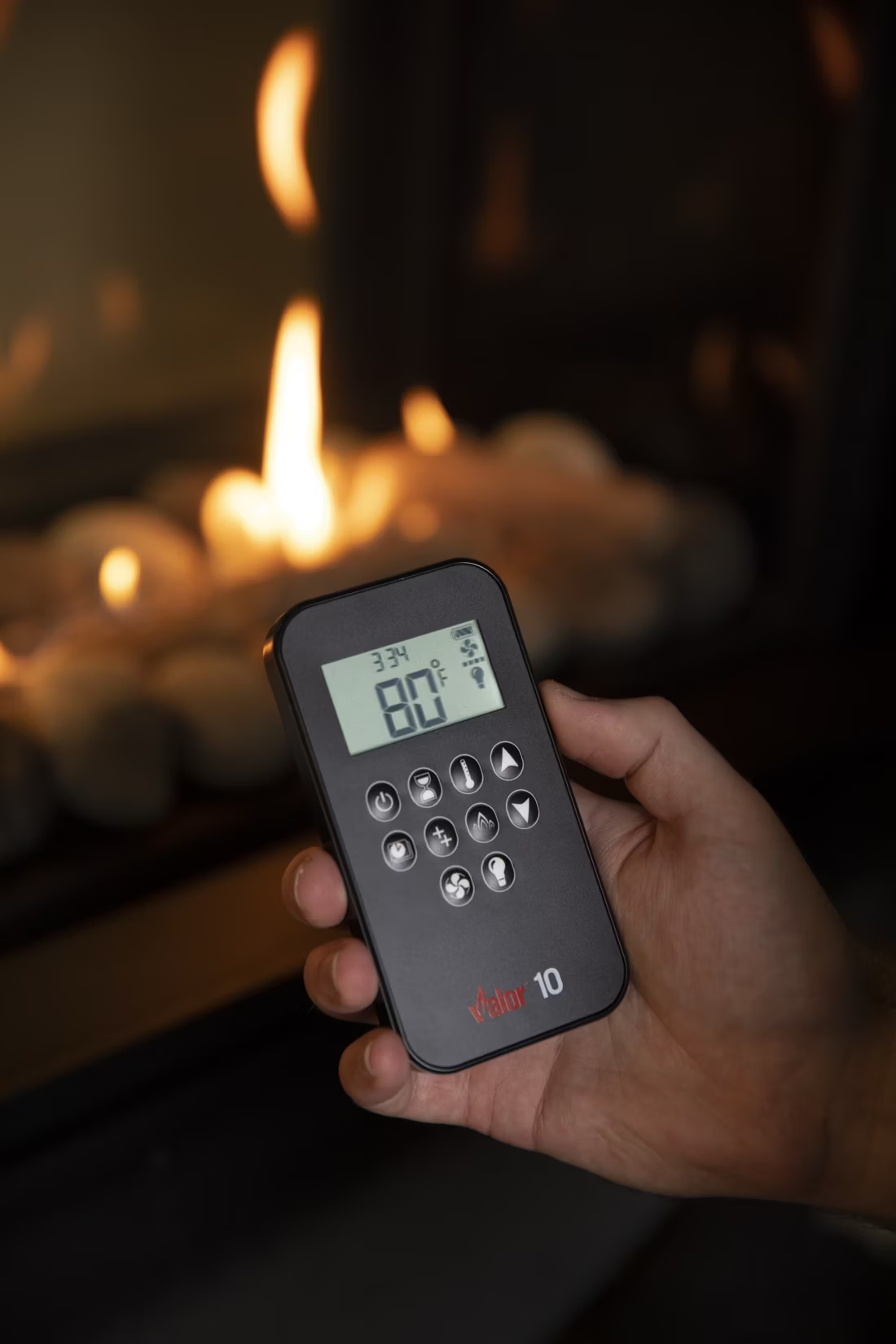
Most will, provided you choose the right ignition system. Units with intermittent pilot ignition (IPI) run on a battery backup that kicks in automatically when Holy Cross Electric power drops—which does happen during the heavy, wet spring storms and high-wind events that hit the Gore Range. Valor's gas fireplaces go a step further: the pilot's thermocouple generates the small amount of electricity the unit needs, so there's no battery to remember at all. For a full-time Vail home, or a condo that sits empty for weeks between visits, that kind of self-sufficiency is worth asking your dealer about directly.
What's the difference between a gas fireplace, gas insert, and gas stove?
A gas fireplace is a built-in unit framed into a wall—the standard choice for new mountain-modern construction going up around Vail. A gas insert drops into an existing masonry firebox, which is the common retrofit for the town's older condo buildings. A gas stove is a freestanding cast-iron or steel unit that sits on the floor, useful in smaller footprints like a one-bedroom ski unit where a full fireplace surround isn't practical. Local dealers who work regularly in Vail's condo associations can tell you quickly which option your building's HOA and chimney chase will actually allow.
Do I need a permit to install a gas fireplace in Vail?
Yes. Work inside town limits goes through the Town of Vail's Community Development Department, which requires both a building permit and sign-off on the gas line work; properties outside town limits fall under Eagle County's building department. Given how much of Vail's housing is in HOA-governed condo buildings, you'll often need HOA architectural approval as well before a permit is pulled, particularly for anything that changes an exterior vent termination. A local installer who's worked in Vail Village or Lionshead before will already know which HOAs require what.
Should I get a vented or vent-free gas fireplace in Vail?
Vented, essentially without exception. Vent-free gas appliances burn directly into the room and are rated by most manufacturers only up to a certain elevation—commonly around 4,500 to 7,000 feet—because thinner air changes combustion and oxygen-depletion sensor behavior. At 8,239 feet, Vail sits above where most vent-free units are certified to operate safely at all. Direct-vent gas fireplaces, which pull combustion air from outside and exhaust sealed to the exterior, are the standard here and the only option most local code officials and dealers will install.
How often should my gas fireplace be serviced in Vail?
Once a year, ideally before the heating season ramps up in early fall. A technician should check the burner, pilot assembly, gas connections, and venting, and confirm the unit is still performing correctly at altitude—high-altitude orifice kits and pressure settings can drift or need adjustment over years of heavy use. Given how long and cold Vail's heating season runs, a fireplace used as daily supplemental or primary heat sees more burn hours in a winter here than the same unit would in most of the country, so don't skip the annual visit.
Gas vs. wood—which makes more sense for a Vail home?
Wood is genuinely abundant here—ponderosa pine, aspen, pinyon, and juniper are all available through cutting permits from the White River National Forest, running $5 to $20 per cord during the May-to-October season—and wood keeps working if the power goes out. But wood also means someone on-site to split, stack, and tend it, and summer wildfire smoke is a real air quality concern in the Eagle Valley that makes some owners think twice about additional smoke sources. Gas wins for the town's condos, second homes, and any property where the owner isn't around daily: it lights instantly, needs no fuel storage beyond a propane tank, and requires far less upkeep between visits. Full-time residents with a wood stove already in place often keep both—gas for daily convenience, wood as backup and ambiance.
What's the difference between an insert and a zero-clearance fireplace?
An insert is a fireplace that slides into a pre-existing wood-burning fireplace—if you don't have one, there's nothing to insert it into. A zero-clearance fireplace is built into a framed wall, which makes it the answer for remodels and new construction. Simple test: existing masonry fireplace means insert; blank or framed wall means zero-clearance.
Why is my open fireplace making my house colder?
Open fireplaces suck—literally. As the fire burns, it consumes air your furnace already paid to heat and pulls it out through the chimney, so the house is actually colder after the fire goes out than before you lit it. An insert fixes this: it seals the chimney, puts fixed glass across the front, and turns that hole in your house into a real heat source.
Can I install a fireplace myself?
If you're putting a fire in your house on purpose, it's best to work with an expert. Unless you're genuinely experienced in framing, gas line, vent pipe, and the national code on clearances to combustibles, have a professional do it—and ideally the same company that sells you the fireplace, so warranty, service, and liability all live under one roof.
Can a fireplace actually lower my heating bill?
Yes—by creating a comfort zone. A furnace heats every square foot of the house just to warm the one room you're in; a gas fireplace on low burns roughly a sixth of the gas a typical furnace does. Set the furnace around 55–60 degrees as a baseline, then heat the rooms your family actually uses. Families who heat this way commonly save $20–$60 a month.
Nearby Dealers
Hearth shops serving Vail and the surrounding area. Every listing shows whether it is a WhyFire partner, a dealer we have verified as authorized for the brands we recommend, or a local business carrying hearth products. No manufacturer pays for placement. How we verify dealers →
We’ve paused dealer listings for this connection today. Enter your zip or postal code above to find dealers near you, or come back tomorrow.
Popular Gas Brands
Where each brand came from, what's inside it today, and every current model. No brand pays to be here. Not every dealer carries every brand, so enter your zip code to see what's sold near Vail.
Kozy Heat
Kozy Heat was founded in 1976 by Dudley Hussong in Lakefield, Minnesota, and incorporated as Hussong Manufacturing Co., Inc. in 1978.
28 gas models →Fireplace Xtrordinair
Fireplace Xtrordinair, now often called FireplaceX, is the fireplace brand of Travis Industries, Inc., of Mukilteo, Washington.
25 gas models →Town & Country
Town & Country Fireplaces is the luxury gas fireplace brand of Pacific Energy Fireplace Products Ltd., of Duncan, British Columbia.
14 gas models →Lopi
Lopi is a wood, pellet, and gas stove brand founded by Kurt Rumens in Bellevue, Washington, in 1979.
7 gas models →Forge & Flame
Forge & Flame is the stove brand Hearth & Home Technologies introduced in August 2023 to bring Vermont Castings, Harman, and Quadra-Fire under one name.
6 gas models →Vermont Castings
Vermont Castings was founded in 1975 by Duncan Syme, the designer, and his brother-in-law Murray Howell, the business partner, in Randolph, Vermont.
6 gas models →Get your Vail gas fireplace Project Guide & Parts List.
Tell us about your home or condo and we'll help you find a trusted local dealer who installs at altitude—then send you a free Project Guide & Parts List with the exact vent kit and equipment your project needs.
Find Your Fireplace →