
Ambiance and heat, without a flue, above 8,200 feet.
No chimney, no gas line, no altitude derating—just plug-in or hardwired warmth built for Vail's condos, lodges, and HOA-governed buildings. Find the right unit and connect with a trusted local dealer.
Every Project Starts From One of These Five Situations
The hearth option built for altitude and HOA rules.
Vail sits at 8,239 feet in Eagle County, with winter lows averaging 7°F and a heating load that runs nearly as long and cold as Duluth, Minnesota, rather than Denver, a hundred miles east. At that elevation, combustion appliances lose efficiency and often need altitude-specific venting kits or orifice changes to burn correctly. Electric fireplaces skip the problem entirely: no flame, no combustion, no altitude derating, no venting math.
Vail's housing stock is dominated by condominiums, ski-in/ski-out lodges, and HOA-governed buildings, many of which restrict or flatly prohibit solid-fuel wood stoves and limit gas line access in older construction near Gore Creek. Add in periodic wildfire smoke concerns during dry summers, and it's easy to see why property managers and full-time residents alike lean on electric units for supplemental heat and ambiance. An electric fireplace or insert fits into nearly any interior wall, runs on power from Holy Cross Electric Association—the member-owned cooperative serving most of Eagle County—at a residential rate around 12 cents per kWh, and needs nothing more than an outlet or a simple new circuit.
Three steps. No salesperson until you're ready.
Tell us about your project
Your zip code, your situation, and the fuel you're leaning toward—or let the answers point you to one.
See what's actually available
The brands dealers within 100 miles genuinely carry—real options, never a catalog mirage.
Get your dealer & Project Guide
A trusted local dealer, plus the free Project Guide & Parts List that names every component of the job.
Frequently Asked Questions
How much does an electric fireplace installation cost in Vail?
Electric fireplace installs are typically the least expensive hearth project in Vail precisely because they skip the venting complications that wood and gas units face at 8,239 feet. A plug-in unit that fits into an existing outlet involves little more than the cost of the unit and mounting. A built-in linear model or insert that requires a dedicated 120V or 240V circuit and a custom surround runs more, mostly in electrical and finish carpentry labor rather than venting work. Either way, it's a fraction of what a wood stove chimney or a gas line extension typically costs in this market.
Do electric fireplaces work differently at Vail's elevation?
Not really, and that's the appeal. Wood and gas appliances burn less efficiently at 8,239 feet and often need altitude-adjusted venting or orifice sizing to perform correctly—something local gas techs deal with regularly in Eagle County. Electric fireplaces have no combustion process, so there's nothing for altitude to affect. The heat output and flame effect perform identically whether the unit is installed in Vail Village or at sea level.
Can I install an electric fireplace in my Vail condo or HOA building?
In most cases, yes, and more easily than wood or gas. Because electric units produce no emissions and require no chimney or gas line, they typically clear HOA covenants that specifically restrict solid-fuel appliances. That said, always check your building's governing documents first—some Vail HOAs still require architectural review for any wall-mounted or built-in unit. If the install requires a new dedicated circuit, an electrical permit through Eagle County or the Town of Vail Community Development Department may be required; a plug-in unit generally needs no permit at all.
Is electric heat enough for Vail's winters, or do I need wood or gas too?
With a long, cold winter season and lows regularly in the single digits, most Eagle County homes treat electric fireplaces as zone heat or ambiance rather than a whole-house solution—a typical 1,500-watt unit tops out around 5,000 to 7,000 BTU, enough to warm one room but not a whole chalet on a subzero night. Many full-time residents pair an electric fireplace with central heat, or with a wood stove fed by permits from the White River National Forest ($5 to $20 per cord, cutting season runs May through October) for real backup heat during outages, since electric units go dark when the power does.
What does it cost to run an electric fireplace on Holy Cross Electric power?
Holy Cross Electric Association's residential rate runs around 12 cents per kWh, which is reasonable for a mountain resort market. A standard 1,500-watt electric fireplace on high costs roughly 18 cents an hour to run—inexpensive compared to propane, the dominant backup fuel in areas of Eagle County without natural gas service. Most owners run electric fireplaces on the flame-only, low-heat, or heat-off ambiance setting most of the time, which draws a fraction of that.
Do I need a permit for an electric fireplace in Vail?
Simple plug-in units generally don't require any permit. If your installation involves running a new dedicated circuit, adding a junction box, or built-in framing work, an electrical permit through Eagle County Building or the Town of Vail is typically required—most licensed electricians and hearth dealers handle this as part of the install. It's a far simpler process than the building and gas permits wood or gas installations require at this elevation.
What electric fireplace styles work best in a Vail condo or lodge?
Linear wall-mounted electric fireplaces are popular in Vail's newer condo remodels for their clean, low-profile look in tight square footage. For older units with an existing masonry fireplace opening, an electric insert can slide in without touching the chimney. Water-vapor models that simulate real smoke are increasingly common in short-term rental properties around Vail Village and Lionshead, where property managers want a dramatic look without any venting or fuel logistics. A local dealer can walk through what fits your specific wall or fireplace opening.
How much heat can I actually expect from an electric fireplace in a mountain home?
Most electric fireplaces are capped at 1,500 watts by code, which puts real heat output around 5,000 to 7,000 BTU—enough to noticeably warm a bedroom, den, or condo living area, but not enough to replace central heat in a Vail home dealing with a long, demanding winter heating season. Think of it as targeted comfort for the room you're actually in, not a substitute for your furnace or boiler on a cold January night.
Electric vs. propane fireplace—which makes more sense in Vail?
Propane is the common gas alternative in much of Eagle County where natural gas mains don't reach, and it delivers more heat output per unit along with a more traditional flame. But propane means a tank, delivery logistics, and combustion venting that has to be sized for elevation. Electric skips all of that—no tank, no delivery truck, no venting—which is why it's become the default choice for short-term rental units, condo remodels, and any space where simplicity and HOA compliance matter more than raw BTU output.
Can I put a TV above my fireplace?
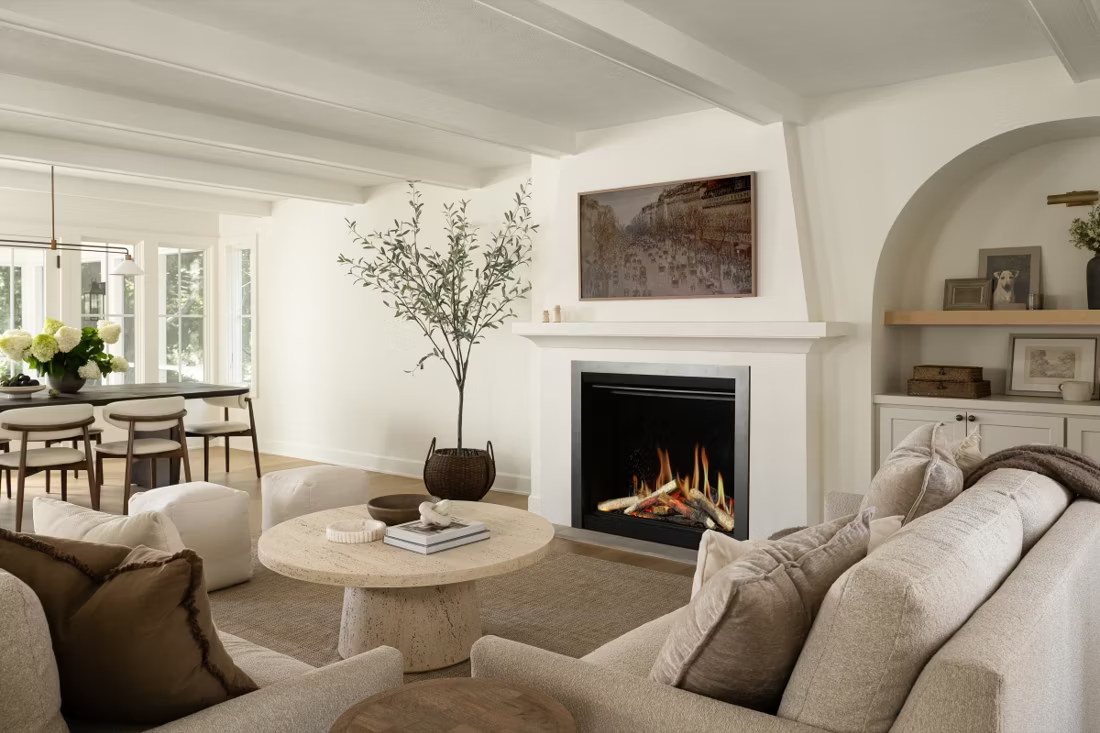
Yes—with an asterisk. Fireplaces are hot and TVs don't like heat. Either put a mantel between them to deflect rising warmth, or choose a fireplace with heat-management technology that creates a cool zone on the wall above—the wall stays around 125 degrees, barely warm, while the room still gets full heat. If you like clean lines and don't want a mantel, heat management is the answer.
Does an electric fireplace need a vent or chimney?
No—that's its superpower. An electric fireplace needs a wall and an outlet, period. No vent pipe, no gas line, no clearances to design around, which is why it works in bedrooms, offices, apartments, and walls where venting a gas or wood unit would be impractical or impossible. Installation is typically the simplest and least expensive of any fireplace type.
Can I install a fireplace myself?
If you're putting a fire in your house on purpose, it's best to work with an expert. Unless you're genuinely experienced in framing, gas line, vent pipe, and the national code on clearances to combustibles, have a professional do it—and ideally the same company that sells you the fireplace, so warranty, service, and liability all live under one roof.
Does a fireplace add value to my home?
On average, a fireplace adds back to the home about the same amount you spent installing it. Add the monthly savings from heating the rooms you actually use instead of the whole house—often hundreds of dollars a year—and the value case is strong before you even count what a fire does for how your family uses the room.
Nearby Dealers
Hearth shops serving Vail and the surrounding area. Every listing shows whether it is a WhyFire partner, a dealer we have verified as authorized for the brands we recommend, or a local business carrying hearth products. No manufacturer pays for placement. How we verify dealers →
We’ve paused dealer listings for this connection today. Enter your zip or postal code above to find dealers near you, or come back tomorrow.
Popular Electric Brands
Where each brand came from, what's inside it today, and every current model. No brand pays to be here. Not every dealer carries every brand, so enter your zip code to see what's sold near Vail.
Fireplace Xtrordinair
Fireplace Xtrordinair, now often called FireplaceX, is the fireplace brand of Travis Industries, Inc., of Mukilteo, Washington.
5 electric models →DaVinci
DaVinci Custom Fireplaces is a brand of Travis Industries, Inc., of Mukilteo, Washington, the company behind Lopi and Fireplace Xtrordinair.
5 electric models →Kozy Heat
Kozy Heat was founded in 1976 by Dudley Hussong in Lakefield, Minnesota, and incorporated as Hussong Manufacturing Co., Inc. in 1978.
3 electric models →Forge & Flame
Forge & Flame is the stove brand Hearth & Home Technologies introduced in August 2023 to bring Vermont Castings, Harman, and Quadra-Fire under one name.
1 electric model →Electric Service in Vail
An electric fireplace's heater draws about 1,500 watts—pennies per hour at local rates.
Holy Cross Electric Assn, Inc
Find your electric fireplace in Vail.
Tell us about your condo, chalet, or rental and we'll help you find the right electric fireplace or insert, plus a free Project Guide & Parts List and a trusted local Eagle County dealer who knows Vail's HOA rules and altitude quirks.
Find Your Fireplace →