
Real Warmth, Zero Smoke, for Spanish Fork Homes.
No venting, no chimney, no contribution to Utah Valley's winter inversion. Find the right electric fireplace and connect with a trusted local dealer.
Every Project Starts From One of These Five Situations
Built for inversion season, not against it.
Spanish Fork sits at nearly 4,700 feet in Utah Valley, part of the Wasatch Front's PM2.5 nonattainment area. When winter inversions settle over the valley—trapping cold, stagnant air against the Wasatch Range for days at a time—the Utah Division of Air Quality regularly calls mandatory no-burn days that restrict solid-fuel appliances. That's a big part of why wood and pellet heat have limited traction here even though pinyon, juniper, and aspen grow in the nearby Uinta-Wasatch-Cache and Manti-La Sal National Forests. Electric heat sidesteps the issue entirely: no smoke, no particulate emissions, and no risk of getting shut down on a red air day.
Most Spanish Fork homes get their power from Spanish Fork City Corporation's municipal utility, which offers a notably competitive residential rate around 10.1 cents per kWh—cheaper than the roughly 12.5 cents per kWh charged by PacifiCorp (Rocky Mountain Power) in unincorporated pockets of Utah County nearby. That rate advantage, combined with the fact that an electric fireplace needs nothing more than an outlet or a dedicated circuit, makes electric a low-friction option for the finished basements and newer subdivisions that have sprung up across Spanish Fork's growth corridor. No gas line, no masonry, no roof penetration—just a unit on the wall or in an existing firebox.
Three steps. No salesperson until you're ready.
Tell us about your project
Your zip code, your situation, and the fuel you're leaning toward—or let the answers point you to one.
See what's actually available
The brands dealers within 100 miles genuinely carry—real options, never a catalog mirage.
Get your dealer & Project Guide
A trusted local dealer, plus the free Project Guide & Parts List that names every component of the job.
Frequently Asked Questions
How much does an electric fireplace installation cost in Spanish Fork?
Plug-in units—freestanding stoves, mantel packages, or inserts that slide into an existing fireplace opening—typically run $300 to $1,200 installed, since they just need a standard outlet and no electrician work. Built-in wall units or linear fireplaces that require a dedicated 20-amp circuit, in-wall wiring, or drywall and framing work run higher, often $1,500 to $4,000 depending on the unit size and whether a licensed electrician needs to run new circuits from your panel. Local dealers can tell you which category your project falls into during a quick home walkthrough.
Can an electric fireplace heat my whole house in Spanish Fork's winters?
No—with a long, cold winter season and average winter lows around 22°F, Spanish Fork gets cold enough that most electric fireplaces (typically 1,500 watts, about 5,100 BTU) are best treated as zone heat for a single room rather than a whole-home solution. They're a strong complement to a central furnace: use the fireplace to heat the room you're actually in during the evening and turn the thermostat down elsewhere, which is where most of the real energy savings come from. For whole-home heat in a Utah Valley winter, your furnace still needs to do the heavy lifting.
Do I need a permit to install an electric fireplace in Spanish Fork?
A simple plug-in insert or freestanding electric stove generally doesn't require a permit since it uses an existing outlet. If your project involves a built-in wall unit that needs a new dedicated circuit, the electrical work typically requires a permit through the Spanish Fork City Building Department (or Utah County Building Division if you're just outside city limits). Most local dealers coordinate the electrician and permit as part of the installation, so it's rarely something you have to manage yourself.
Why don't more people in Spanish Fork use wood stoves?
Spanish Fork sits inside the Wasatch Front's PM2.5 nonattainment area, and Utah County is subject to mandatory no-burn restrictions during winter inversion episodes, which can shut down solid-fuel appliances for days or weeks at a stretch. Combined with tighter local rules on new wood-burning installs, that's pushed most Spanish Fork homeowners toward gas or electric options instead. Wood is still available for cutting through Forest Service permits in the Uinta-Wasatch-Cache and Manti-La Sal National Forests (roughly $5-$20 per cord, May through October), but as a primary heat appliance inside city limits, it's become the exception rather than the rule.
What's the difference between an electric insert, a wall-mount unit, and a mantel package?
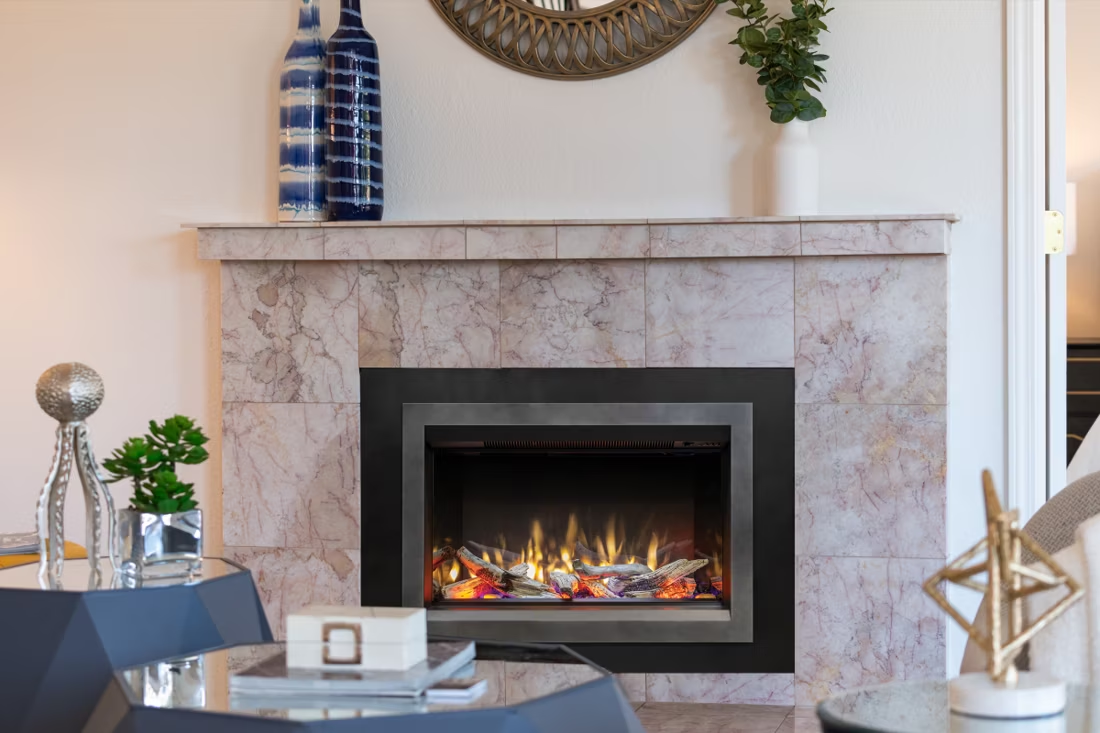
An electric insert slides into an existing masonry or factory-built firebox, giving you flame effect and heat without touching the surrounding structure—a popular choice for older Spanish Fork homes converting an unused wood-burning fireplace. A wall-mount (linear) unit is a slim, modern rectangle mounted flush or recessed into a wall, common in newer builds and finished basements. A mantel package combines an electric firebox with a surrounding cabinet or shelf, giving you a complete fireplace look without any construction. All three run on standard household current, though larger wall-mount units may call for a dedicated circuit.
What will an electric fireplace add to my power bill?
A typical 1,500-watt electric fireplace run 4 hours a day for a month uses about 180 kWh. At Spanish Fork City Corporation's residential rate of roughly $0.101/kWh, that's about $18 a month. If you're on PacifiCorp instead, at around $0.1252/kWh, the same usage runs closer to $22.50. Either way, electric heat is inexpensive to operate for zone heating, though it costs more per BTU than natural gas if you're using it as a substitute for whole-home heating rather than supplemental warmth in one room.
Will my electric fireplace work during a power outage?
No—electric fireplaces need power to run the heater and flame effect, so they'll go dark along with everything else if Spanish Fork City Corporation or PacifiCorp service is interrupted. Outages here are typically short, but if backup heat during storms is a priority for your household, that's worth factoring in when you're comparing electric against a gas unit with battery-backed ignition. Some homeowners choose gas for the living room specifically for this reason and electric for secondary spaces like a bedroom or basement.
What should I look for in an electric fireplace for a Spanish Fork home?
Look for a unit with a true 1,500-watt heater rated for the square footage of the room you're heating, adjustable thermostat control, and a flame-only mode so you can run the ambiance without the heat during shoulder-season evenings when Spanish Fork doesn't need extra warmth yet. Brands like Dimplex, Napoleon, and Touchstone offer models sized for everything from a small bedroom insert to a great-room linear unit. A local dealer can match wattage and unit size to your actual room dimensions rather than guessing from a big-box display.
Electric vs. gas—which is right for my Spanish Fork home?
Gas fireplaces put out more heat per unit and can serve as real supplemental warmth on the coldest Utah Valley nights, but they need a gas line and proper venting, which adds cost and construction. Electric units install almost anywhere—no gas line, no venting, no clearance requirements—which makes them the practical choice for condos, rentals, finished basements, or any room where running new gas piping isn't realistic. Given Spanish Fork's inversion-driven air quality restrictions, both electric and gas are considered clean options locally; the choice usually comes down to how much heat you actually need from the unit and whether the room already has gas service nearby.
Does an electric fireplace need a vent or chimney?
No—that's its superpower. An electric fireplace needs a wall and an outlet, period. No vent pipe, no gas line, no clearances to design around, which is why it works in bedrooms, offices, apartments, and walls where venting a gas or wood unit would be impractical or impossible. Installation is typically the simplest and least expensive of any fireplace type.
Do electric fireplaces actually produce heat?
Yes—most put out around 4,800–5,000 BTUs from a standard outlet, which comfortably warms a bedroom, office, or den as a comfort-zone heater. What they won't do is carry a whole house the way wood, gas, or pellet can. Think of electric as ambiance-first with honest supplemental heat: flames on with no heat in July, flames plus warmth in January.
Can a fireplace actually lower my heating bill?
Yes—by creating a comfort zone. A furnace heats every square foot of the house just to warm the one room you're in; a gas fireplace on low burns roughly a sixth of the gas a typical furnace does. Set the furnace around 55–60 degrees as a baseline, then heat the rooms your family actually uses. Families who heat this way commonly save $20–$60 a month.
What is an in-home preview and do I need one?
It's a visit where a hearth professional measures your space, confirms the model you picked actually works in your home, and walks the specs—framing, gas line, venting, finish work—before anything is ordered. Some details you just can't know until you see the house. Never make a down payment without one; it's the single most-skipped step that burns buyers.
Nearby Dealers
Hearth shops serving Spanish Fork and the surrounding area.
Electric Service in Spanish Fork
An electric fireplace's heater draws about 1,500 watts—pennies per hour at local rates.
Spanish Fork City Corporation
Find your electric fireplace in Spanish Fork.
Tell us about your room and your home, and we'll match you with a trusted local dealer and send over your free Project Guide & Parts List—the exact unit, mounting or circuit needs, and parts list for your Spanish Fork installation.
Find Your Fireplace →