
Pellet Stoves Are the Exception in Midvale, Not the Rule.
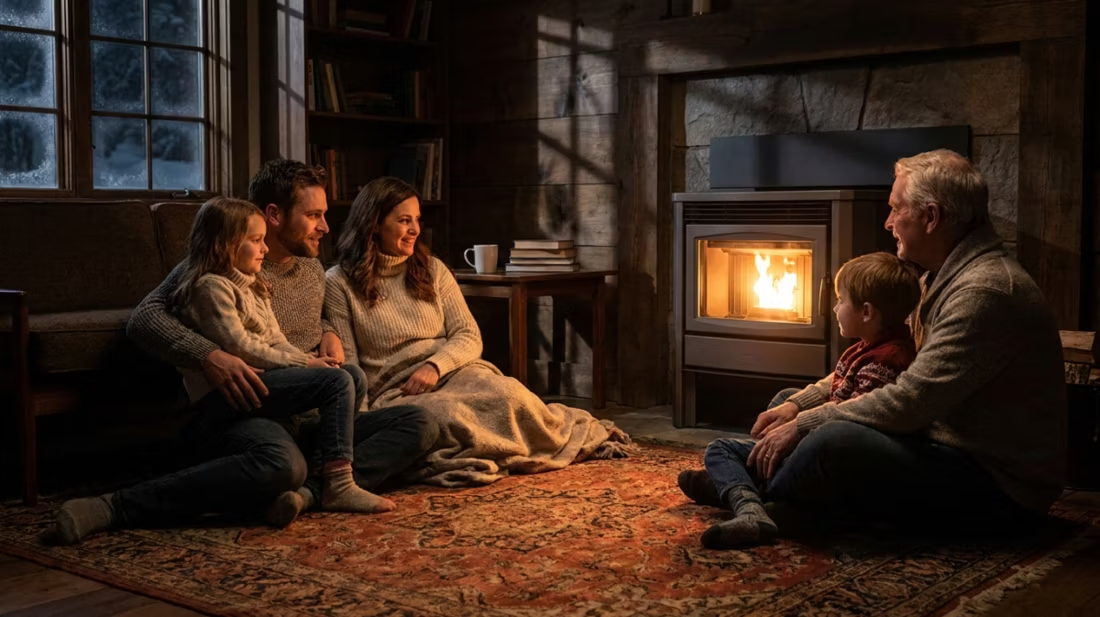
Salt Lake County's winter inversion rules and near-universal gas access make pellet stoves rare in Midvale—but if a pellet appliance is still the right fit for your home, we'll connect you with a trusted local dealer who knows the compliance details.
Every Project Starts From One of These Five Situations
Solid fuel takes a back seat to gas here.
Midvale sits at 4,389 feet in the Salt Lake Valley, a bowl-shaped basin that traps cold air and fine particulate matter against the Wasatch and Oquirrh ranges for weeks at a time most winters. Salt Lake County is a federal nonattainment area for PM2.5, and Utah's Division of Air Quality restricts new solid-fuel burning devices—a category that includes pellet stoves, not just cordwood units—in nonattainment counties. That regulatory reality, layered on top of natural gas service that reaches nearly every established Midvale neighborhood, is why pellet appliances are a rare sight here compared to mountain cabins served by the Uinta-Wasatch-Cache National Forest above the valley.
None of this is about fuel availability. Regional pellet brands like Bear Mountain, Lignetics, and Forest Energy are all produced within a day's drive along the Wasatch Front, so supply isn't the bottleneck—the barrier is regulatory and market-driven. A small number of Midvale homeowners still install pellet stoves in detached garages, shops, or basements not tied to the main gas or electric HVAC system, or as backup heat that doesn't depend on the grid the way an electric-only home does. If that's your situation, the compliance details matter more here than in most cities, and it's worth working with a dealer who understands how Salt Lake County's rules apply to your specific structure.
Three steps. No salesperson until you're ready.
Tell us about your project
Your zip code, your situation, and the fuel you're leaning toward—or let the answers point you to one.
See what's actually available
The brands dealers within 100 miles genuinely carry—real options, never a catalog mirage.
Get your dealer & Project Guide
A trusted local dealer, plus the free Project Guide & Parts List that names every component of the job.
Frequently Asked Questions
Are pellet stoves legal to install in Midvale?
It depends on the structure and whether it's new construction. Utah's Division of Air Quality classifies pellet stoves as solid-fuel burning devices under state code, which means they fall under the same new-construction restrictions and mandatory no-burn day curtailment rules that apply to wood stoves in Salt Lake County's PM2.5 nonattainment area. Retrofitting an existing home or outbuilding is generally more straightforward than installing one in new construction, but you'll want to confirm current requirements with a local dealer or Salt Lake County's air quality program before you buy—the rules are specific to this valley and don't map cleanly onto pellet-friendly states.
Why don't more homes in Midvale have pellet stoves?
Two things work against pellet stoves here. First, natural gas service reaches nearly every established neighborhood in Midvale, and gas fireplaces and inserts deliver instant, thermostat-controlled heat without the hopper-loading routine a pellet stove requires. Second, Salt Lake County's winter inversion problem has led to state air quality rules that specifically limit new solid-fuel device installations. Put those together and most Midvale homeowners land on gas or electric before ever seriously considering pellet.
What do Midvale homeowners use instead of pellet stoves?
Gas fireplaces and inserts are the default choice in Midvale, since natural gas infrastructure already serves most homes and gas units aren't subject to the same solid-fuel curtailment rules during inversion season. Electric fireplaces are also common, particularly in secondary rooms or newer builds—PacifiCorp serves the area at a residential rate around 12.5 cents per kWh, which keeps electric units cheap to run for zone heating. Both options sidestep the DAQ compliance questions that come with solid fuel entirely.
Is a pellet stove ever a good fit in Midvale?
Sometimes. A detached shop, workshop, or cabin-style outbuilding that isn't tied into the home's main gas or electric system is the most common scenario where a pellet stove still makes sense locally. Homeowners with property farther up toward the Wasatch bench or near Uinta-Wasatch-Cache National Forest land sometimes want a pellet unit specifically because it burns cleaner and more consistently than cordwood while still functioning as real backup heat. If that describes your situation, a local dealer can walk you through whether your specific structure qualifies under current county rules.
How much does a pellet stove installation cost in Midvale?
Because pellet installations are uncommon here, there isn't a well-established local price benchmark the way there is for gas fireplace installs. Nationally, a pellet stove installation with proper venting typically runs $3,000 to $6,000 depending on the unit and whether venting runs through an exterior wall or the roof. In Midvale, budget for a local installer to also verify compliance with Salt Lake County's solid-fuel device rules before finalizing a quote—that step isn't optional the way it would be in a rural mountain town.
Where can I buy pellets in Midvale?
Regional brands like Bear Mountain, Lignetics, and Forest Energy are produced within the broader Wasatch Front region and are sold at hearth specialty retailers and some hardware and farm supply stores along the valley. Because local demand is lower than in pellet-heavy markets, selection at any single Midvale-area store may be thinner, and some homeowners order pallets ahead of the season rather than buying bag by bag as needed. A local hearth dealer can point you to whoever currently stocks pellets closest to your zip code.
Pellet vs. gas insert—which makes more sense for a Midvale home?
For most Midvale homes, gas wins. A gas insert or fireplace runs off infrastructure that's already in place in most neighborhoods, requires no fuel storage or hopper loading, and isn't subject to solid-fuel curtailment during winter inversion action days. A pellet stove needs electricity to run its auger and blower, so it isn't reliable backup heat during a PacifiCorp outage the way a wood stove would be, and it's harder to install in compliance with local air rules. Pellet only pulls ahead in specific cases—a detached structure without gas service, or a strong preference for pellet's steadier, self-feeding burn over a wood stove's hands-on tending.
Does Salt Lake County's winter inversion affect pellet stove use?
Yes. During mandatory and voluntary no-burn action days called by Utah's Division of Air Quality when inversion traps PM2.5 pollution in the valley, solid-fuel burning devices—pellet stoves included—can be restricted from operating, even certified units. Gas and electric appliances aren't affected by these curtailment periods, which is a big part of why they're the default choice in Midvale rather than pellet or wood. If you already have a pellet stove or are considering one, keep an eye on county air quality alerts through the winter burn season.
What should I do if I still want a pellet stove in Midvale?
Start by confirming whether your structure—main house versus detached garage, shop, or outbuilding—is subject to Salt Lake County's new-construction solid-fuel restrictions, since the answer changes the project significantly. From there, work with a dealer who installs pellet appliances regularly enough in this market to know the current DAQ requirements firsthand, rather than a big-box retailer unfamiliar with Wasatch Front rules. We can match you with a trusted local dealer and put together a Project Guide & Parts List so you know exactly what's required before you commit to a unit.
Why is my open fireplace making my house colder?
Open fireplaces suck—literally. As the fire burns, it consumes air your furnace already paid to heat and pulls it out through the chimney, so the house is actually colder after the fire goes out than before you lit it. An insert fixes this: it seals the chimney, puts fixed glass across the front, and turns that hole in your house into a real heat source.
What's the difference between an insert and a zero-clearance fireplace?
An insert is a fireplace that slides into a pre-existing wood-burning fireplace—if you don't have one, there's nothing to insert it into. A zero-clearance fireplace is built into a framed wall, which makes it the answer for remodels and new construction. Simple test: existing masonry fireplace means insert; blank or framed wall means zero-clearance.
Can a fireplace actually lower my heating bill?
Yes—by creating a comfort zone. A furnace heats every square foot of the house just to warm the one room you're in; a gas fireplace on low burns roughly a sixth of the gas a typical furnace does. Set the furnace around 55–60 degrees as a baseline, then heat the rooms your family actually uses. Families who heat this way commonly save $20–$60 a month.
How much should I budget for a fireplace?
For an average home—covering the fireplace, the vent pipe, and basic installation—a budget between $3,900 and $5,500 gives you a lot of options across wood, gas, and pellet. By the time you add finish work, gas line, and electrical, the average complete installation lands between $5,000 and $12,000 all-in. In a remodel or new build, a good rule is to put about 2.5% of the total project cost toward the fireplace.
Nearby Dealers
Hearth shops serving Midvale and the surrounding area.
(Sugar House) Alpine Fireplaces (In Breezeway Next To Theatres)
Hearth & Home Distributors Of Utah - Salt Lake City
Pellet Brands Stocked Around Midvale
Manufacturers will point you to the nearest stocking dealer.
Find your pellet stove in Midvale.
Tell us about your home and, if a pellet stove is genuinely the right fit, we'll match you with a trusted local dealer and put together a free Project Guide & Parts List—including the vent kit and what to check against Salt Lake County's air quality rules before you buy.MediaType
Find Your Fireplace →