
Gas heat that fits Fort Mill's mild Carolina winters.
Instant, controllable warmth for York County homes—whether you're finishing a great room in Baxter Village or adding ambiance to a home near downtown. Find the right unit and connect with a trusted local dealer.
Every Project Starts From One of These Five Situations
Ambiance and zone heat, not a survival necessity.
Fort Mill sits in climate zone 3A along the Catawba River just south of Charlotte, at only 646 feet of elevation with an average winter low of 31°F and a fairly mild, modest winter heating load overall. Compare that to a place like Fargo, North Dakota, which has a winter heating load nearly three times as heavy—Fort Mill homeowners aren't fighting for survival heat, they're adding comfort. A gas fireplace here is chosen for the flip-a-switch flame on a 28-degree January morning, a warm focal point in a great room, and the kind of instant zone heat that makes sense for a handful of genuinely cold weeks each winter rather than a five-month heating season.
Natural gas service reaches many of Fort Mill's newer developments—think the corridors around Hwy 160, Gold Hill Road, Baxter Village, and Kingsley—while some older in-town lots and outlying York County subdivisions still rely on propane tanks. Electric service comes from either Duke Energy Carolinas or York Electric Cooperative depending on your address, which matters when you're comparing running costs or picking an ignition system that can operate through the occasional ice-storm outage. With no wood-smoke air quality restrictions or curtailment periods in this part of the Piedmont, gas installation and operation here is refreshingly free of the seasonal red tape that some regions deal with.
Three steps. No salesperson until you're ready.
Tell us about your project
Your zip code, your situation, and the fuel you're leaning toward—or let the answers point you to one.
See what's actually available
The brands dealers within 100 miles genuinely carry—real options, never a catalog mirage.
Get your dealer & Project Guide
A trusted local dealer, plus the free Project Guide & Parts List that names every component of the job.
Frequently Asked Questions
How much does a gas fireplace installation cost in Fort Mill?
A typical gas fireplace or insert installation in Fort Mill runs roughly $3,800 to $9,500, depending on the unit, the venting path, and whether new gas line work is required. A direct-vent insert going into an existing masonry fireplace that already has gas nearby sits toward the lower end. A new built-in gas fireplace in a remodel or an addition—with framing, venting, and a fresh gas line run from the meter—lands in the middle to upper range. Homes that need a propane tank set and line run because piped gas isn't available at the lot will typically land at the higher end. A local dealer can firm this up after an in-home visit.
Can I convert my existing wood fireplace to gas?
Yes, and it's a common request in Fort Mill's older neighborhoods where builder-standard masonry fireplaces are common. A gas log set or a sealed gas insert can go into the existing firebox, using the current chimney as the vent path with a liner. Conversions with a log set alone run less than a full insert install; a proper direct-vent insert conversion typically runs $3,800 to $8,000 depending on whether the home already has a gas line nearby or needs one extended from the street or a new propane tank. Given how few Fort Mill homes rely on wood heat for anything beyond occasional weekend fires, this is one of the more popular upgrades local dealers handle.
Do I need natural gas, or should I plan on propane?
It depends on where in Fort Mill you're located. Newer developments along the Hwy 160 and Gold Hill Road corridors, plus communities like Baxter Village and Kingsley, more often have piped natural gas already running to the home. Older in-town lots and some outlying York County parcels are more likely to run on propane, either from an existing buried tank or a new above-ground tank set by a regional propane supplier. Most gas fireplace models can be configured for either fuel with the right orifice kit—your dealer will confirm what's actually available at your address before recommending a unit.
Will my gas fireplace work if the power goes out?
Most modern gas fireplaces will, with the right ignition setup. Units with IPI (intermittent pilot ignition) run on battery backup—usually a set of AA batteries inside the unit—that kicks in the moment power drops, so the fireplace still lights on demand. Valor units go a step further: their pilot generates its own electricity through the thermocouple, so there's no battery to remember at all. This matters more than you'd think in Fort Mill, since ice storms occasionally take down lines served by Duke Energy Carolinas or York Electric Cooperative for a day or two at a time. Ask about the ignition system specifically when comparing models.
What's the difference between a gas fireplace, gas insert, and gas stove?
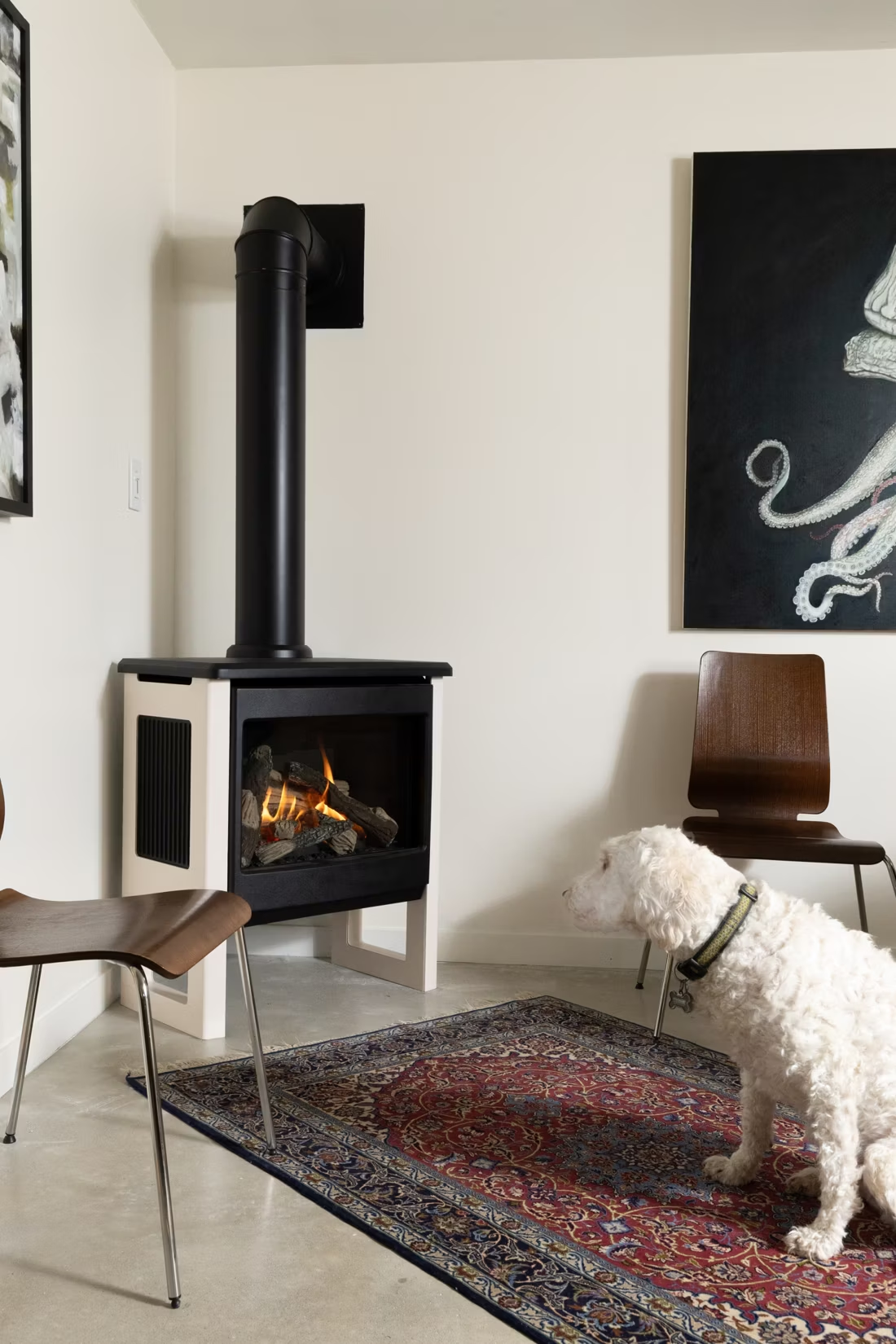
A gas fireplace is a fully built-in unit framed into a wall—common in new construction and additions around Fort Mill's newer subdivisions. A gas insert drops into an existing masonry firebox, sealing it up and venting through the existing chimney with a liner—the go-to choice for older homes near downtown Fort Mill with a builder-standard fireplace already in place. A gas stove is a freestanding cabinet-style unit that sits out in the room, useful when there's no existing fireplace and running a full built-in isn't practical. Most Fort Mill homeowners with an existing fireplace end up choosing an insert; new spaces without one usually go built-in.
Do I need a permit to install a gas fireplace in Fort Mill?
Yes—gas fireplace installations require both a building permit and a gas permit, pulled through either the Town of Fort Mill Building Services or the York County Building Codes Division depending on whether your address is inside town limits. The gas line portion has to be handled by a licensed gas-fitter, which is one of the main reasons to go through a certified hearth dealer rather than a general handyman—they coordinate the gas work, venting, and inspection sign-off as one job instead of leaving you to juggle separate trades.
What's the difference between vented and vent-free gas fireplaces?
Vented (direct-vent) gas fireplaces pull combustion air from outside and exhaust it back outside through a sealed pipe—they're the cleanest and most universally recommended option, and they're what most Fort Mill dealers install by default. Vent-free units burn directly into the room without external venting; they're legal in South Carolina but come with room-size minimums and oxygen depletion sensor requirements, and they add moisture and combustion byproducts to indoor air. In newer, tightly sealed homes around Baxter Village and Kingsley, that indoor air quality tradeoff is a real consideration—most homeowners there stick with direct-vent. Ask your dealer to walk through both if you're on the fence.
How often should my gas fireplace be serviced?
Plan on an annual inspection, ideally in early fall before the first cold snap. A technician checks the burner, pilot or ignition system, venting, and gas connections, and cleans the glass and interior—a much quicker visit than a wood chimney sweep, but just as important for safety. Local service providers typically charge $125 to $200 for this. Since Fort Mill's fireplaces mostly see occasional or seasonal use rather than daily heavy burning, annual service is usually enough to catch anything before it becomes a problem.
Gas vs. wood—which makes sense in Fort Mill?
Wood fireplaces are genuinely uncommon as a heating choice here—with a fairly mild, modest winter heating load overall and winter lows averaging 31°F, few Fort Mill homes need the BTU output or self-sufficiency wood heat provides in colder climates. Some homeowners with existing masonry fireplaces still keep them for occasional oak, pine, or hickory fires on a cold night, but as a primary or even reliable backup heat source, wood rarely pencils out here. Gas, on the other hand, gives you instant on-off operation, no ash or smoke, and consistent zone heat exactly when a cold front rolls through—which matches how most Fort Mill households actually use their fireplace. If you already have a wood-burning fireplace and are weighing whether to keep it or convert, a gas insert conversion is almost always the more practical fit for this climate.
Is my gas fireplace wasting gas?
If it was installed more than 15 years ago, probably. Older gas fireplaces keep a standing pilot light burning all the time, and that little flame can cost a couple hundred dollars a year. Newer models use pilot-on-demand ignition—the pilot lights only when you use the fireplace and goes out when you turn it off.
What's the difference between an insert and a zero-clearance fireplace?
An insert is a fireplace that slides into a pre-existing wood-burning fireplace—if you don't have one, there's nothing to insert it into. A zero-clearance fireplace is built into a framed wall, which makes it the answer for remodels and new construction. Simple test: existing masonry fireplace means insert; blank or framed wall means zero-clearance.
Can a fireplace actually lower my heating bill?
Yes—by creating a comfort zone. A furnace heats every square foot of the house just to warm the one room you're in; a gas fireplace on low burns roughly a sixth of the gas a typical furnace does. Set the furnace around 55–60 degrees as a baseline, then heat the rooms your family actually uses. Families who heat this way commonly save $20–$60 a month.
What is an in-home preview and do I need one?
It's a visit where a hearth professional measures your space, confirms the model you picked actually works in your home, and walks the specs—framing, gas line, venting, finish work—before anything is ordered. Some details you just can't know until you see the house. Never make a down payment without one; it's the single most-skipped step that burns buyers.
Nearby Dealers
Hearth shops serving Fort Mill and the surrounding area.
Find your gas fireplace in Fort Mill.
Tell us a bit about your home and we'll match you with the right gas fireplace, insert, or stove—plus a free Project Guide & Parts List and a trusted local Fort Mill dealer to install it.
Find Your Fireplace →