
Zone heat that never touches a historic chimney.
Rose Valley's early-1900s stone and shingle homes weren't built with modern HVAC zoning in mind. With winter lows averaging 27°F and a heating season typical of the Philadelphia area, an electric insert adds real supplemental warmth to a sunroom or study without opening a wall or a flue.
Every Project Starts From One of These Five Situations
The simplest upgrade for a century-old stone cottage.
At just 92 feet elevation in Delaware County, Rose Valley sits in climate zone 4A with a moderate Mid-Atlantic winter—average lows near 27°F and a heating season comparable to a typical Philadelphia-area winter, a real heating season but nowhere near the depth of a Midwest or Upper New England winter. The borough itself is tiny, barely 1,000 residents, and known for the arts-and-crafts stone and shingle homes architect William Lightfoot Price built here in the early 1900s. Many of those homes still carry original masonry fireplaces that the borough's historic character guidelines discourage altering, which is exactly the situation an electric insert solves: no new flue, no exterior venting, no change to the facade the Rose Valley Historical Commission cares about.
Wood and pellet heat don't get much traction in Rose Valley despite oak, hickory, maple, and cherry being the common trees on local lots—there's no public land cutting access this close to Philadelphia, lot sizes are small, and running a wood stove flue through a protected stone facade is a harder sell than it would be in a rural township. Natural gas through PECO is the standard choice for primary supplemental heat in larger renovations, but electric fireplaces have carved out a real niche for additions, finished basements, and rooms where residents want heat and ambiance without any gas line or masonry work at all. At PECO's residential rate of roughly $0.1474 per kWh, running a 1,500-watt unit for a few hours on a cold evening costs around 60 to 75 cents—cheap enough that most owners run it on supplemental zone heat rather than worrying about the electric bill.
Three steps. No salesperson until you're ready.
Tell us about your project
Your zip code, your situation, and the fuel you're leaning toward—or let the answers point you to one.
See what's actually available
The brands dealers within 100 miles genuinely carry—real options, never a catalog mirage.
Get your dealer & Project Guide
A trusted local dealer, plus the free Project Guide & Parts List that names every component of the job.
Frequently Asked Questions
How much does an electric fireplace installation cost in Rose Valley?
Most projects run $500 to $3,000. A plug-in insert that drops into an existing masonry firebox—common in Rose Valley's older stone homes—sits at the low end since it needs no new wiring beyond a standard outlet. A built-in linear unit for a renovation or addition, with a dedicated 20-amp circuit and custom millwork to match the home's original woodwork, lands toward the top. Because so many houses here are on the Rose Valley Historical Commission's radar for exterior changes, electric is often the least complicated option precisely because nothing visible to the street or the roofline has to change.
Will an electric fireplace actually heat a room, given our winters?
It will handle supplemental zone heating comfortably, but it's not meant to replace a home's primary system during a 27°F average winter low. A typical 1,500-watt unit covers roughly 400 to 600 square feet on its own—fine for a sunroom, den, or finished basement—but in a larger original living room in one of Rose Valley's older homes, it's best used alongside the existing heat source rather than instead of it. Local dealers typically size the unit to the specific room, not the whole house.
Do I need a permit to install an electric fireplace in Rose Valley?
A simple plug-in insert generally doesn't require a permit since it just needs an outlet. A built-in unit wired to its own dedicated circuit is electrical work and typically needs a permit through the township's building office, with inspection by a licensed electrician. If the fireplace is going into a room visible from the street in one of the borough's historically designated homes, it's worth a quick check with the Rose Valley Historical Commission before any exterior changes—though in practice, most electric installs here don't touch the exterior at all, which is part of the appeal.
What does an electric fireplace cost to run on PECO's rates?
At PECO Energy's residential rate of about $0.1474 per kWh, a 1,500-watt electric fireplace costs roughly 22 cents an hour to run on full heat. Used for 4 to 5 hours on a cold evening, that's under $1.10 a day, or somewhere around $25 to $35 a month if you're running it most evenings through the colder stretch of the season—a modest add to a Rose Valley household's winter PECO bill, especially compared to the cost of extending gas service or building new masonry.
What's the difference between an electric insert, a mantel package, and a wall-mount unit?
An electric insert fits into an existing masonry firebox, which is the most common route in Rose Valley's older stone homes since it reuses the opening that's already there. A mantel package pairs a freestanding electric unit with a surround for a room with no existing fireplace. A wall-mount or linear unit is a flatter, more modern profile often chosen for additions, sunrooms, or finished lower levels where the home doesn't have a historic mantel to work around. All three plug into standard or dedicated circuits—none need venting or a chimney.
Why doesn't wood heat show up more in a town surrounded by oak and hickory?
It's a fair question given how much oak, hickory, maple, and cherry grow on local lots, but Rose Valley is a small, densely settled borough with no nearby public land offering cutting permits, and most of its historic stone homes have fireplaces that the Historical Commission would rather see left original than retrofitted with a new flue liner or stovepipe. Between the lack of firewood supply access and the facade restrictions, wood stoves just haven't found a foothold here the way they have in more rural parts of Delaware County.
Electric vs. gas—which makes more sense for a Rose Valley home?
Gas, run through PECO's gas service where it's available on your street, is the better choice if you want a fireplace that functions as a genuine secondary heat source during a sustained cold snap—it puts out more heat and keeps running during a power outage if it has battery-backup ignition. Electric wins on installation simplicity: no gas line, no venting, and no changes to a historic exterior, which matters in a borough where several homes carry protected architectural status. A lot of Rose Valley homeowners choose electric specifically for rooms where a gas line run would mean disturbing original plaster or masonry.
How much maintenance does an electric fireplace need?
Very little. There's no chimney to sweep and no burner to service—just an occasional wipe of the glass front and, every several years, a bulb or LED module replacement depending on the model. Most units are rated for 10,000+ hours of flame-effect LED life, which at typical evening use translates to a decade or more before you'd need to think about it. It's one of the lower-maintenance options available for Rose Valley's older homes, where upkeep on original masonry and woodwork already takes enough attention.
Can I add an electric fireplace to a finished basement or addition?
Yes, and it's one of the more common requests from Rose Valley homeowners finishing a lower level or enclosing a porch, since those spaces often don't have an existing chimney to work with and a new gas line would mean trenching through an older foundation. A wall-mount or built-in electric unit on a dedicated circuit handles the space cleanly, adds real supplemental heat for the typical Philadelphia-area winter season, and doesn't require any venting path through a historic roofline.
Can I put a TV above my fireplace?
Yes—with an asterisk. Fireplaces are hot and TVs don't like heat. Either put a mantel between them to deflect rising warmth, or choose a fireplace with heat-management technology that creates a cool zone on the wall above—the wall stays around 125 degrees, barely warm, while the room still gets full heat. If you like clean lines and don't want a mantel, heat management is the answer.
Does an electric fireplace need a vent or chimney?
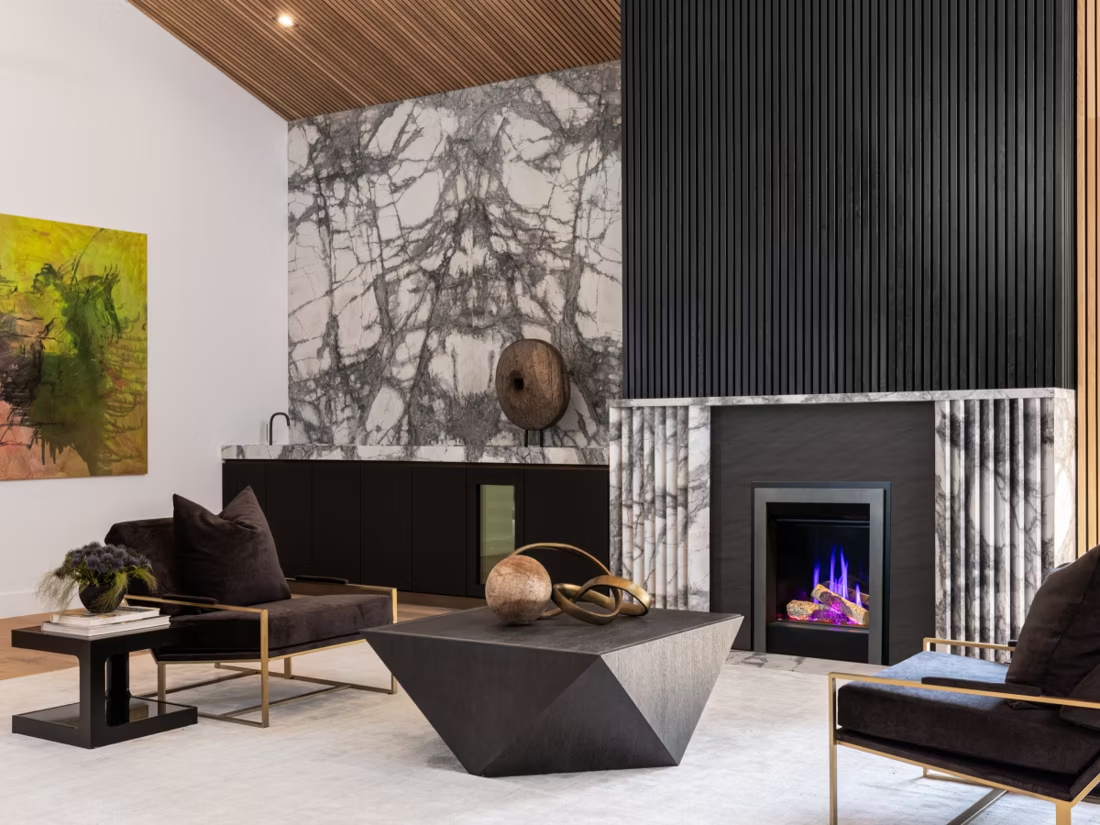
No—that's its superpower. An electric fireplace needs a wall and an outlet, period. No vent pipe, no gas line, no clearances to design around, which is why it works in bedrooms, offices, apartments, and walls where venting a gas or wood unit would be impractical or impossible. Installation is typically the simplest and least expensive of any fireplace type.
How much should I budget for a fireplace?
For an average home—covering the fireplace, the vent pipe, and basic installation—a budget between $3,900 and $5,500 gives you a lot of options across wood, gas, and pellet. By the time you add finish work, gas line, and electrical, the average complete installation lands between $5,000 and $12,000 all-in. In a remodel or new build, a good rule is to put about 2.5% of the total project cost toward the fireplace.
Does a fireplace add value to my home?
On average, a fireplace adds back to the home about the same amount you spent installing it. Add the monthly savings from heating the rooms you actually use instead of the whole house—often hundreds of dollars a year—and the value case is strong before you even count what a fire does for how your family uses the room.
Nearby Dealers
Hearth shops serving Rose Valley and the surrounding area. Every listing shows whether it is a WhyFire partner, a dealer we have verified as authorized for the brands we recommend, or a local business carrying hearth products. No manufacturer pays for placement. How we verify dealers →
We’ve paused dealer listings for this connection today. Enter your zip or postal code above to find dealers near you, or come back tomorrow.
Popular Electric Brands
Where each brand came from, what's inside it today, and every current model. No brand pays to be here. Not every dealer carries every brand, so enter your zip code to see what's sold near Rose Valley.
Fireplace Xtrordinair
Fireplace Xtrordinair, now often called FireplaceX, is the fireplace brand of Travis Industries, Inc., of Mukilteo, Washington.
5 electric models →DaVinci
DaVinci Custom Fireplaces is a brand of Travis Industries, Inc., of Mukilteo, Washington, the company behind Lopi and Fireplace Xtrordinair.
5 electric models →Kozy Heat
Kozy Heat was founded in 1976 by Dudley Hussong in Lakefield, Minnesota, and incorporated as Hussong Manufacturing Co., Inc. in 1978.
3 electric models →Forge & Flame
Forge & Flame is the stove brand Hearth & Home Technologies introduced in August 2023 to bring Vermont Castings, Harman, and Quadra-Fire under one name.
1 electric model →Electric Service in Rose Valley
An electric fireplace's heater draws about 1,500 watts—pennies per hour at local rates.
Peco Energy Co
Get your free Project Guide & Parts List for a Rose Valley electric fireplace.
Tell us about your home and which room you're heating, and we'll help you find a trusted local dealer and send a free Project Guide & Parts List with the exact unit, circuit requirements, and install notes for your Rose Valley project.
Find Your Fireplace →