
Keep Your Family Warm and Safe—No Matter What
Reliable oak and hickory heat for Pushmataha County winters—from Antlers to Clayton and every farm and cabin in between. We'll match you with a trusted local dealer who knows the terrain.
Every Project Starts From One of These Five Situations
A dependable backup for mild winters and rural distances.
Pushmataha County sits in climate zone 3A in the pine-and-hardwood hill country of southeastern Oklahoma, where winter lows average around 28°F and the heating season runs about 3,182 degree days—a fraction of what a place like Bismarck ND or Duluth MN sees, but still enough cold nights to matter. This isn't extreme-cold wood-heat country, but it's real wood-heat country: oak and hickory are abundant on the ridges and bottomland around the Kiamichi River, and mesquite shows up in the drier southern stretches of the county.
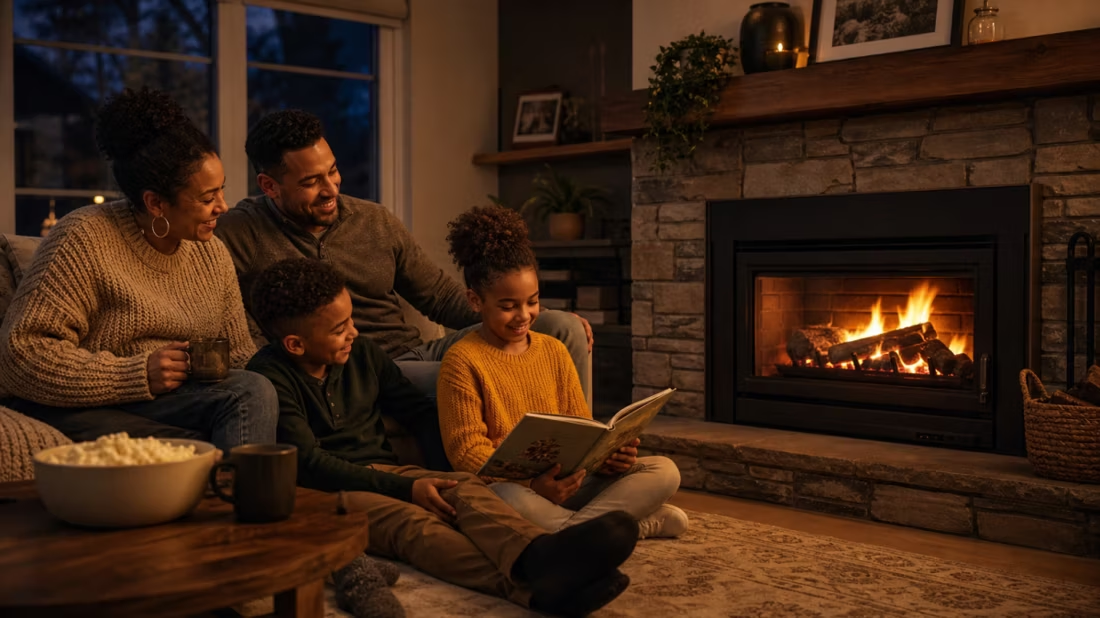
With no air quality restrictions on wood burning here—no non-attainment status, no winter curtailment periods to track—a wood stove in Pushmataha County is a straightforward proposition. For the county's spread-out rural households, many with long driveways and utility lines that can go down in an ice storm, a wood stove or insert is less about daily necessity and more about a dependable backup: heat that works whether or not the power does, running on wood that's often already on the property.
Three steps. No salesperson until you're ready.
Tell us about your project
Your zip code, your situation, and the fuel you're leaning toward—or let the answers point you to one.
See what's actually available
The brands dealers within 100 miles genuinely carry—real options, never a catalog mirage.
Get your dealer & Project Guide
A trusted local dealer, plus the free Project Guide & Parts List that names every component of the job.
Frequently Asked Questions
How much does a wood stove installation cost in Pushmataha County?
A typical wood stove or insert installation in Pushmataha County runs in the $4,500 to $9,000 range, similar to national norms, depending on the unit, whether you need new chimney work, and hearth pad requirements. Homes converting an existing open masonry fireplace to an insert tend to land on the lower end since the chimney is already in place. New freestanding stove installations in homes without an existing chimney—common on rural properties outside Antlers or Clayton—run higher once Class A pipe and roof penetration are factored in. Because the county is rural and spread out, expect a modest travel charge if your installer is coming from Hugo or a neighboring county.
What size wood stove do I need for my home?
With Pushmataha County's relatively mild 28°F average winter low and 3A climate zone, most homes don't need the largest catalytic stoves built for sub-zero nights. A small to medium stove (rated for 1,000 to 2,000 square feet) is usually enough for a well-insulated home, and many rural households size for supplemental heat rather than whole-house primary heat, since the coldest stretches are shorter and less severe than in the northern tier states. Older farmhouses with less insulation, common throughout the county's older housing stock, may need to size up a bit. A local dealer can size your space accurately with an in-home visit—it's worth doing rather than guessing off a box label.
Where can I find certified wood stove installers near Pushmataha County?
Look for installers carrying NFI (National Fireplace Institute) or CSIA (Chimney Safety Institute of America) certification. Given Pushmataha County's small population and rural footprint, most homeowners will work with a dealer based in a larger nearby town who services the county as part of their coverage area—expect to schedule a bit further out and possibly pay a small travel fee for installs around Clayton, Moyers, or the more remote parts of the county. Avoid a general handyman install for a wood-burning unit; improper clearances and venting are the leading cause of chimney fires, and a certified installer also keeps your warranty intact.
What's the difference between a wood stove and a wood insert?
A wood stove is a freestanding unit on a hearth pad, vented through a chimney, and can go almost anywhere with the right clearances. A wood insert slides into an existing masonry fireplace opening and turns a drafty open hearth into a sealed, efficient heat source using the chimney you already have. Many older homes in Pushmataha County—especially farmhouses built with a traditional masonry fireplace—are good insert candidates, since it reuses existing infrastructure. Homes without an existing fireplace, including newer rural builds, are better suited to a freestanding stove.
Do I need a permit to install a wood stove in Pushmataha County?
Building permit requirements for wood-burning appliances in unincorporated Pushmataha County are limited compared to more heavily regulated states, but incorporated towns like Antlers may have their own building permit process, so it's worth checking with the local building authority before installing. There are no air quality curtailment periods or non-attainment restrictions here, unlike in parts of the West—Pushmataha County has no listed air quality concerns, so burning wood on a normal winter evening isn't something you need to plan around. A reputable local installer will confirm whatever paperwork applies to your specific property and town.
What's the best wood stove for Pushmataha County's climate?
Since winters here are moderate compared to the northern Plains or Rockies, you don't need the biggest 20-hour-burn catalytic stove on the market. A mid-size non-catalytic stove from a brand like Pacific Energy or Lopi is a solid fit for most homes, burning local oak and hickory efficiently without needing to run oversized for occasional cold snaps. If your household plans to rely on wood as a genuine backup heat source during ice storms—a real consideration given how quickly rural power lines can go down here—ask your dealer about models with simple mechanical thermostats or air controls that don't depend on electronics.
How often should my chimney be inspected and cleaned?
The CSIA recommends an annual inspection for any wood-burning appliance, and that holds even in a milder climate like Pushmataha County's. Since usage here often skews toward supplemental or backup heat rather than daily all-winter burning, an annual sweep before the season starts (late summer or early fall) is typically sufficient—heavy users burning several cords a winter should watch for creosote buildup and consider a mid-season check. Given the rural nature of the county, plan ahead so you're not scrambling to book a sweep once the first cold front rolls through.
Where can I get firewood in Pushmataha County?
Firewood is genuinely abundant here—oak, hickory, and mesquite all grow locally, and many rural properties in the county already have standing timber or downed wood available for cutting. Local firewood sellers and farm operations in and around Antlers and Clayton often sell by the cord, with prices generally running below national averages given how much wood is locally available. For homeowners without their own land to cut from, checking with neighbors or local classifieds is often more productive than searching for a formal commercial supplier, since this is a low-population, high-timber county.
Wood stove vs. pellet stove—which is right for me?
Wood stoves burn cordwood, need no electricity to operate, and are a natural fit in Pushmataha County given how much oak and hickory is locally available—that also makes wood the stronger choice for genuine backup heat during an ice storm outage. Pellet stoves burn compressed pellets from brands like Lignetics, offer easier day-to-day operation and less ash, but require electricity to run the auger and blower, so they go dark in a power outage. Pellet availability in a rural county like this is also worth checking ahead of time, since it's not a market with many local pellet retailers. For most Pushmataha County households, especially those focused on outage-proof heat, wood is the more practical everyday fit.
Why is my open fireplace making my house colder?
Open fireplaces suck—literally. As the fire burns, it consumes air your furnace already paid to heat and pulls it out through the chimney, so the house is actually colder after the fire goes out than before you lit it. An insert fixes this: it seals the chimney, puts fixed glass across the front, and turns that hole in your house into a real heat source.
Why won't my new wood stove get going like my old one?
New wood stoves are 70%+ efficient, so far less heat goes up the flue—which also means less draft to get a fire established. The rule: build a genuinely hot fire for about 45 minutes before you choke it down. Skip that and you get smoke in the room, creosote in the chimney, and a fire that never takes off. Most performance complaints trace straight back to this.
How much should I budget for a fireplace?
For an average home—covering the fireplace, the vent pipe, and basic installation—a budget between $3,900 and $5,500 gives you a lot of options across wood, gas, and pellet. By the time you add finish work, gas line, and electrical, the average complete installation lands between $5,000 and $12,000 all-in. In a remodel or new build, a good rule is to put about 2.5% of the total project cost toward the fireplace.
Can a fireplace actually lower my heating bill?
Yes—by creating a comfort zone. A furnace heats every square foot of the house just to warm the one room you're in; a gas fireplace on low burns roughly a sixth of the gas a typical furnace does. Set the furnace around 55–60 degrees as a baseline, then heat the rooms your family actually uses. Families who heat this way commonly save $20–$60 a month.
Find your wood stove in Pushmataha County.
Tell us a bit about your home and we'll match you with a trusted local dealer and a free Project Guide & Parts List—the exact parts, vent kit included, for your wood heating project in Pushmataha County.
Find Your Fireplace →