
Instant heat and real flame look—no chimney required in Guernsey County.
From Cambridge's Victorian-era downtown to farmhouses out along the National Road, electric fireplaces bring zone heat and fireplace ambiance to homes with no gas line and no flue. Find the right unit and connect with a trusted local dealer.
Every Project Starts From One of These Five Situations
Simple, safe heat for Cambridge's historic homes and outlying townships.
Guernsey County sits in the Appalachian foothills of eastern Ohio, where the National Road (US 40) and I-70 cross paths in Cambridge, the county seat and former home of the Cambridge Glass Company. Winters here average a low around 21°F with roughly 5,324 heating degree days—a climate similar to Madison, Wisconsin, though the hills and hollows around Senecaville and Salt Fork State Park can run a few degrees colder on clear nights. Cambridge's downtown is lined with brick Victorian-era storefronts and homes, many without an existing chimney or the structural allowance for one, while the surrounding townships mix newer ranch-style construction with older farmhouses on acreage.
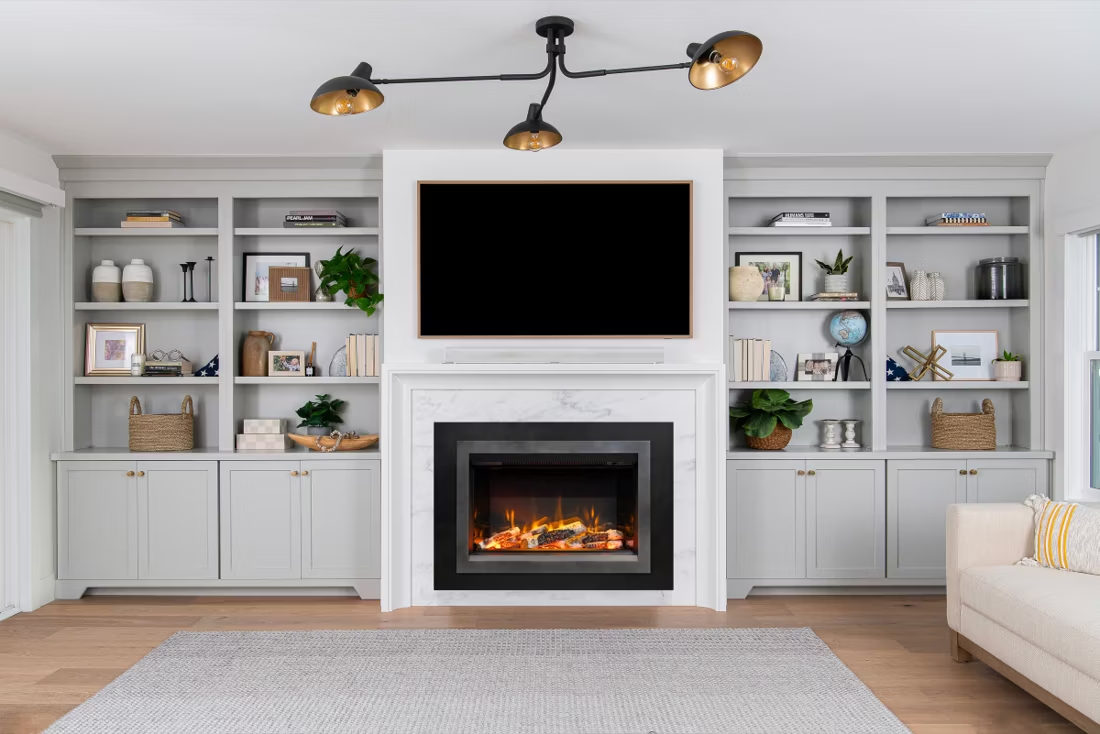
That mix is exactly where electric fireplaces earn their place. A plug-in or hardwired unit needs no gas line, no masonry flue, and no venting through a wall or roof—which matters in a county where AEP Ohio serves in-town customers and rural electric cooperative territory picks up much of the unincorporated county outside Cambridge and Byesville. Homeowners here are surrounded by hardwood country—oak, hickory, maple, and cherry all grow locally and still get cut for firewood—but not every household wants the splitting, stacking, and chimney upkeep that comes with it. An electric insert or built-in linear unit gives a finished basement, a rental property, or a historic storefront apartment real flame appearance and supplemental zone heat without touching the structure.
Three steps. No salesperson until you're ready.
Tell us about your project
Your zip code, your situation, and the fuel you're leaning toward—or let the answers point you to one.
See what's actually available
The brands dealers within 100 miles genuinely carry—real options, never a catalog mirage.
Get your dealer & Project Guide
A trusted local dealer, plus the free Project Guide & Parts List that names every component of the job.
Frequently Asked Questions
How much does it cost to install an electric fireplace in Guernsey County?
Electric fireplaces are the least expensive hearth option to install because there's no venting, no gas line, and often no permit involved. A plug-in insert or wall-mount unit that runs on a standard 120V outlet can be installed by the homeowner or a handyman in an afternoon, generally landing well under $1,000 including the unit. Larger built-in linear fireplaces or units drawing on a dedicated 240V circuit typically need a licensed electrician to run new wiring, which adds labor cost on top of the unit price—plan for a few hundred dollars in electrical work if your Cambridge bungalow or township farmhouse doesn't already have a circuit sized for it. A local dealer can walk your specific room and give you a firm number.
What size electric fireplace do I need for my home?
Sizing an electric fireplace is mostly about the room, not the whole house, since electric units are designed as supplemental zone heat rather than a primary furnace replacement. A compact wall-mount or freestanding unit works well for a bedroom or den in one of Cambridge's older two-story homes with plaster walls and single-pane storm windows, where a little extra warmth in one room goes a long way on a 21°F night. A wider linear built-in, sized to a mantel or media wall, suits a larger open-concept living area common in newer construction out in the townships around Byesville or Old Washington. Most electric units list a square-footage heating capacity on the spec sheet—a local dealer can match that to your room's insulation and ceiling height.
Do I need a permit for an electric fireplace in Guernsey County?
Usually not. A plug-in electric fireplace that uses an existing wall outlet typically doesn't trigger a building or electrical permit anywhere in Guernsey County, whether you're inside Cambridge city limits or out in the unincorporated townships. If you're adding a built-in unit that requires a new dedicated circuit, that electrical work generally does need a permit and should be pulled by a licensed electrician—the same rule that applies to adding any new circuit in a home. Because there's no chimney, gas line, or clearance-to-combustible venting involved, electric is the fastest path to a working fireplace with the least code entanglement of any fuel option in the county.
What's the difference between an electric fireplace, insert, and stove?
An electric fireplace is typically a built-in or wall-mounted unit meant to sit inside a mantel surround or media wall—common in newer construction and remodels around Cambridge. An electric insert is sized to slide into an existing masonry fireplace opening, which is a popular option for the historic homes lining downtown Cambridge that have a fireplace opening but no working flue or one that's been capped. An electric stove is a freestanding cabinet-style unit that mimics a wood stove's look and can sit against nearly any wall since it needs no clearance for venting. All three run on standard household power and produce the same electric-resistance or infrared heat—the choice comes down to which best fits your existing opening or room layout.
Will my electric fireplace still work during a power outage?
No—and this is the one honest tradeoff worth knowing before you buy. Electric fireplaces run entirely on household power, so when the power goes out, the flame effect and the heat both stop. That's a real consideration in Guernsey County's hillier, more rural townships served by cooperative electric lines, where ice and wind can knock out power for a stretch during a winter storm. If backup heat during outages matters to you, a wood stove or an insert with a battery-backup ignition system is a better primary choice, with an electric unit added elsewhere in the house purely for supplemental comfort and ambiance on ordinary nights.
What's the best electric fireplace for a Guernsey County home?
For a single room or den, a mid-size infrared or linear electric insert in the 1,500-watt range covers most bedrooms and home offices in the smaller homes common around Byesville and Old Washington. For an open living area in a newer township build, a wider linear built-in with a higher heater capacity and multi-speed flame settings gives you more even coverage across a larger footprint. Brands like Dimplex and Amantii are widely stocked by hearth dealers and offer models sized for everything from a studio apartment above a Cambridge storefront to a great room addition on a rural property. A local dealer can match wattage and unit width to your specific room.
How much maintenance does an electric fireplace need?
Very little, which is a big part of the appeal. There's no chimney to sweep, no gas line to inspect, and no ash or creosote to deal with. Maintenance is limited to occasionally dusting the interior, wiping the glass front, and replacing the LED flame bulbs if the unit uses them—most modern units use long-life LEDs that last years before needing attention. Compare that to the annual chimney sweep recommended for wood-burning appliances or the yearly gas-line inspection for a gas fireplace, and electric is the lowest-upkeep option available to Guernsey County homeowners by a wide margin.
How much does it cost to run an electric fireplace day to day?
Running cost depends on the heater setting and your electric rate through AEP Ohio or your local rural electric cooperative, but as a rough guide, a 1,500-watt heater running on high costs somewhere around 15-25 cents an hour at typical Ohio residential rates—noticeably less than heating an entire drafty room with a whole-house furnace running longer cycles. Most homeowners use the fireplace's flame effect without the heater turned on for a lot of the year, which costs only a few cents an hour, and switch the heater on as zone heat for the room they're actually using on the coldest nights. That flexibility is part of why electric works well as a supplement to central heat rather than a full replacement.
Electric vs. wood or gas—which is right for my Guernsey County home?
Wood, split from the oak, hickory, maple, and cherry that grow throughout the county, gives you the highest heat output and keeps working when the power's out—a real advantage in the more rural townships during a winter ice storm. Gas gives instant, consistent heat and works well where a natural gas line already reaches the house, though many outlying Guernsey County properties rely on propane instead. Electric gives you the lowest installation cost, the least maintenance, and no permitting hassle, but it won't function without power and it won't match wood's raw heat output on the coldest nights. For a lot of homes here, electric ends up as the practical answer for a bedroom, basement, or historic storefront apartment where running a chimney or gas line simply isn't realistic—with wood or gas handling the primary living space.
Can I put a TV above my fireplace?
Yes—with an asterisk. Fireplaces are hot and TVs don't like heat. Either put a mantel between them to deflect rising warmth, or choose a fireplace with heat-management technology that creates a cool zone on the wall above—the wall stays around 125 degrees, barely warm, while the room still gets full heat. If you like clean lines and don't want a mantel, heat management is the answer.
Do electric fireplaces actually produce heat?
Yes—most put out around 4,800–5,000 BTUs from a standard outlet, which comfortably warms a bedroom, office, or den as a comfort-zone heater. What they won't do is carry a whole house the way wood, gas, or pellet can. Think of electric as ambiance-first with honest supplemental heat: flames on with no heat in July, flames plus warmth in January.
Can a fireplace actually lower my heating bill?
Yes—by creating a comfort zone. A furnace heats every square foot of the house just to warm the one room you're in; a gas fireplace on low burns roughly a sixth of the gas a typical furnace does. Set the furnace around 55–60 degrees as a baseline, then heat the rooms your family actually uses. Families who heat this way commonly save $20–$60 a month.
How much should I budget for a fireplace?
For an average home—covering the fireplace, the vent pipe, and basic installation—a budget between $3,900 and $5,500 gives you a lot of options across wood, gas, and pellet. By the time you add finish work, gas line, and electrical, the average complete installation lands between $5,000 and $12,000 all-in. In a remodel or new build, a good rule is to put about 2.5% of the total project cost toward the fireplace.
Find your electric fireplace in Guernsey County.
Tell us a bit about your home and we'll put together a free Project Guide & Parts List—the right electric fireplace or insert for your space, plus a trusted local Guernsey County dealer to install it.
Find Your Fireplace →