
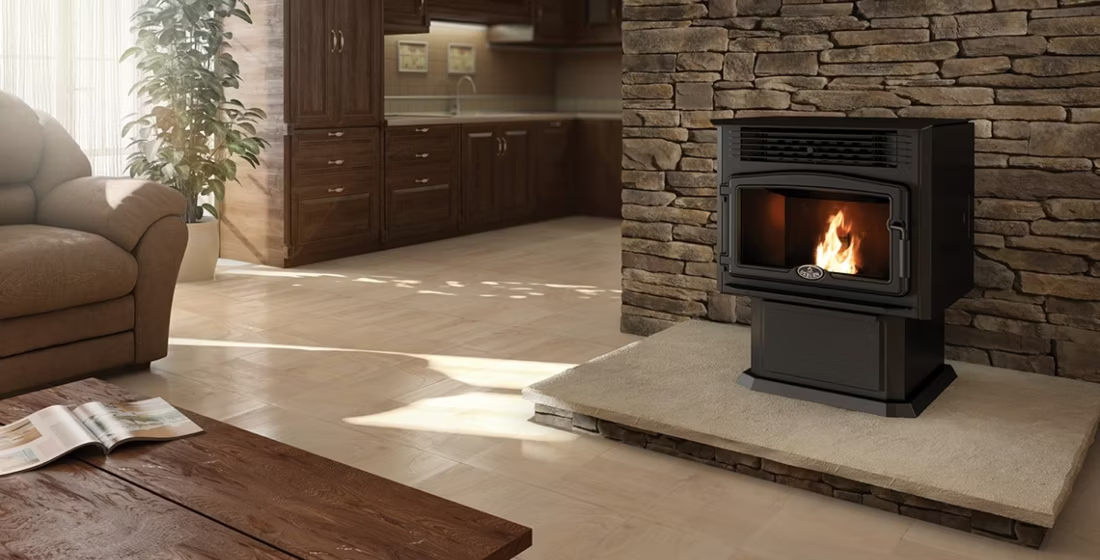
Find the Right Pellet Stove for Your Green Home.
Pellet heat is a niche choice in a Summit County suburb built on natural gas—but for the right home, it's a smart supplemental or backup option. We'll match you with a local dealer who can tell you honestly if it fits.
Every Project Starts From One of These Five Situations
A specialty choice in natural-gas territory.
Green sits in Summit County just south of Akron, in climate zone 5A with a winter heating season comparable to places like Cleveland and average winter lows around 20°F—cold enough to need serious heat, but not the kind of extreme, off-grid climate that drives most households toward solid-fuel appliances. Most homes here were built in the last several decades with forced-air natural gas furnaces and no masonry chimney, which is the main reason both wood and pellet stoves are uncommon locally—there's often no existing flue to work with, and a full Class A chimney or pellet-vent retrofit adds real cost to a project most homeowners weren't planning around.
That said, pellet stoves do show up in Green—usually in homes without a gas hookup, in finished basements or additions where running a gas line isn't practical, or as backup heat for households wanting warmth that doesn't depend entirely on the electric grid for their furnace's blower motor. Pellets sourced from regional producers like Lignetics and Somerset Pellet Fuel are readily available in the Akron-Canton area, so fuel supply isn't the limiting factor—fit for your specific house is. I'd rather tell you upfront that pellet may be the minority option here than pretend otherwise.
Three steps. No salesperson until you're ready.
Tell us about your project
Your zip code, your situation, and the fuel you're leaning toward—or let the answers point you to one.
See what's actually available
The brands dealers within 100 miles genuinely carry—real options, never a catalog mirage.
Get your dealer & Project Guide
A trusted local dealer, plus the free Project Guide & Parts List that names every component of the job.
Frequently Asked Questions
How much does a pellet stove installation cost in Green?
Because pellet stoves are a less common install in Green than gas or electric options, exact local pricing varies more by dealer than in markets where they're the default choice. Nationally, a typical pellet stove install—including the appliance, PL venting through an exterior wall, and a hearth pad—runs in the $3,000 to $6,000 range. Costs rise if the dealer needs to run new electrical for the unit's auger and blower, or if you're converting an existing masonry fireplace with a pellet insert, which adds liner and venting work. A local dealer can give you a firm number after seeing your specific layout.
Does a pellet stove even make sense in Green, given how common natural gas is here?
For most Green homes already on natural gas, a gas fireplace or insert is going to be the simpler, lower-maintenance choice—no hopper to fill, no ash to empty, no electricity dependency. Pellet makes more sense in specific situations: homes without gas service in parts of unincorporated Summit County, additions or basements where extending a gas line is impractical, or households who want a heat source that can run on stored fuel if gas prices spike or supply is interrupted. If none of those apply to your situation, it's worth being honest with yourself that gas will likely serve you better here.
Where can I buy wood pellets near Green?
Pellets from regional producers including Lignetics and Somerset Pellet Fuel are stocked at hardware stores and farm supply retailers throughout the Akron-Canton corridor, typically sold in 40-pound bags. Prices for hardwood and softwood blends generally run in the same range as the rest of the Midwest—expect to budget for several dozen bags per heating season if you're using a pellet stove as a primary or heavy supplemental heat source. Buying a season's supply in late summer, before demand picks up, usually gets you the best price.
Will my pellet stove work during a power outage?
No—this is the most important thing to understand before choosing pellet over wood. Pellet stoves rely on an electric auger to feed fuel and a blower to distribute heat, so they shut down without power. If Ohio Edison service goes out during an ice storm, so does your pellet stove, unless you have a battery backup or generator sized to run it. Some homeowners in Green pair a pellet stove with a small generator for exactly this reason. If uninterrupted heat during outages is your top priority, a wood-burning appliance or a battery-backed gas fireplace is a better fit.
What size pellet stove do I need for my Green home?
Pellet stove output is rated in BTUs, and sizing depends on square footage, ceiling height, and insulation quality. As a rough guide for Green's climate: a small unit (rated around 40,000–50,000 BTU) handles a single large room or finished basement, while a larger unit (up to 60,000+ BTU) can supplement heat for a full main floor. Because pellet installs are less routine here than in heavier pellet markets, it's worth having a local dealer walk your specific space rather than guessing from a chart—oversizing leads to a stove that short-cycles and underperforms on efficiency.
Why isn't wood burning more common in Green if pellet isn't either?
Green's housing stock is the main factor. Most homes here were built with forced-air natural gas systems and no masonry fireplace or chimney, so both wood stoves and pellet stoves require adding venting from scratch—there isn't an existing flue to retrofit into, unlike older homes in cities with a lot of pre-1960s construction. Local hardwoods like oak, hickory, maple, and cherry are certainly available from area tree services and firewood sellers, but without an existing chimney, the upfront cost of a full wood-burning setup tends to push homeowners toward gas or, in select cases, pellet with simpler through-wall venting instead.
How is a pellet stove vented, and does it need a chimney?
Unlike wood stoves, pellet stoves don't require a traditional masonry chimney. They vent through a smaller-diameter PL (pellet vent) pipe that can run horizontally through an exterior wall, which is one reason they're sometimes chosen over wood stoves in Green homes that lack an existing flue. This makes the installation less invasive than adding a full Class A wood-stove chimney, though it still requires proper clearances and a permit through the local building department. A local dealer will handle the permitting and sizing as part of the install.
How much maintenance does a pellet stove need?
Pellet stoves need more routine attention than a gas fireplace but less than a wood stove: the ash pan should be emptied every few days during regular use, the burn pot cleaned weekly to prevent clinker buildup, and the glass wiped down as needed. A full professional cleaning and inspection—checking the auger motor, exhaust blower, and gaskets—is recommended annually, ideally before the start of heating season. Because electric components are involved, a technician familiar with pellet appliances specifically (not just wood stoves) is the right person for that annual service.
Pellet vs. gas—which makes more sense for my Green home?
Gas wins on convenience for most Green households: instant on-off, no fuel storage, no ash, and it keeps working with a battery-backup ignition system during short outages. Pellet wins in narrower situations—homes without a gas hookup, a desire to reduce dependence on utility gas pricing, or wanting a visible flame with real combustion (not just a log-set look) without the labor of cutting and hauling cordwood. Given that natural gas service through the local utility network covers most of Green, gas is the default recommendation for primary heat, with pellet reserved for supplemental or specific-use cases. A local dealer can walk through your specific situation and tell you honestly which fits.
Why is my open fireplace making my house colder?
Open fireplaces suck—literally. As the fire burns, it consumes air your furnace already paid to heat and pulls it out through the chimney, so the house is actually colder after the fire goes out than before you lit it. An insert fixes this: it seals the chimney, puts fixed glass across the front, and turns that hole in your house into a real heat source.
What's the difference between an insert and a zero-clearance fireplace?
An insert is a fireplace that slides into a pre-existing wood-burning fireplace—if you don't have one, there's nothing to insert it into. A zero-clearance fireplace is built into a framed wall, which makes it the answer for remodels and new construction. Simple test: existing masonry fireplace means insert; blank or framed wall means zero-clearance.
What is an in-home preview and do I need one?
It's a visit where a hearth professional measures your space, confirms the model you picked actually works in your home, and walks the specs—framing, gas line, venting, finish work—before anything is ordered. Some details you just can't know until you see the house. Never make a down payment without one; it's the single most-skipped step that burns buyers.
Does a fireplace add value to my home?
On average, a fireplace adds back to the home about the same amount you spent installing it. Add the monthly savings from heating the rooms you actually use instead of the whole house—often hundreds of dollars a year—and the value case is strong before you even count what a fire does for how your family uses the room.
Nearby Dealers
Hearth shops serving Green and the surrounding area.
Pellet Brands Stocked Around Green
Manufacturers will point you to the nearest stocking dealer.
Find your pellet stove in Green.
Tell us about your home and whether pellet is even the right fit—we'll connect you with a trusted local dealer and send a free Project Guide & Parts List with the exact venting and parts your Green installation needs.
Find Your Fireplace →