
Real flame look, no chimney required, for Delaware County homes.
From new-build subdivisions in Powell and Lewis Center to finished basements in Sunbury and Galena, electric units give Delaware County homeowners real ambiance without venting, gas lines, or masonry work. Find the right unit and connect with a trusted local dealer.
Every Project Starts From One of These Five Situations
Built for new construction and finished spaces.
Delaware County has grown fast on the strength of the Columbus market, and most of that growth shows up as new subdivisions in Berlin, Liberty, and Orange Townships—Powell, Lewis Center, Sunbury—where HOA rules and modern building codes rarely leave room for a masonry chimney. At 5A climate zone with a solid winter heating season and average winter lows around 21°F, the county gets genuinely cold, but nowhere near the extremes of a Madison, WI winter. That combination—real but moderate cold, plus a housing stock dominated by newer construction—is exactly where electric fireplaces do their best work: zone heat and fireplace ambiance in a room without touching the chimney, the gas line, or the exterior wall.
Electricity in Delaware County comes through a patchwork of providers—AEP Ohio serves most of the unincorporated townships, the City of Delaware runs its own municipal electric utility for in-city addresses, and Consolidated Cooperative reaches some of the more rural pockets toward Ashley and Radnor. That reliability matters less for an electric fireplace than it would for whole-home electric heat, since these units are typically installed as supplemental heat or pure ambiance—plug-in freestanding models start well under $1,000, while a wall-recessed built-in with a custom surround and a dedicated 20-amp circuit runs $1,500 to $4,500 installed. Either way, there's no venting to size and no combustion byproduct to manage, which is a real simplification compared to the wood or gas options also common across the county.
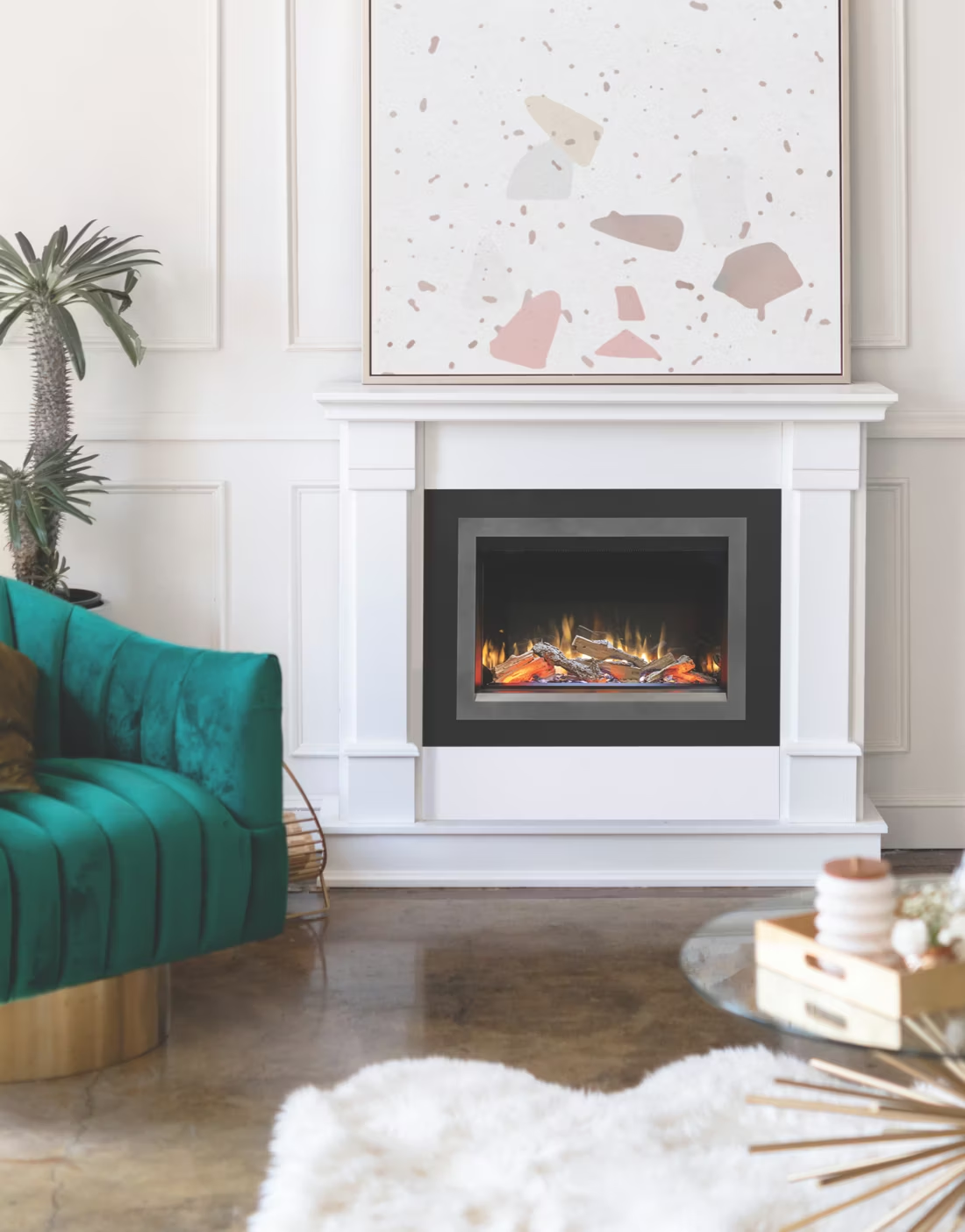
Three steps. No salesperson until you're ready.
Tell us about your project
Your zip code, your situation, and the fuel you're leaning toward—or let the answers point you to one.
See what's actually available
The brands dealers within 100 miles genuinely carry—real options, never a catalog mirage.
Get your dealer & Project Guide
A trusted local dealer, plus the free Project Guide & Parts List that names every component of the job.
Frequently Asked Questions
How much does an electric fireplace installation cost in Delaware County?
A basic plug-in electric fireplace or insert runs $300 to $1,200 and typically needs nothing more than an existing outlet—many homeowners in Powell and Lewis Center subdivisions install these into an existing wall opening or media cabinet themselves. A built-in, wall-recessed unit with a custom surround and a dedicated electrical circuit is the bigger project, running $1,500 to $4,500 once an electrician is involved. Costs run toward the higher end for linear or multi-sided units popular in newer Orange Township and Berlin Township great rooms, since those often require framing work alongside the electrical run.
Do I need a permit for an electric fireplace in Delaware County?
Most plug-in electric fireplaces don't require any permit since there's no venting, gas line, or structural change involved. If you're installing a built-in unit that requires a new dedicated circuit, an electrical permit is typically required—through the City of Delaware Division of Building Regulations for in-city addresses, or the Delaware County Building Department for unincorporated townships like Berlin, Genoa, or Liberty. Your electrician or installer generally pulls this permit as part of the job, so it rarely falls on the homeowner to coordinate.
What's the difference between a built-in and a plug-in electric fireplace?
A plug-in (freestanding or insert-style) electric fireplace runs off a standard 120-volt outlet and can be relocated or removed without any electrical work—a good fit for renters, condos near downtown Delaware, or anyone testing the format before committing. A built-in electric fireplace is recessed into a wall or custom surround, often wired to a dedicated circuit for the heater element, and is treated as a permanent fixture. For the newer great-room and basement layouts common in Sunbury and Lewis Center construction, built-ins are the more popular choice because they read as a genuine architectural feature rather than an appliance.
Will an electric fireplace actually heat my house?
Not on its own, and it's worth being honest about that upfront. Most electric fireplace heaters put out around 4,000 to 5,000 BTU (roughly 1,500 watts), which comfortably supplements a single room of 400 to 500 square feet but won't carry a whole home through a Delaware County winter—even with the county's moderate winter heating season and average lows around 21°F. Think of an electric unit as zone heat for the room you're actually sitting in, paired with your existing furnace, rather than a primary heat source. Homeowners looking for genuine whole-room heat output in a fireplace format typically look at the gas options also common throughout the county.
What does it cost to run an electric fireplace in Delaware County?
At Ohio's typical residential rate of roughly $0.12 to $0.14 per kWh, a 1,500-watt electric fireplace heater costs about $0.18 to $0.20 per hour to run on full heat, or a fraction of that with the flame effect alone and the heater switched off. AEP Ohio customers and City of Delaware municipal electric customers see slightly different rate structures, but the difference on a fireplace's modest draw is negligible—this is a low-cost appliance to operate compared to running a furnace harder to heat the same room.
Are electric fireplaces a good fit for finished basements?
Yes, and it's one of the most common installs we see requested in Delaware County's newer subdivisions—Powell, Lewis Center, and Sunbury in particular, where basement finishing is a popular next project after move-in. Electric units are the natural choice below grade: no chimney or vent penetration through the framing above, no combustion air concerns in a below-grade space, and simple wiring to a nearby circuit. A built-in linear unit set into a media wall is the most requested configuration for these basement rec rooms.
Can I put an electric insert into my existing masonry fireplace?
Yes—this is a common project in Delaware County's older housing stock, particularly in the historic district around downtown Delaware and older farmhouses near Ashley and Galena. An electric insert slides into the existing firebox opening and runs off a nearby outlet or a new circuit, giving you a working fireplace look again without touching a chimney that may be aging, capped, or unlined. It's a practical option when a full masonry or liner repair isn't in the budget but the homeowner still wants the fireplace opening to do something.
Electric vs. gas fireplace—which is right for my Delaware County home?
Gas fireplaces produce real, meaningful heat output and are widely installed throughout Delaware County wherever natural gas service (Columbia Gas of Ohio in most incorporated areas) or propane is available—a solid choice for a primary living space you want to actually heat. Electric fireplaces trade heat output for simplicity: no gas line, no venting, no annual gas appliance service, and a lower installed cost, especially for secondary rooms, basements, or bedrooms where ambiance matters more than BTUs. Many Delaware County homeowners end up with both—gas in the main living area, electric in a basement or bedroom.
Is wood heat common in Delaware County?
Not really, and it's worth saying plainly. Delaware County has plenty of oak, hickory, maple, and cherry in its wooded acreage, but the county's growth over the last two decades has been dominated by suburban subdivisions in Berlin, Liberty, and Orange Townships, where HOA covenants and modern lot sizes rarely accommodate a masonry chimney or wood storage. A small number of older rural properties near Ostrander and Radnor still run a wood stove for backup heat, but for most of the county's newer housing stock, electric and gas have effectively taken over the role wood heat once played.
Can I put a TV above my fireplace?
Yes—with an asterisk. Fireplaces are hot and TVs don't like heat. Either put a mantel between them to deflect rising warmth, or choose a fireplace with heat-management technology that creates a cool zone on the wall above—the wall stays around 125 degrees, barely warm, while the room still gets full heat. If you like clean lines and don't want a mantel, heat management is the answer.
Does an electric fireplace need a vent or chimney?
No—that's its superpower. An electric fireplace needs a wall and an outlet, period. No vent pipe, no gas line, no clearances to design around, which is why it works in bedrooms, offices, apartments, and walls where venting a gas or wood unit would be impractical or impossible. Installation is typically the simplest and least expensive of any fireplace type.
Can I install a fireplace myself?
If you're putting a fire in your house on purpose, it's best to work with an expert. Unless you're genuinely experienced in framing, gas line, vent pipe, and the national code on clearances to combustibles, have a professional do it—and ideally the same company that sells you the fireplace, so warranty, service, and liability all live under one roof.
Can a fireplace actually lower my heating bill?
Yes—by creating a comfort zone. A furnace heats every square foot of the house just to warm the one room you're in; a gas fireplace on low burns roughly a sixth of the gas a typical furnace does. Set the furnace around 55–60 degrees as a baseline, then heat the rooms your family actually uses. Families who heat this way commonly save $20–$60 a month.
Stove and Fireplace Dealers in Delaware County
Find your electric fireplace in Delaware County.
Tell us about your home and your room, and we'll put together a free Project Guide & Parts List—the right electric fireplace or insert for your space, the parts you'll need, and a trusted local Delaware County dealer to install it.
Find Your Fireplace →