
Electric fireplace warmth for Ramsey County's coldest nights.
Zone heat for Ramsey County's farmhouses, lake homes, and small towns around Devils Lake—where propane furnaces do the heavy lifting and an electric fireplace adds warmth and ambiance to the room you live in most.
Every Project Starts From One of These Five Situations
Zone heat, not whole-home heat.
Ramsey County sits in the far north of North Dakota, in an area classified as IECC Climate Zone 7—the same brutal-cold category as International Falls, Minnesota. Winter lows routinely fall below zero, and stretches of -20°F to -30°F aren't unusual around Devils Lake and the smaller communities scattered across the county. In a climate like this, the primary heat source in nearly every home is a propane or fuel-oil furnace, not a fireplace of any kind—electric heat simply can't compete with a 30-below overnight low as a whole-home solution.
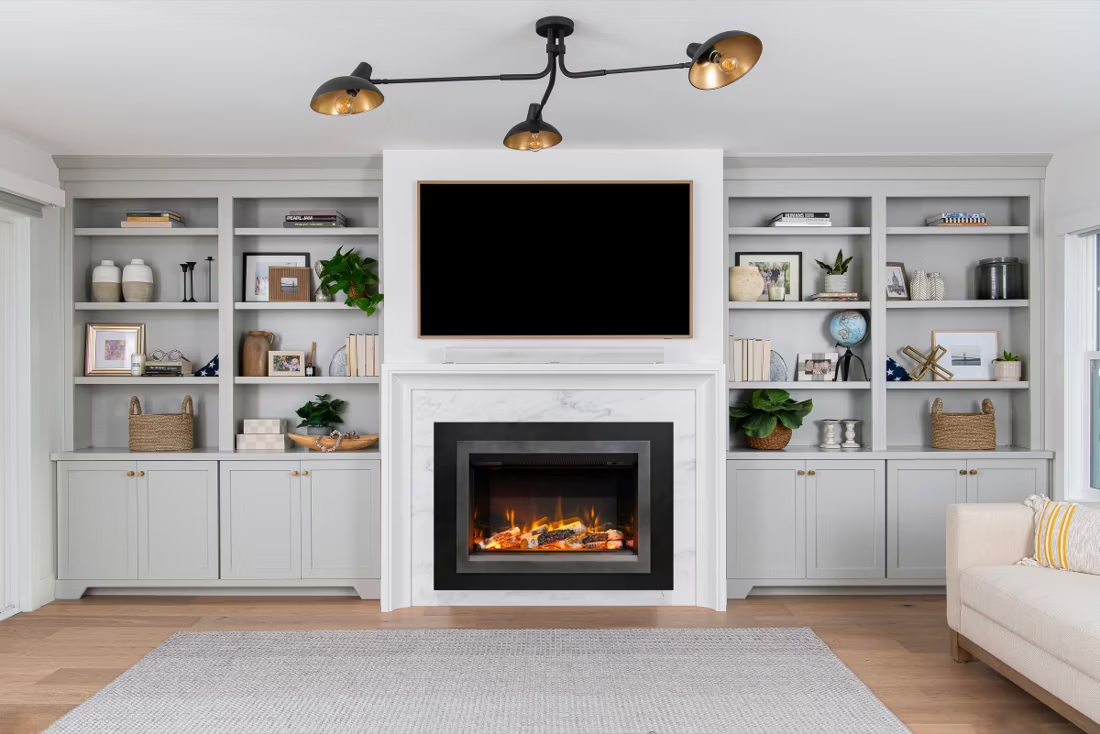
That's exactly where electric fireplaces earn their place. With no chimney, no gas line, and no venting to run, an electric insert or wall unit adds real, controllable zone heat to a living room, bedroom, or lake cabin near Devils Lake without touching the furnace that's doing the heavy lifting. Ramsey County is home to just a few hundred residents spread across farms, small towns, and lakeshore properties, and the retail hearth market here is thin—most homeowners either drive to Devils Lake, Minot, or Grand Forks to look at units in person, or work with a regional dealer who installs directly. Wood-burning stoves, despite the oak, cottonwood, and ash that grow along the Sheyenne River bottomlands and the lakeshore, are rare installs in the county; pellet stoves are essentially absent too, even though regional biomass suppliers like Lignetics and Indeck Energy Services operate in the broader region. Electric is the simplest, most practical supplemental-heat fireplace option for most households here.
Three steps. No salesperson until you're ready.
Tell us about your project
Your zip code, your situation, and the fuel you're leaning toward—or let the answers point you to one.
See what's actually available
The brands dealers within 100 miles genuinely carry—real options, never a catalog mirage.
Get your dealer & Project Guide
A trusted local dealer, plus the free Project Guide & Parts List that names every component of the job.
Frequently Asked Questions
How much does an electric fireplace installation cost in Ramsey County?
A plug-in freestanding electric fireplace or a slide-in insert into an existing mantel typically runs $300 to $900 for the unit itself, with no professional installation required beyond plugging it into a standard outlet. A built-in wall unit or a fireplace insert that requires new electrical wiring—a dedicated 20-amp circuit, for instance—runs closer to $1,200 to $3,500 installed, depending on whether an electrician needs to run new wire through log or frame walls. Given how few full-service hearth dealers operate directly in Ramsey County, most installed jobs are handled by a regional electrician or installer who travels in from Devils Lake, Minot, or Grand Forks, which can add a modest trip charge for rural properties outside town.
Can an electric fireplace be my main heat source in Ramsey County?
No—and this is worth being direct about. Ramsey County sits in IECC Climate Zone 7, the same extreme-cold category as places like International Falls, Minnesota, where overnight lows in January routinely bottom out well below zero. A typical electric fireplace draws about 1,500 watts and puts out roughly 5,000 BTU of heat, enough to comfortably warm a single room but nowhere near enough to replace a furnace when it's 25 below outside. In this county, electric fireplaces are a supplemental or zone-heat product—used to warm a living room or bedroom while the propane or fuel-oil furnace handles the rest of the house.
Do I need a permit to install an electric fireplace in Ramsey County?
Most plug-in electric fireplaces need no permit at all—you're just plugging into an existing outlet. If you're installing a hardwired built-in unit that requires a new dedicated circuit, that electrical work typically needs a permit through Ramsey County's building department, and it should be pulled by a licensed electrician regardless of whether an inspection is required. Because there's no venting, no gas line, and no combustion involved, electric installations are by far the least permit-intensive fireplace option available in the county.
What's the difference between a freestanding electric fireplace, an insert, and a built-in?
A freestanding electric fireplace is a self-contained cabinet unit you plug in and place anywhere—no installation beyond finding an outlet. An electric insert is a slimmer unit designed to slide into an existing wood-burning fireplace opening or a custom-built cavity, giving you the look of a built-in without any venting. A wall-mounted or built-in electric fireplace is designed to be recessed into a wall like a flat-screen TV, wired directly into the electrical system, and often requires a dedicated circuit. For Ramsey County's older farmhouses with existing masonry fireplaces, an insert is usually the simplest upgrade; for new builds or lake homes around Devils Lake, a built-in wall unit is popular for the clean look.
Will my electric fireplace work during a power outage?
No—electric fireplaces need grid power to run, full stop, which is worth considering in a county where winter storms and ice can knock out power for hours or days at a stretch. If you're looking for heat you can count on during an outage, a propane space heater or a wood-burning appliance (though these are rare installs in Ramsey County) will keep working when the lights go out. Most homeowners here treat their electric fireplace as an everyday ambiance and zone-heat feature, not a storm-outage backup plan.
What about wood-burning stoves—are those an option in Ramsey County?
Wood-burning stoves and fireplaces are uncommon installs in Ramsey County today, even though oak, cottonwood, and ash grow along the Sheyenne River bottomlands and the shoreline around Devils Lake. Part of it is scale—with roughly 500 residents in the county, there isn't a dedicated wood-stove retailer or installer based locally, and most heating decisions default to a propane furnace plus electric or gas fireplaces for supplemental warmth. A small number of rural households with existing masonry chimneys still burn wood, but it's the exception rather than the rule here.
What's the best electric fireplace for a Zone 7 climate like Ramsey County's?
Look for a unit with a true infrared or fan-forced heating element rated at 1,500 watts (the standard for most 120-volt units), a thermostat you can set to hold a target room temperature rather than just high/low settings, and a realistic flame display if ambiance matters as much as heat. Brands like Dimplex, Touchstone, and Napoleon all make units suited to supplemental zone heating in cold-climate homes. For a lake cabin around Devils Lake that only sees occasional weekend use, a simpler plug-in model is usually enough; for a primary residence where the fireplace runs daily through a long Zone 7 winter, a hardwired built-in with a stronger heating element is worth the extra cost.
Electric vs. gas fireplace—which is right for my home?
Propane is the standard fuel for both furnaces and gas fireplaces across most of rural Ramsey County, since natural gas pipelines don't reach the sparsely populated parts of the county. A gas fireplace run on propane puts out substantially more heat than an electric unit—often 20,000 to 30,000 BTU versus an electric fireplace's roughly 5,000 BTU—and it can keep running during a power outage if it has a battery-backup or millivolt ignition system, which electric units simply can't do. Electric wins on installation simplicity (no gas line, no venting, no permit hassle) and lower upfront cost. For a secondary bedroom or a lake house used occasionally, electric is usually the practical choice; for a primary living space where real backup heat matters during a Zone 7 winter storm, gas is worth the extra investment.
Where do I find someone to install an electric fireplace near me in Ramsey County?
With just a few hundred residents in Ramsey County, there's no dedicated hearth showroom in the county itself—most homeowners either travel to Devils Lake for a look at floor models, or work with a regional dealer based out of Minot or Grand Forks who handles orders and installation for rural Zone 7 counties across north-central North Dakota. That regional-dealer model works fine for electric fireplaces specifically, since there's no local code inspection tangle or gas-line coordination required—the main thing is making sure whoever does the electrical work is licensed and pulls a permit if a new circuit is involved.
Do electric fireplaces actually produce heat?
Yes—most put out around 4,800–5,000 BTUs from a standard outlet, which comfortably warms a bedroom, office, or den as a comfort-zone heater. What they won't do is carry a whole house the way wood, gas, or pellet can. Think of electric as ambiance-first with honest supplemental heat: flames on with no heat in July, flames plus warmth in January.
Does an electric fireplace need a vent or chimney?
No—that's its superpower. An electric fireplace needs a wall and an outlet, period. No vent pipe, no gas line, no clearances to design around, which is why it works in bedrooms, offices, apartments, and walls where venting a gas or wood unit would be impractical or impossible. Installation is typically the simplest and least expensive of any fireplace type.
Can I install a fireplace myself?
If you're putting a fire in your house on purpose, it's best to work with an expert. Unless you're genuinely experienced in framing, gas line, vent pipe, and the national code on clearances to combustibles, have a professional do it—and ideally the same company that sells you the fireplace, so warranty, service, and liability all live under one roof.
Can a fireplace actually lower my heating bill?
Yes—by creating a comfort zone. A furnace heats every square foot of the house just to warm the one room you're in; a gas fireplace on low burns roughly a sixth of the gas a typical furnace does. Set the furnace around 55–60 degrees as a baseline, then heat the rooms your family actually uses. Families who heat this way commonly save $20–$60 a month.
Find your electric fireplace in Ramsey County.
Tell us about your home near Devils Lake or elsewhere in Ramsey County, and we'll match you with a trusted local or regional dealer and send over a free Project Guide & Parts List—the exact parts and recommended installer for your electric fireplace project.
Find Your Fireplace →