
Real warmth for your Haywood County home—no chimney required.
From Waynesville's older homes to Maggie Valley cabins and condos around Lake Junaluska, electric fireplaces bring instant ambiance and zone heat without venting or a masonry chimney. Find the right unit and connect with a trusted local dealer.
Every Project Starts From One of These Five Situations
Ambiance and shoulder-season warmth for mountain homes.
Haywood County sits in the Blue Ridge and Great Smoky Mountains, with elevations ranging from around 2,000 feet near Canton and Clyde up past 6,000 feet along the Blue Ridge Parkway corridor near Cold Mountain. Winters here average lows around 24°F, with a solid but moderate heating season that runs from about October through April in a Climate Zone 4A mixed-humid climate. That's cold enough to matter but not brutal, which is exactly the range where electric fireplaces earn their keep: real heat on chilly spring and fall evenings without cranking the whole-house system.
A lot of Haywood County housing stock—from older Waynesville homes without a working chimney to newer cabins and vacation rentals scattered through Maggie Valley and along the Pigeon River—either never had a masonry fireplace or has one that's expensive to bring up to code. Electric inserts and wall-mounted units solve that: most plug into a standard outlet, larger built-ins run on a dedicated 240V circuit an electrician can add in an afternoon, and there's no venting, chimney, or gas line to worry about. Whether your power comes from Haywood Electric Membership Corporation's co-op lines in the outlying areas or Duke Energy Progress in town, running an electric fireplace as supplemental heat is straightforward and predictable to budget for.
Three steps. No salesperson until you're ready.
Tell us about your project
Your zip code, your situation, and the fuel you're leaning toward—or let the answers point you to one.
See what's actually available
The brands dealers within 100 miles genuinely carry—real options, never a catalog mirage.
Get your dealer & Project Guide
A trusted local dealer, plus the free Project Guide & Parts List that names every component of the job.
Frequently Asked Questions
How much does an electric fireplace installation cost in Haywood County?
Plug-in electric inserts and freestanding units—the kind that slide into an existing fireplace opening or sit against a wall—typically run $300 to $1,200 installed, with most of that being the unit itself since no venting or gas line is required. Built-in wall units or larger linear models that need a dedicated 240V circuit run higher, often $1,000 to $2,500 once an electrician runs the circuit and a carpenter frames the surround. Homes in older parts of Waynesville with older electrical panels sometimes need a panel upgrade first, which adds to the total. A local dealer can give you a firm number after seeing your wall or existing fireplace opening.
Is an electric fireplace just a fancy space heater?
Not really. A basic electric space heater from a hardware store is a bare heating element with no design intent. A true electric fireplace or insert—from brands like Dimplex or Napoleon—pairs a real heating element (usually 1,500 watts, similar output to a space heater) with a built LED flame effect, a mantel or surround option, and often a thermostat and remote. For a Haywood County living room where you want both the visual of a fire and supplemental warmth on a cold Blue Ridge evening, the fireplace-style unit does what a space heater can't: it looks intentional and can be the visual centerpiece of the room.
Do I need a permit to install an electric fireplace in Haywood County?
Plug-in electric fireplaces that use a standard outlet generally don't require a permit—they're treated like any other appliance. If your installation involves running a new 240V circuit, adding an outlet behind drywall, or building a framed surround that alters the wall structure, that electrical work typically does require a permit through the county, and a licensed electrician will pull it as part of the job. Most local dealers can tell you within a few minutes of seeing photos of your space whether your project crosses that line.
Can an electric fireplace actually heat a room in Haywood County's winters?
Most electric fireplace inserts put out around 4,600–5,000 BTUs (roughly 1,500 watts), which is enough to comfortably heat a single room of 300–400 square feet as supplemental heat—not enough to be a whole-home solution on a night when the temperature drops toward the winter average low of 24°F. They're best used the way most Haywood County homeowners actually use them: taking the edge off a chilly living room or bedroom in the shoulder seasons, or supplementing central heat during a cold stretch, rather than replacing a furnace or heat pump.
Can I put an electric insert into my existing wood fireplace?
Yes, and it's a common project in older Waynesville and Clyde homes with a masonry fireplace that's no longer used for wood burning—maybe the chimney needs expensive repair, or the homeowner just wants the look of a fire without the ash and creosote. An electric insert sized to fit the existing firebox opening slides in, plugs into a nearby outlet (or a new one added behind the surround), and gives you flame ambiance and zone heat with none of the chimney maintenance. It's typically one of the lower-cost projects a local dealer handles since the masonry opening is already there.
Electric vs. propane fireplace—which fits my Haywood County home better?
Since natural gas service is limited in Haywood County, most gas fireplace options here run on propane, which means a tank and a fuel bill to manage. Electric skips both—no tank, no delivery, no combustion byproducts to vent. The tradeoff is heat output: propane units can put out several times the BTUs of an electric insert, making them a better fit if you want a fireplace that can genuinely offset your heating bill on a cold night near Cold Mountain or up in the higher elevations. If you're after ambiance and light supplemental warmth in town or in a cabin with simple electrical access, electric is usually the easier, lower-maintenance choice.
What size electric fireplace do I need for my room?
For most rooms, sizing is more about visual proportion than heating capacity, since nearly all electric inserts put out a similar amount of heat regardless of width. As a rule of thumb, a 30–40 inch unit suits a standard bedroom or den, while a 50–60 inch linear unit fills a great room wall or a fireplace opening in a larger Waynesville or Maggie Valley living space. If the goal is heating a larger open-concept mountain home, plan on it as one zone among several—you may want a unit in more than one room rather than relying on a single fireplace to carry the whole floor.
What does it cost to run an electric fireplace day to day?
A typical electric fireplace insert draws about 1,500 watts on its heat setting. At average residential electric rates through Haywood Electric Membership Corporation or Duke Energy Progress, running one for a few hours each evening costs somewhere in the range of a dollar or two a day—considerably cheaper than heating an entire home with a furnace or heat pump for the same stretch. Most units also let you run the flame effect alone with the heater off, which draws only a few watts, so you can get the visual any time of year without the added electric cost.
Electric vs. wood—which is right for my Haywood County home?
Wood is deeply rooted here—oak, hickory, maple, and pine are all common locally, and Forest Service cutting permits through the Nantahala-Pisgah National Forests run about $20 per cord during the May-to-October season, which keeps self-cut firewood affordable for rural Haywood County homeowners. A wood stove or insert also works without electricity, which matters if you're in a spot along the Pigeon River or up toward the Parkway where winter storms can knock out power. Electric fireplaces can't compete on raw heat output or storm-proof reliability, but they win on convenience—no wood to split or stack, no chimney to sweep, and instant on-off operation that fits homes without an existing chimney. Many Haywood County homeowners end up with both: wood for backup heat and cabin character, electric for easy ambiance in a room where running a chimney isn't practical.
Can I put a TV above my fireplace?
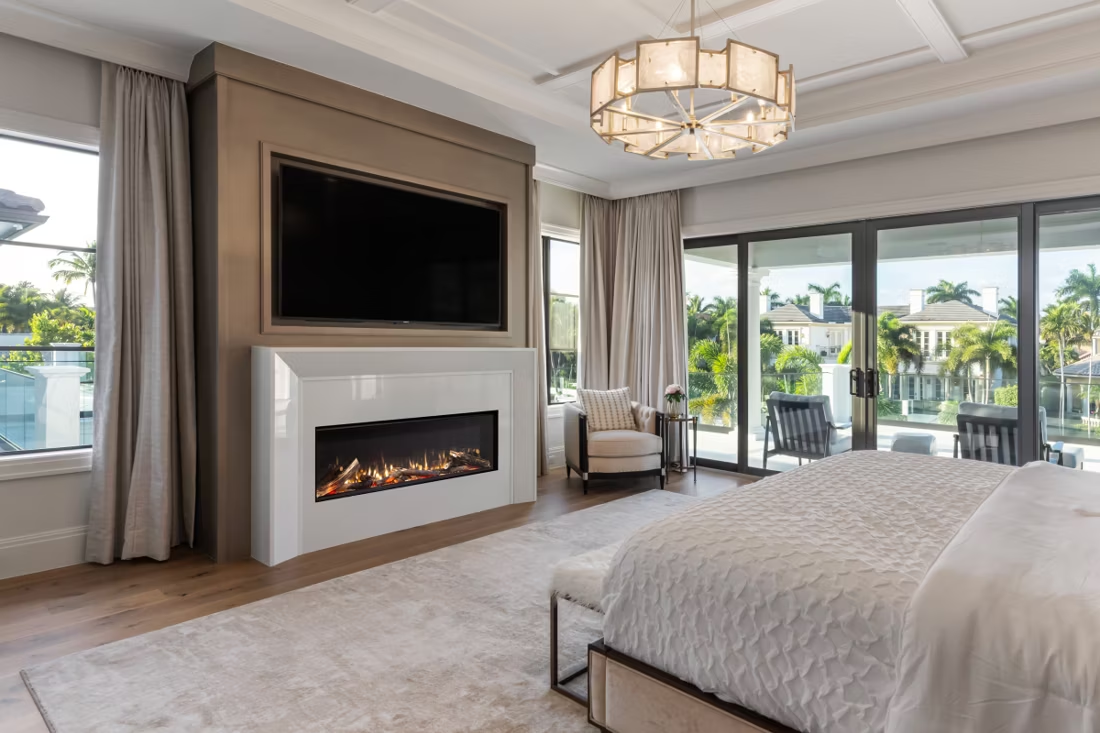
Yes—with an asterisk. Fireplaces are hot and TVs don't like heat. Either put a mantel between them to deflect rising warmth, or choose a fireplace with heat-management technology that creates a cool zone on the wall above—the wall stays around 125 degrees, barely warm, while the room still gets full heat. If you like clean lines and don't want a mantel, heat management is the answer.
Does an electric fireplace need a vent or chimney?
No—that's its superpower. An electric fireplace needs a wall and an outlet, period. No vent pipe, no gas line, no clearances to design around, which is why it works in bedrooms, offices, apartments, and walls where venting a gas or wood unit would be impractical or impossible. Installation is typically the simplest and least expensive of any fireplace type.
How much should I budget for a fireplace?
For an average home—covering the fireplace, the vent pipe, and basic installation—a budget between $3,900 and $5,500 gives you a lot of options across wood, gas, and pellet. By the time you add finish work, gas line, and electrical, the average complete installation lands between $5,000 and $12,000 all-in. In a remodel or new build, a good rule is to put about 2.5% of the total project cost toward the fireplace.
Can a fireplace actually lower my heating bill?
Yes—by creating a comfort zone. A furnace heats every square foot of the house just to warm the one room you're in; a gas fireplace on low burns roughly a sixth of the gas a typical furnace does. Set the furnace around 55–60 degrees as a baseline, then heat the rooms your family actually uses. Families who heat this way commonly save $20–$60 a month.
Stove and Fireplace Dealers in Haywood County
Albert’s Clean Sweep, The Fireplace Shop
Find your electric fireplace in Haywood County.
Tell us about your home and we'll match you with the right electric fireplace or insert, plus a free Project Guide & Parts List—the exact parts for your project and a trusted local Haywood County dealer to install it.
Find Your Fireplace →