
Find the right gas fireplace for your Putnam County home.
Instant, reliable heat for the cold Hudson Highlands winters—matched to a trusted local dealer who knows what's actually installable in your part of Putnam County.
Every Project Starts From One of These Five Situations
Consistent heat for a county built on hills and long winters.
Putnam County sits in the Hudson Highlands, a landscape of ridgelines and reservoirs where winter lows average 17°F and the heating season is a long, demanding one—roughly comparable to what a homeowner in Madison, Wisconsin deals with each year. Older farmhouses in Kent and Patterson, ridge-top homes near Cold Spring, and newer construction around Carmel and Brewster all face the same basic problem: central heat alone struggles to keep pace on the coldest nights, and a lot of local building stock has real drafts to fight.
Natural gas service reaches parts of the more developed corridors of the county, but a meaningful share of Putnam County households—particularly in Kent, Southeast, and the more rural stretches near Patterson—rely on propane rather than piped gas. Either fuel works fine for a modern direct-vent fireplace or insert; the difference is just which supplier feeds the line. A properly sized, correctly vented gas unit gives you heat at the flip of a switch, works as a genuine backup during Highlands winter storms when the power drops, and turns a cold, rarely-used masonry fireplace into the room you actually want to sit in.
Three steps. No salesperson until you're ready.
Tell us about your project
Your zip code, your situation, and the fuel you're leaning toward—or let the answers point you to one.
See what's actually available
The brands dealers within 100 miles genuinely carry—real options, never a catalog mirage.
Get your dealer & Project Guide
A trusted local dealer, plus the free Project Guide & Parts List that names every component of the job.
Frequently Asked Questions
How much does a gas fireplace installation cost in Putnam County?
Most gas fireplace and insert installations in Putnam County run in the same general range seen across the lower Hudson Valley: a direct-vent insert into an existing masonry fireplace, with gas already run to the room, sits toward the lower end of the cost spectrum. A new built-in gas fireplace requiring fresh framing, venting, and a gas line extension runs higher, and propane installations that require a new tank push costs up further still. Homes on the ridges around Cold Spring or in more rural parts of Kent sometimes see modestly higher install costs due to chimney access or longer gas line runs. A local dealer will give you a firm number after seeing the space.
Can I convert my existing wood fireplace to gas?
Yes, and it's a common project in Putnam County's older housing stock—plenty of homes in Cold Spring, Carmel, and the Patterson area have original masonry fireplaces that see little use because hauling and tending wood doesn't fit daily life anymore. A gas insert typically uses your existing chimney, run with a stainless liner, so the exterior of the house doesn't change. Whether you're on natural gas or propane determines some of the installation details, but the conversion itself is straightforward for a local hearth dealer who handles this regularly.
Do I need natural gas, or can I use propane?
Either works, and which one you use usually comes down to what's already running to your house. If natural gas service reaches your street—more common in the denser parts of Brewster and Carmel—adding a fireplace onto an existing gas meter is simple. In Kent, Southeast, and other areas where piped gas doesn't reach, propane is the standard choice, either from an existing tank or a new one set by a local propane supplier. Nearly every direct-vent fireplace on the market can be configured for either fuel; your installer sets the correct orifice and regulator for whichever you have.
Will my gas fireplace work during a power outage?
Most will, which matters in a county where ice storms and downed lines on wooded roads knock out power for days at a time. Units with intermittent pilot ignition (IPI) run on a small battery backup that kicks in the instant power drops, so the fireplace lights on demand just like normal. Valor fireplaces go a step further—their pilot assembly generates its own electricity through the thermocouple, so there's no battery to remember at all. If backup heat during outages is a priority for your Putnam County home, ask your local dealer specifically about the ignition system on any unit you're considering.
What's the difference between a gas fireplace, gas insert, and gas stove?
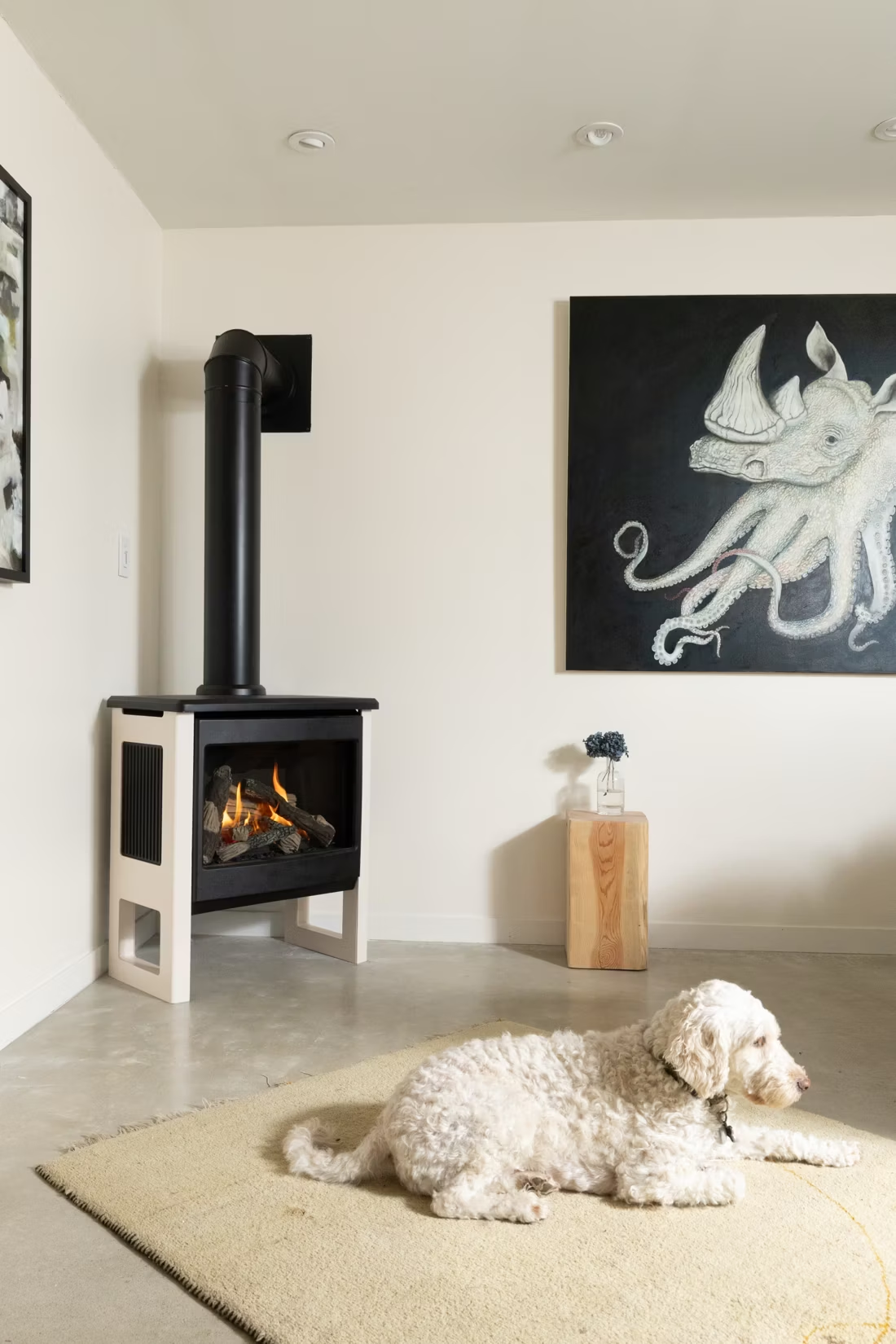
A gas fireplace is a fully built-in unit framed into a wall—the right call for new construction or a remodel without an existing hearth. A gas insert drops into an existing masonry fireplace opening and uses the current chimney as its vent path, which is the common route for Putnam County's older homes. A gas stove is a freestanding cast-iron or steel unit that sits on the floor like a wood stove but burns gas—a good option for a room without any existing fireplace where you don't want to frame in a full built-in. For most homeowners here upgrading an existing hearth in Carmel or Cold Spring, an insert is the simplest path.
Do I need a permit to install a gas fireplace in Putnam County?
Yes. New gas fireplace installations require both a building permit and a gas line permit, issued through your local town building department—Carmel, Kent, Southeast, Patterson, and Philipstown each handle their own permitting rather than routing through a single county office. The gas line portion of the work has to be done by a licensed gas-fitter. Most established hearth dealers coordinate the permit, the gas line, and the final inspection as one package, so you're not left managing separate trades yourself.
What's the difference between vented and vent-free gas fireplaces?
Vented (direct-vent) fireplaces pull combustion air from outside and exhaust the byproducts back outside through a sealed pipe—they're the cleanest and most universally code-compliant option, and by far the most common choice in this part of New York. Vent-free units burn without any outside venting at all, releasing some water vapor and trace combustion gases into the room; New York allows them but with strict room-sizing and ventilation rules, and quite a few local dealers steer homeowners away from them for exactly that reason. For a Putnam County home, a direct-vent unit is almost always the recommendation—real heat output, no compromise on indoor air, and no debate about code compliance at resale.
How often should my gas fireplace be serviced?
Plan on an annual inspection, ideally before the start of the heating season in early fall. A technician checks the burner, pilot assembly, venting, gas connections, and glass, and confirms the battery backup or Valor thermocouple system is working correctly—a real consideration heading into a Putnam County winter where an outage and a cold snap tend to arrive together. This is a much smaller job than sweeping a wood chimney, but skipping it for a few years is how minor issues (a weak pilot, a dirty burner) turn into a service call in the middle of a January cold spell.
Gas vs. wood—which is right for my Putnam County home?
Wood, burned in local oak, maple, birch, or ash, delivers strong heat output and keeps working with no electricity at all—a real advantage during multi-day outages on rural roads in Kent or Patterson. Gas offers instant on-off convenience, no ash or creosote, and steadier output without the daily work of tending a fire. Given how many Putnam County homes already have an underused wood fireplace, a lot of homeowners here end up choosing a gas insert for the primary living space and keeping (or adding) a wood-burning option elsewhere in the house for true backup heat. A local dealer can walk through both given your specific home and how you actually plan to use it.
Why is my open fireplace making my house colder?
Open fireplaces suck—literally. As the fire burns, it consumes air your furnace already paid to heat and pulls it out through the chimney, so the house is actually colder after the fire goes out than before you lit it. An insert fixes this: it seals the chimney, puts fixed glass across the front, and turns that hole in your house into a real heat source.
What does it take to replace an existing fireplace?
Fireplaces are like icebergs—bigger behind the wall than in front of it. Replacement means removing the surrounding tile or stone (the finish material laps onto the fireplace face), pulling the old unit, setting the new one in the same enclosure, and re-finishing the wall. A hearth professional can determine what's behind your wall without demolition during an in-home preview.
Can a fireplace actually lower my heating bill?
Yes—by creating a comfort zone. A furnace heats every square foot of the house just to warm the one room you're in; a gas fireplace on low burns roughly a sixth of the gas a typical furnace does. Set the furnace around 55–60 degrees as a baseline, then heat the rooms your family actually uses. Families who heat this way commonly save $20–$60 a month.
How much should I budget for a fireplace?
For an average home—covering the fireplace, the vent pipe, and basic installation—a budget between $3,900 and $5,500 gives you a lot of options across wood, gas, and pellet. By the time you add finish work, gas line, and electrical, the average complete installation lands between $5,000 and $12,000 all-in. In a remodel or new build, a good rule is to put about 2.5% of the total project cost toward the fireplace.
Stove and Fireplace Dealers in Putnam County
Get your Putnam County gas fireplace Project Guide & Parts List.
Tell us about your home and we'll match you with a trusted local Putnam County dealer and send a free Project Guide & Parts List—the exact parts, including the vent kit, for your gas fireplace project.
Find Your Fireplace →