
Keep Your Family Warm and Safe—No Matter What
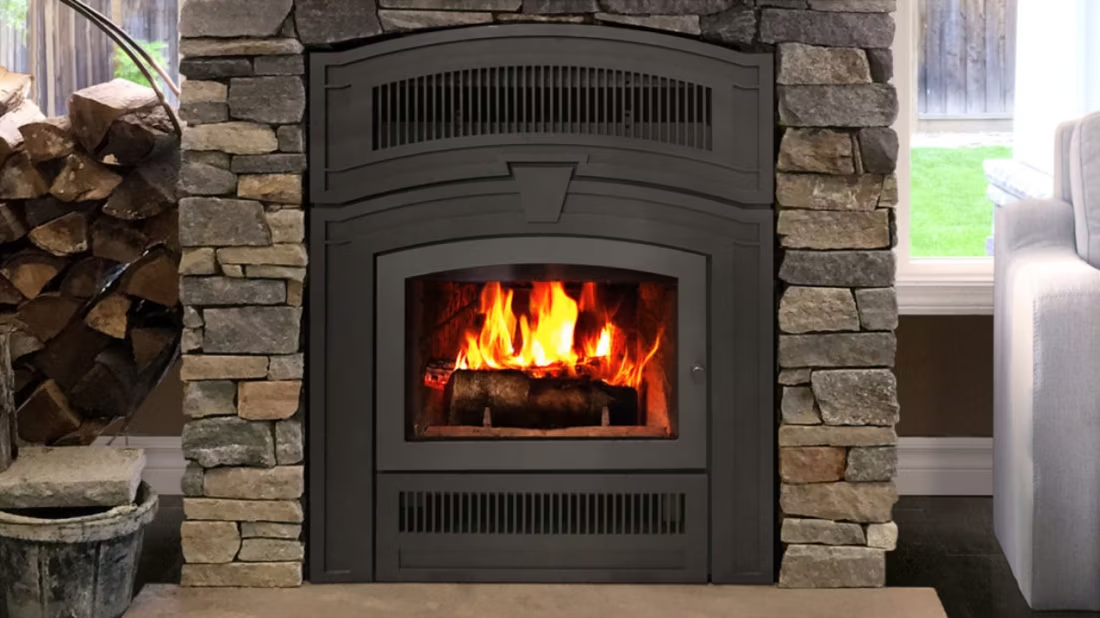
Wood heat is uncommon on the bay side of Atlantic County, but it's not unheard of. If you want one, we'll connect you with a local dealer who can size and install it correctly for a coastal home.
Every Project Starts From One of These Five Situations
Wood is the exception here, not the rule.
Somers Point sits at 16 feet of elevation on Great Egg Harbor Bay, with winters that average a low around 30°F and a fairly short, mild heating season overall—mild by any national standard, and nowhere close to the demands of a place like Duluth, MN, where wood is often the primary source of heat. Most homes here lean on natural gas or electric resistance heat, and that's reflected in the housing stock: shore cottages, raised coastal homes, and condos built for summer occupancy as much as winter comfort.
That said, a wood stove or fireplace insert still shows up in Somers Point—usually in a year-round home on a larger lot, a vacation property where the owner wants the ambiance of a real fire, or a household that wants backup heat for the nor'easters that regularly knock out Atlantic City Electric service along the bay. Oak, hickory, and maple are the common regional hardwoods, and there are no air-quality non-attainment restrictions here, so burning wood is straightforward from a regulatory standpoint—it's just genuinely optional rather than essential.
Three steps. No salesperson until you're ready.
Tell us about your project
Your zip code, your situation, and the fuel you're leaning toward—or let the answers point you to one.
See what's actually available
The brands dealers within 100 miles genuinely carry—real options, never a catalog mirage.
Get your dealer & Project Guide
A trusted local dealer, plus the free Project Guide & Parts List that names every component of the job.
Frequently Asked Questions
Does a wood stove actually make sense in Somers Point?
For most homes here, no—natural gas or electric heat handles Somers Point's mild winters (average low around 30°F) just fine, and that's what most year-round residents install. But wood stoves aren't out of place either. They show up most often in older shore homes with existing masonry fireplaces, in households that want a backup heat source for nor'easter power outages, or simply in homes where the owner wants a real wood fire for ambiance. If that's you, a wood stove or insert is a perfectly reasonable project—it's just not the default choice in this climate the way it would be further inland or up north.
What does a wood stove installation cost in Somers Point?
Expect a range similar to the rest of coastal South Jersey—roughly $3,500 to $8,000 for a freestanding stove with new Class A chimney venting, or $4,000 to $9,000 for an insert into an existing masonry fireplace with a stainless liner. Costs run higher on elevated or piling-supported homes near the bay, where the chimney chase has to be engineered around the raised structure rather than a standard slab foundation. A local dealer will give you a firm number after seeing the house.
Do I need a permit to install a wood stove in Somers Point?
Yes. Under New Jersey's Uniform Construction Code, any new wood-burning appliance requires a construction permit, typically pulled through the City of Somers Point Construction Code Office. The stove itself needs to meet current EPA 2020 NSPS emissions standards. Most hearth dealers who install in Atlantic County handle this paperwork as part of the job. One local wrinkle: homes elevated on pilings or crawl spaces after flood-zone rebuilds sometimes need additional structural sign-off for chimney chases, so it's worth mentioning your foundation type up front.
Wood stove or wood insert—which fits a Somers Point home better?
If your house already has a working masonry fireplace—common in the older sections of Somers Point near the bay—an insert is usually the better move. It uses the existing chimney with a new stainless liner and turns a decorative, heat-losing fireplace into an actual heat source. A freestanding stove makes more sense in a home without an existing chimney, or where you want the stove positioned somewhere other than the original fireplace footprint, like a converted garage or a great room addition.
What firewood works best, and where do people get it around here?
Oak, hickory, and maple are the standard hardwoods in this part of South Jersey, and all three burn well once properly seasoned. Because of the coastal humidity, plan on a full 12 months of covered, split seasoning rather than the 6-8 months you might get away with in a drier inland climate—wood that looks dry on the outside can still be wet in the core here. There isn't a public-lands cutting permit system the way there is out west; most Somers Point and Atlantic County residents buy seasoned cordwood from local tree services or firewood dealers, typically $250 to $350 per cord depending on species and delivery distance.
Is wood heat useful as backup during storm outages?
This is actually the strongest local argument for a wood stove in Somers Point. Nor'easters and tropical remnants regularly knock out Atlantic City Electric service along the bay, sometimes for days. A wood stove keeps working with zero electricity, unlike a furnace blower, an electric fireplace, or a heat pump. Given that Atlantic City Electric's residential rate runs around $0.2257 per kWh—on the higher end nationally—a wood stove also gives you a way to heat one room cheaply if you're riding out a long outage or just want to offset an expensive electric heating bill on the coldest nights.
How often does a chimney need cleaning in a coastal climate like this?
An annual inspection is the standard recommendation from the Chimney Safety Institute of America, and that holds true in Somers Point. The one added consideration here is salt air: metal chimney caps, flashing, and cricket details near the bay corrode faster than they do inland, so it's worth having your annual inspection include a check of all exterior metal components, not just the flue itself. A CSIA-certified sweep will know to look for this in a shore environment even if you don't ask.
Are there air quality restrictions on wood burning in Somers Point?
No—Atlantic County isn't a designated non-attainment area, so there are no wintertime burn curtailment periods or air-quality advisories restricting wood stove use here the way there are in some inversion-prone western towns. The only rules that apply are the standard EPA 2020 NSPS certification requirement for new stove installs and normal Uniform Construction Code clearance and venting standards. Practically speaking, once your stove is installed and inspected, you're free to burn as you like.
Wood vs. gas—why would I pick wood in a town where gas is standard?
Gas is the more common choice in Somers Point for good reason: it's instant, requires no wood storage or ash cleanup, and fits the seasonal, low-maintenance nature of a lot of shore properties. Wood wins for people who specifically want the experience of a real fire, who like the idea of a heat source that works without electricity during storm outages, or who own a larger property where stacking a few cords of local oak or hickory isn't a hassle. It's a smaller audience here than in colder inland climates, but for that audience, wood is still a solid, well-supported choice—a local dealer can walk you through whether it fits your specific house.
Why is a fireplace insert so efficient?
An insert does two things: it seals the chimney completely, so you stop losing air you already paid to heat, and it radiates warmth into the room through the firebox and glass. Most add a heat-exchange fan that pulls cool room air underneath, wraps it around the hot firebox, and pushes it back out warm. Your home is more efficient before you've even lit the first fire.
Why won't my new wood stove get going like my old one?
New wood stoves are 70%+ efficient, so far less heat goes up the flue—which also means less draft to get a fire established. The rule: build a genuinely hot fire for about 45 minutes before you choke it down. Skip that and you get smoke in the room, creosote in the chimney, and a fire that never takes off. Most performance complaints trace straight back to this.
Does a fireplace add value to my home?
On average, a fireplace adds back to the home about the same amount you spent installing it. Add the monthly savings from heating the rooms you actually use instead of the whole house—often hundreds of dollars a year—and the value case is strong before you even count what a fire does for how your family uses the room.
Can a fireplace actually lower my heating bill?
Yes—by creating a comfort zone. A furnace heats every square foot of the house just to warm the one room you're in; a gas fireplace on low burns roughly a sixth of the gas a typical furnace does. Set the furnace around 55–60 degrees as a baseline, then heat the rooms your family actually uses. Families who heat this way commonly save $20–$60 a month.
Nearby Dealers
Hearth shops serving Somers Point and the surrounding area. Every listing shows whether it is a WhyFire partner, a dealer we have verified as authorized for the brands we recommend, or a local business carrying hearth products. No manufacturer pays for placement. How we verify dealers →
The Chimney Doctor Inc.
Quality Home Center
Find your wood fireplace in Somers Point.
Tell us about your home and how you plan to use a wood stove or insert, and we'll match you with a trusted local dealer and a free Project Guide & Parts List for your Somers Point install.
Find Your Fireplace →