
Keep Your Family Warm and Safe—No Matter What
Iselin runs on natural gas, and most lots here have no room for a woodpile. But if you've got an old masonry fireplace or want backup heat for the next PSE&G outage, we'll connect you with a local dealer who can tell you honestly whether it's worth it.
Every Project Starts From One of These Five Situations
A dense, gas-heated suburb with little room for cordwood.
Iselin is an unincorporated section of Woodbridge Township packed into a single zip code (08830) with over 18,000 residents—mostly postwar single-family homes on small lots, garden apartments, and townhomes. Winters here are moderate by Northeast standards: Climate Zone 4A, a moderate winter heating load, and an average winter low around 24°F. That's real cold, but nothing close to what drives wood heat in places like Burlington, VT or Duluth, MN, where households burn multiple cords a season to survive months of sub-zero nights. In Iselin, nearly every home already has a gas line and a furnace, and PSEG Long Island's parent utility PSE&G supplies both the gas and the electricity most residents rely on for daily heat.
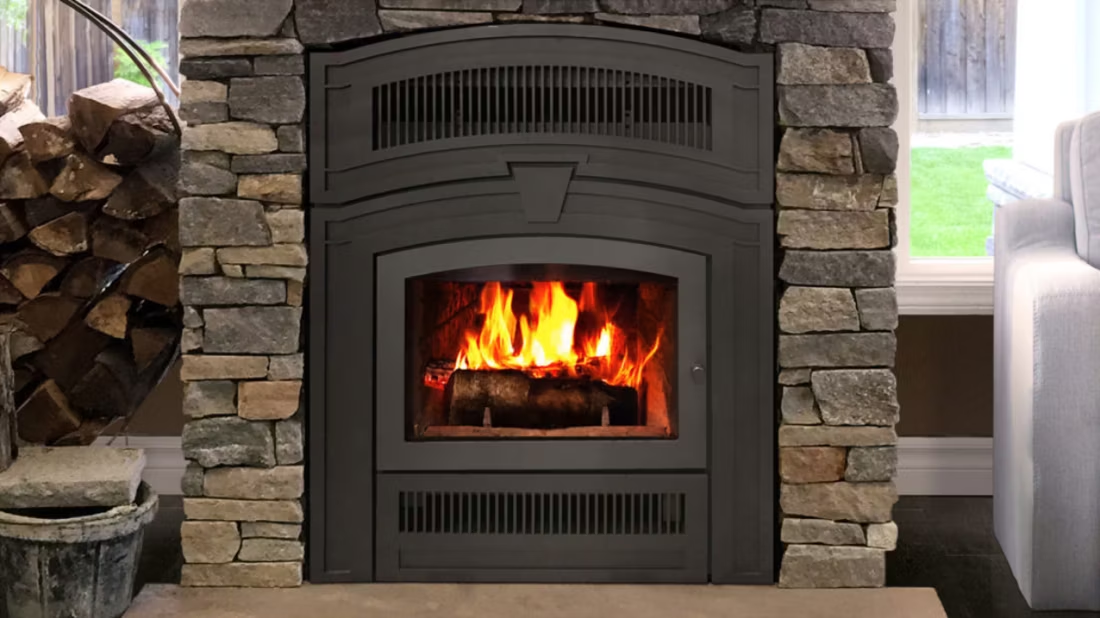
That's why wood stoves and inserts are genuinely uncommon here—this isn't a market with cutting permits, national forest land, or a culture of self-sufficient wood heat. There's no local timber to speak of, so any firewood gets trucked in from western New Jersey or Pennsylvania. Still, a small number of Iselin homeowners do pursue wood heat: those with an original 1950s or '60s masonry fireplace looking to upgrade it into something functional, and those who want a non-electric backup heat source for the storms that periodically knock out power along the PSE&G grid. If that's you, a wood insert or a compact freestanding stove can make sense—but go in with eyes open about storage space, township rules, and the fact that very few local dealers stock wood-burning product compared to gas.
Three steps. No salesperson until you're ready.
Tell us about your project
Your zip code, your situation, and the fuel you're leaning toward—or let the answers point you to one.
See what's actually available
The brands dealers within 100 miles genuinely carry—real options, never a catalog mirage.
Get your dealer & Project Guide
A trusted local dealer, plus the free Project Guide & Parts List that names every component of the job.
Frequently Asked Questions
Is a wood stove or insert actually practical for a home in Iselin?
For most Iselin homes, no—not as a primary plan. Lots here are small, many properties don't have a chimney at all, and natural gas from PSE&G already reaches nearly every block, making a gas insert or furnace the default choice. Where it does make sense is a home with an existing masonry fireplace that's just sitting unused, or a household that wants one non-electric heat source in case of a winter power outage. If that describes your situation, a wood insert into your existing chimney is a far more realistic project than a new freestanding stove requiring all-new venting.
What does a wood stove or insert installation cost in Iselin?
Because wood isn't a common installation here, pricing tends to track general Northeast averages rather than a well-established local market rate. Expect roughly $4,000 to $7,500 for a wood insert into an existing masonry fireplace, and $5,000 to $9,000 for a freestanding stove that requires new Class A chimney pipe run through a wall or roof. Homes without any existing masonry fireplace or chimney chase will land at the higher end, since the venting work is the main cost driver. Get a firm number from a local hearth dealer after they see your home—with so few wood installs happening in Middlesex County, phone quotes aren't reliable.
Do I need a permit to install a wood stove in Iselin?
Yes. Iselin falls under Woodbridge Township, so any new wood-burning appliance install requires a building permit through the Woodbridge Township Division of Code Enforcement/Construction, with inspection tied to Middlesex County code requirements. The stove itself needs to meet current EPA 2020 NSPS emissions standards—nearly everything sold new today qualifies, but older used stoves often don't and may not pass inspection. A reputable local installer will pull the permit as part of the job, which is one more reason to avoid a DIY install for a fuel type most local contractors rarely touch.
Where would I even get firewood in Iselin?
There's no national forest or public cutting land anywhere near Middlesex County, so self-cut firewood isn't really an option the way it is in, say, upstate New York or northern New England. Local firewood comes from commercial suppliers who source oak, hickory, and maple from western New Jersey and eastern Pennsylvania and deliver by the cord (a stacked 4×4×8-foot pile) to the northern NJ suburbs. Expect to pay more per cord here than in a rural wood-heavy market—budget $300–$400 delivered and seasoned, since transport is baked into the price.
I have an old fireplace that's never been used—can it take a wood insert?
Often, yes, and this is the most common wood project we see in a town like Iselin. Many of the ranch and split-level homes built here in the 1950s and '60s have an original brick fireplace that's been decorative for decades. A local installer will inspect the flue and masonry condition first—older chimneys sometimes need a stainless liner before an insert can go in safely, which adds to the cost but is non-negotiable for code and safety. If the masonry checks out, converting that fireplace into a working wood insert is usually the most cost-effective wood project available in this area.
Wood vs. gas—which makes more sense for an Iselin home?
For nearly every Iselin household, gas wins on convenience: PSE&G's gas network already serves most of the town, a gas insert or fireplace lights instantly with no ash or wood handling, and installation costs are usually comparable or lower than wood once you factor in venting. Wood's real advantage is that a stove or insert keeps producing heat with the power out—gas furnaces and even most gas fireplaces with electronic ignition still need electricity to run their blowers and controls. If backup heat during a storm is your main concern, that's the scenario where wood earns its keep here. Otherwise, gas is the more practical everyday choice in this market.
Will a wood stove keep my house warm if the power goes out?
Yes—this is one of the few scenarios where wood clearly outperforms every other option in Iselin. A properly sized wood stove or insert needs no electricity to produce heat, unlike gas furnaces, most gas fireplaces, and all electric heat, which depend on PSE&G's grid staying up. If your neighborhood has seen extended outages during past Nor'easters or summer storms, even a modest wood insert in one room can keep a family comfortable and give you a place to boil water or dry out gear until power returns.
Are there air quality or burning restrictions I should know about in Iselin?
Middlesex County doesn't carry the winter inversion or non-attainment designations that trigger burn bans in some Western states—there's no local air quality restriction on wood burning here. That said, any new stove must be EPA 2020 NSPS-certified to pass Woodbridge Township's building inspection, and New Jersey DEP guidance still recommends burning only seasoned hardwood (oak, hickory, and maple burn cleanest) to keep smoke and creosote to a minimum, especially in a tightly packed neighborhood like Iselin where a smoky chimney affects nearby homes.
What's the best type of wood stove for a small Iselin lot?
Given the limited outdoor space for stacking firewood on most Iselin properties, a compact or medium wood insert into an existing fireplace is usually more realistic than a large freestanding stove sized for whole-home heating—you simply won't have room to store multiple cords for a long burn season. A smaller-firebox insert used for supplemental heat and outage backup, paired with a modest quarter- or half-cord storage rack along a side yard or garage wall, tends to be the practical fit. A local dealer can walk your property and tell you what's actually feasible before you commit to a unit.
What's the difference between an insert and a zero-clearance fireplace?
An insert is a fireplace that slides into a pre-existing wood-burning fireplace—if you don't have one, there's nothing to insert it into. A zero-clearance fireplace is built into a framed wall, which makes it the answer for remodels and new construction. Simple test: existing masonry fireplace means insert; blank or framed wall means zero-clearance.
Why won't my new wood stove get going like my old one?
New wood stoves are 70%+ efficient, so far less heat goes up the flue—which also means less draft to get a fire established. The rule: build a genuinely hot fire for about 45 minutes before you choke it down. Skip that and you get smoke in the room, creosote in the chimney, and a fire that never takes off. Most performance complaints trace straight back to this.
Does a fireplace add value to my home?
On average, a fireplace adds back to the home about the same amount you spent installing it. Add the monthly savings from heating the rooms you actually use instead of the whole house—often hundreds of dollars a year—and the value case is strong before you even count what a fire does for how your family uses the room.
Can a fireplace actually lower my heating bill?
Yes—by creating a comfort zone. A furnace heats every square foot of the house just to warm the one room you're in; a gas fireplace on low burns roughly a sixth of the gas a typical furnace does. Set the furnace around 55–60 degrees as a baseline, then heat the rooms your family actually uses. Families who heat this way commonly save $20–$60 a month.
Nearby Dealers
Hearth shops serving Iselin and the surrounding area. Every listing shows whether it is a WhyFire partner, a dealer we have verified as authorized for the brands we recommend, or a local business carrying hearth products. No manufacturer pays for placement. How we verify dealers →
Fireplaces R Us
Hot Concepts Fireplaces
Harris Hearth And Home
Costello's Hearth & Spa - Bernardsville
Appliance Brokers, Ltd.
Island Renovations
D & D Design Center
Builders Architectural Millwork
Fireside Pros/Awning Design
Fire Design
Find out if wood heat makes sense for your Iselin home.
Tell us about your home and whether you're working with an existing fireplace or starting fresh, and we'll match you with a trusted local dealer plus a free Project Guide & Parts List—the exact parts, including the vent kit, and no big-box guesswork.
Find Your Fireplace →