
Find the right fireplace for your Middlesex County home.
Fireplace resources for the 25 municipalities of Middlesex County—from New Brunswick to Perth Amboy to Old Bridge. Units are uncommon here given the housing stock, but where they exist, we can point you to who services them.
Every Project Starts From One of These Five Situations
Dense suburban heating in central New Jersey.
Middlesex County packs roughly 487,735 residents into about 312 square miles across 25 municipalities—New Brunswick, Edison, Woodbridge, Perth Amboy, Old Bridge, East Brunswick, and more—making it one of the most densely built counties in the state. Climate zone 4A and average winter lows around 23°F put it in a comparatively mild bracket next to a place like Duluth MN's much harsher winters, but the heating season still runs a solid five months, November through March. Natural gas service from PSE&G and New Jersey Natural Gas reaches most of the county, which is why gas fireplaces and inserts are the default upgrade here—not the woodpile-and-chimney setup you'd find in a more rural, forested county.
What you'll find on this hub: hearth retailers, service technicians, and fuel suppliers covering Middlesex County's towns, from the Route 1 corridor around New Brunswick and Edison down to Perth Amboy on the Raritan Bay and out to Old Bridge and Monroe. Gas and electric are the practical fuels for most homes here; if you're in one of the county's older farmhouses or larger lots with an existing masonry fireplace, we can still point you to someone who can service or convert it. Pick your fuel below to see local dealers, install costs, and next steps.
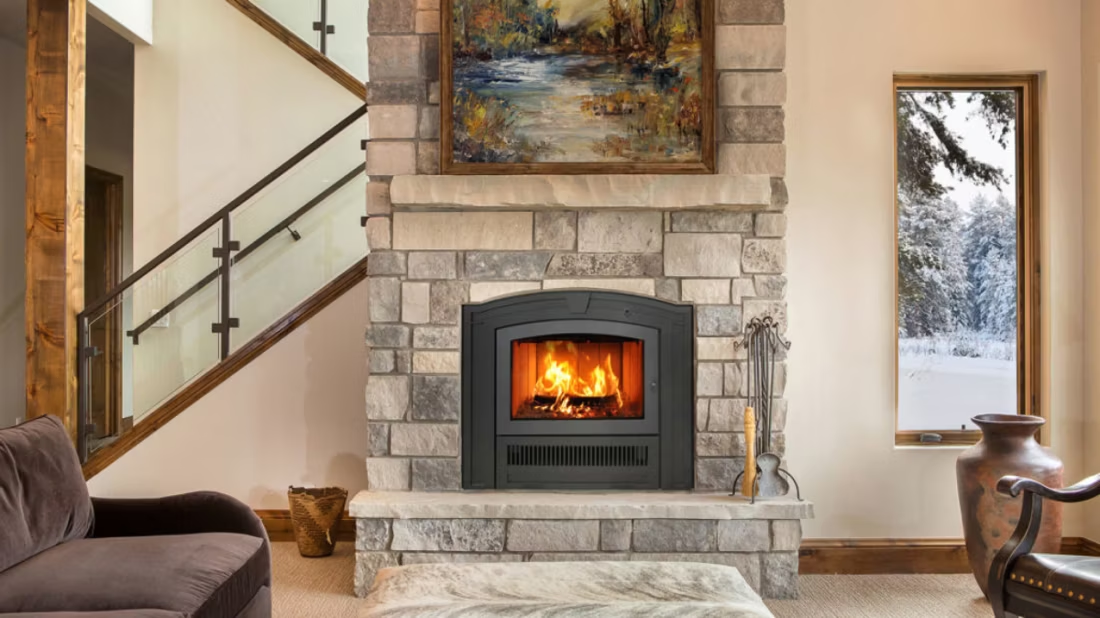
Four fuels. One honest answer for Middlesex County.
Three steps. No salesperson until you're ready.
Tell us about your project
Your zip code, your situation, and the fuel you're leaning toward—or let the answers point you to one.
See what's actually available
The brands dealers within 100 miles genuinely carry—real options, never a catalog mirage.
Get your dealer & Project Guide
A trusted local dealer, plus the free Project Guide & Parts List that names every component of the job.
Frequently Asked Questions
Which fuel works best in Middlesex County?
For most homes here, gas is the practical answer. Natural gas service from PSE&G or New Jersey Natural Gas covers the majority of Middlesex County's towns, and a direct-vent gas fireplace or insert gives instant heat without a chimney or woodpile. Electric is the other mainstream option—especially in the county's condos, townhomes, and apartment-heavy towns like New Brunswick and Piscataway, where venting isn't an option. Wood-burning fireplaces exist in some of the county's older single-family homes—you'll still find oak, hickory, and maple as the local firewood—but new wood stove installs are rare given lot sizes, insurance considerations, and the housing stock. Pellet stoves are similarly uncommon; regional pellet fuel like Energex or Hamer is available, but it's a niche choice here rather than a mainstream one.
Do I need a permit to install a fireplace in Middlesex County?
Yes, in most cases. New Jersey's Uniform Construction Code applies statewide, but each of Middlesex County's 25 municipalities runs its own local construction code office—so a gas insert install in Edison goes through Edison's office, while one in New Brunswick goes through the city's. Gas fireplace and insert installs typically require both a building permit and a licensed gas-fitter for the line work. Electric fireplaces usually skip the permit process for plug-in units, but built-in electric fireplaces that involve new wiring or a dedicated circuit need an electrical permit. Most local retailers handle this paperwork as part of the install, so you're not filing it yourself.
Are wood-burning fireplaces still an option in Middlesex County?
They're allowed, but they're the exception rather than the rule. Middlesex County has no air quality nonattainment flags tied to wood smoke, so it's not a regulatory ban—it's more about the housing stock. Much of the county is townhomes, attached homes, and closer-set single-family lots that were never built with a wood-burning chimney in mind, and newer construction almost always defaults to gas or electric. If you're in one of the county's older homes—parts of South Brunswick, Monroe, or the rural edges near the Millstone River—you may already have a masonry fireplace, and local retailers can often convert it to a gas insert or service it as-is. Ground-up new wood stove installs are uncommon enough that few retailers stock them as a primary line.
Can one local hearth retailer handle both gas and electric?
Yes—most hearth retailers serving Middlesex County carry both gas and electric lines, since those two fuels cover the overwhelming majority of local demand. A retailer near Route 1 in Edison or along Route 9 in Old Bridge will typically have working gas fireplace displays alongside electric wall-mount and insert options, which makes it easy to compare the two side by side. If you specifically need someone who also handles a legacy wood-burning fireplace or a pellet stove, that's a smaller subset of retailers—worth confirming before you drive out.
How does installation and service work across Middlesex County's towns?
Middlesex County's density works in your favor here. At about 312 square miles with 25 municipalities packed close together, most retailers and technicians serving New Brunswick, Edison, or Woodbridge can reach Perth Amboy, Old Bridge, or South Brunswick within a short drive via Route 1, Route 9, or the New Jersey Turnpike. That means shorter wait times for service calls and more competition among installers compared to a spread-out rural county. Gas fireplace service—annual inspection and cleaning—is the most common recurring appointment; electric units generally need less upkeep beyond an occasional dusting or bulb replacement on older models.
What's the typical cost range for fireplace installation across fuel types in Middlesex County?
Gas fireplace, insert, or stove: roughly $4,000–$10,000 depending on whether it's a straightforward insert into an existing masonry fireplace or a new gas line and venting run. Electric fireplace: $200–$3,000 for the unit itself, with $300–$1,000 in labor for anything beyond a plug-and-play wall mount, such as a built-in with a dedicated circuit. Wood stove or insert conversions, where they still happen, run comparably to gas once chimney work is factored in—often $5,000–$9,000. Pellet stove installs are infrequent enough locally that pricing varies more by retailer; expect a similar range to wood. For specifics, see the county + fuel pages above.
Can I install a fireplace myself?
If you're putting a fire in your house on purpose, it's best to work with an expert. Unless you're genuinely experienced in framing, gas line, vent pipe, and the national code on clearances to combustibles, have a professional do it—and ideally the same company that sells you the fireplace, so warranty, service, and liability all live under one roof.
How much should I budget for a fireplace?
For an average home—covering the fireplace, the vent pipe, and basic installation—a budget between $3,900 and $5,500 gives you a lot of options across wood, gas, and pellet. By the time you add finish work, gas line, and electrical, the average complete installation lands between $5,000 and $12,000 all-in. In a remodel or new build, a good rule is to put about 2.5% of the total project cost toward the fireplace.
Wood, gas, pellet, or electric—how do I choose?
Match the fuel to your life, not the other way around. Wood: lowest fuel cost and total power-outage independence, but you're hauling and stacking. Gas: press a button, set a thermostat, no maintenance to speak of. Pellet: wood economics with automatic feeding, in exchange for weekly cleaning and a need for electricity. Electric: plugs in anywhere with honest supplemental heat. Nobody regrets the fuel that fits how they actually live.
Can a fireplace actually lower my heating bill?
Yes—by creating a comfort zone. A furnace heats every square foot of the house just to warm the one room you're in; a gas fireplace on low burns roughly a sixth of the gas a typical furnace does. Set the furnace around 55–60 degrees as a baseline, then heat the rooms your family actually uses. Families who heat this way commonly save $20–$60 a month.
Stove and Fireplace Dealers in Middlesex County
Listings include WhyFire partner dealers, dealers we have verified as authorized for the brands we recommend, and established local businesses that carry hearth products. Every listing shows which one it is. The ones marked Preferred run on WhyFire's software, so they can show you real pricing and book your appointment right here. No manufacturer pays for placement. How we verify dealers →
Appliance Brokers, Ltd.
Island Renovations
Fireplaces R Us
Hot Concepts Fireplaces
Fireside Pros/Awning Design
Central Jersey Masonry & Chimney Sweep
Harris Hearth And Home
Builders Architectural Millwork
Costello's Hearth & Spa - Bernardsville
Alternate Energy Products
East Coast Energy Products Inc.
My Deck, Llc
Flemington Supply Co. Inc
Find your fireplace in Middlesex County.
Tell us about your home and we'll match you with a trusted local dealer and send a free Project Guide & Parts List—the right unit, the vent kit, and a plan for your Middlesex County project.
Find Your Fireplace →