
Keep Your Family Warm and Safe—No Matter What
Most Franklin Lakes homes heat with gas, but a small number of homeowners still choose wood for ambiance, backup heat, or a wooded property that makes it practical. We'll help you find out if it makes sense for yours.
Every Project Starts From One of These Five Situations
Franklin Lakes runs on gas—wood is the exception.
Franklin Lakes sits in northern Bergen County at about 520 feet elevation, with winter lows averaging 20°F and a heating season with roughly the winter chill of Columbus, Ohio—cold enough for a wood stove to make sense on paper, but nowhere near the wood-heat culture you'd find in a place like Madison, Wisconsin or Burlington, Vermont. Natural gas service is standard here, and the overwhelming majority of homes in this commuter town heat with gas furnaces or boilers. That's why wood is flagged as a low-relevance fuel for Franklin Lakes: it's not that wood heat doesn't work, it's that almost nobody chooses it as a primary or even routine supplemental heat source.
The exceptions tend to be homeowners on Franklin Lakes' larger, more wooded parcels—near the lake, the reservoir, or the Ramapo foothills—who want a wood-burning fireplace or insert for the ambiance of a real fire, occasional backup heat during a Rockland Electric outage, or because they already have oak, hickory, or maple on the property. If that's you, a certified local installer can still get you a code-compliant setup. If you're weighing wood against the gas or electric options more common in town, our matching process will point you toward whichever one actually fits your home.
Three steps. No salesperson until you're ready.
Tell us about your project
Your zip code, your situation, and the fuel you're leaning toward—or let the answers point you to one.
See what's actually available
The brands dealers within 100 miles genuinely carry—real options, never a catalog mirage.
Get your dealer & Project Guide
A trusted local dealer, plus the free Project Guide & Parts List that names every component of the job.
Frequently Asked Questions
How much does a wood stove or fireplace installation cost in Franklin Lakes?
Because wood installs are uncommon here, pricing isn't as competitively bid as it is for gas conversions. Expect $4,000 to $9,000 for a freestanding wood stove or insert, including a Class A chimney or liner, hearth pad, and labor—toward the higher end of that range given Bergen County / NYC-metro labor rates. A handful of local hearth dealers who serve northern Bergen County can quote a firm number after an in-home visit; there just aren't many of them, so expect to schedule a bit further out than you would for a gas job.
Is wood heat actually common in Franklin Lakes, or is this unusual?
It's unusual. Wood is flagged as a low-priority fuel option for Franklin Lakes precisely because the town runs almost entirely on natural gas for home heating, and most homeowners who add a fireplace choose a gas insert instead. Wood-burning setups do still get installed—mostly for ambiance, storm backup, or on larger wooded lots—but you should go in expecting a smaller pool of installers and less off-the-shelf pricing than you'd find in, say, a rural Vermont or upstate New York market where wood heat is the default.
Do I need a permit to install a wood stove in Franklin Lakes?
Yes. New Jersey's Uniform Construction Code requires a construction permit for any new wood-burning appliance installation, and in Franklin Lakes that permit is pulled through the Borough's Construction/Building Department. Most licensed installers handle the permit application and inspection scheduling as part of the job. Because wood installs are infrequent here, it's worth confirming your installer has actually pulled a wood-stove permit in Franklin Lakes before, not just a gas insert permit—the clearance and venting requirements are different.
What size wood stove do I need for a Franklin Lakes home?
Franklin Lakes has a lot of larger homes on half-acre-plus lots, so sizing tends to skew toward mid-to-large stoves if you're heating more than one room—1,500 to 2,500 square feet is a common target. But since most Franklin Lakes installs are for ambiance or supplemental heat rather than whole-home primary heat, many homeowners intentionally size down to a smaller unit for a single great room or family room rather than trying to offset the gas furnace entirely. A local installer can size it properly in an in-home visit—oversizing is the most common mistake we see on secondary-heat installs.
Where can I get firewood in Franklin Lakes?
There's no national forest or public cutting-permit program nearby the way there would be in a rural wood-heat market, so firewood here comes from local tree services, landscapers, and seasonal firewood suppliers who deliver by the cord throughout Bergen County. Oak, hickory, and maple are the species you'll most commonly find and burn locally—all good, dense hardwoods with solid BTU output. Expect to pay more per cord than you would in a rural area since it's typically resold rather than self-cut.
Should I get a wood fireplace or a gas fireplace in Franklin Lakes?
For most Franklin Lakes homes, gas is the more practical choice—natural gas service is standard throughout town, installs are faster, and the ongoing convenience (instant on, no ash, no wood storage) fits a commuter lifestyle better. Wood makes more sense if you specifically want the experience of a real wood fire, you have a source of oak or hickory already, or you want a heat source that works without electricity during a storm-related outage. If you're not sure, it's worth comparing both—a local dealer can walk you through what your existing chimney or wall will support for either fuel.
How does wood heat compare to electric fireplaces here?
Electric is the low-commitment option: no venting, no permit in most cases, and it plugs into a standard outlet, though Rockland Electric and Orange & Rockland's residential rates (currently around 20 to 21 cents per kWh) make it a supplemental-heat or ambiance play rather than a way to meaningfully cut your gas bill. Wood, by contrast, requires a real installation and ongoing fuel handling, but it produces genuine radiant heat and keeps working if the power goes out—something an electric unit can't do. In Franklin Lakes, most homeowners choosing between the two are prioritizing convenience (electric) or backup heat and atmosphere (wood), not a serious primary-heat decision.
How often does a wood-burning fireplace need to be inspected in Franklin Lakes?
The Chimney Safety Institute of America recommends an annual inspection for any wood-burning appliance, and that holds even for the occasional-use fireplaces common in Franklin Lakes. Because usage tends to be light—a few fires a month rather than daily heating—creosote buildup is usually slower here than in a full-time wood-heat home, but older masonry chimneys on Franklin Lakes' original 1960s-and-70s housing stock still need a yearly Level 1 sweep and inspection before burning season, especially if the fireplace has sat unused for a while.
Are there any local burn restrictions in Franklin Lakes?
No—Franklin Lakes isn't in a designated air-quality non-attainment area and doesn't have a local wood-burning ordinance or curtailment program the way some western states do. New Jersey's DEP occasionally issues regional air-quality advisories on especially poor-air days, and it's good practice to skip a fire on those days, but there's no formal burn-ban system homeowners need to track here.
Why is a fireplace insert so efficient?
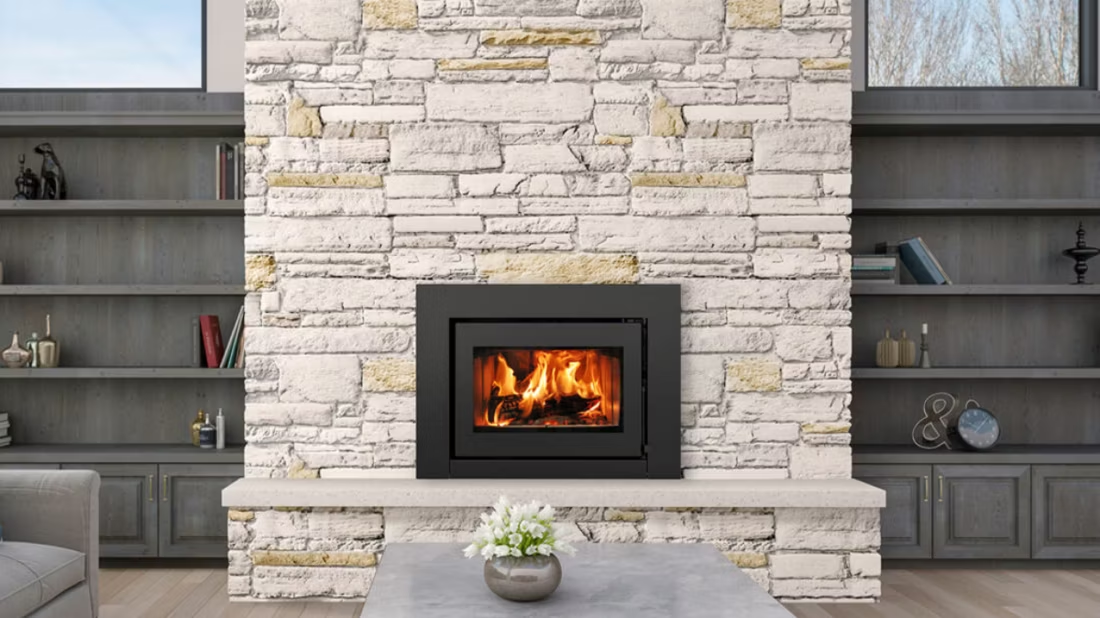
An insert does two things: it seals the chimney completely, so you stop losing air you already paid to heat, and it radiates warmth into the room through the firebox and glass. Most add a heat-exchange fan that pulls cool room air underneath, wraps it around the hot firebox, and pushes it back out warm. Your home is more efficient before you've even lit the first fire.
Why is my open fireplace making my house colder?
Open fireplaces suck—literally. As the fire burns, it consumes air your furnace already paid to heat and pulls it out through the chimney, so the house is actually colder after the fire goes out than before you lit it. An insert fixes this: it seals the chimney, puts fixed glass across the front, and turns that hole in your house into a real heat source.
Can I install a fireplace myself?
If you're putting a fire in your house on purpose, it's best to work with an expert. Unless you're genuinely experienced in framing, gas line, vent pipe, and the national code on clearances to combustibles, have a professional do it—and ideally the same company that sells you the fireplace, so warranty, service, and liability all live under one roof.
How much should I budget for a fireplace?
For an average home—covering the fireplace, the vent pipe, and basic installation—a budget between $3,900 and $5,500 gives you a lot of options across wood, gas, and pellet. By the time you add finish work, gas line, and electrical, the average complete installation lands between $5,000 and $12,000 all-in. In a remodel or new build, a good rule is to put about 2.5% of the total project cost toward the fireplace.
Nearby Dealers
Hearth shops serving Franklin Lakes and the surrounding area. Every listing shows whether it is a WhyFire partner, a dealer we have verified as authorized for the brands we recommend, or a local business carrying hearth products. No manufacturer pays for placement. How we verify dealers →
Kjb Fireplaces
Fireplaces By Design
Mcnamara Fireplace And Stove
Light N Grid
Chimney Sweep Energy Barn
Flue Tech
County Woodstoves Inc
N & N Services
Fire Design
Valley Mason Supply
Westchester Fireplace
Paradise Pool & Spa Inc.
Agi Supply Inc
Timberline Speciality Products
Timberline Stoves
Big Apple Fireplaces
Jones Service Co. LLC, Firecomfort
See what a wood fireplace actually looks like in Franklin Lakes.
Tell us about your home and we'll be honest about whether wood makes sense—then match you with a trusted local dealer and a free Project Guide & Parts List for your specific project.
Find Your Fireplace →