
Instant warmth for Tallahatchie County's Delta winters.
From Charleston to Sumner to Tutwiler, most of Tallahatchie County runs on propane rather than piped natural gas—and a gas fireplace or insert still delivers instant, no-mess heat on the county's cold, damp nights. Find the right unit and get matched with a trusted local dealer.
Every Project Starts From One of These Five Situations
Mild winters, real cold snaps, and gas that just works.
Tallahatchie County sits deep in the Mississippi Delta, where climate zone 3A means long, humid summers and winters that are mild by national standards—a modest heating season, a fraction of what a place like Duluth, Minnesota deals with, and an average winter low around 32°F. But mild doesn't mean absent. The county still sees hard freezes, the occasional ice storm off the Delta flatlands, and stretches of damp, chilly weather that a window unit or space heater simply can't keep up with. That's the gap a gas fireplace fills for a lot of households here.
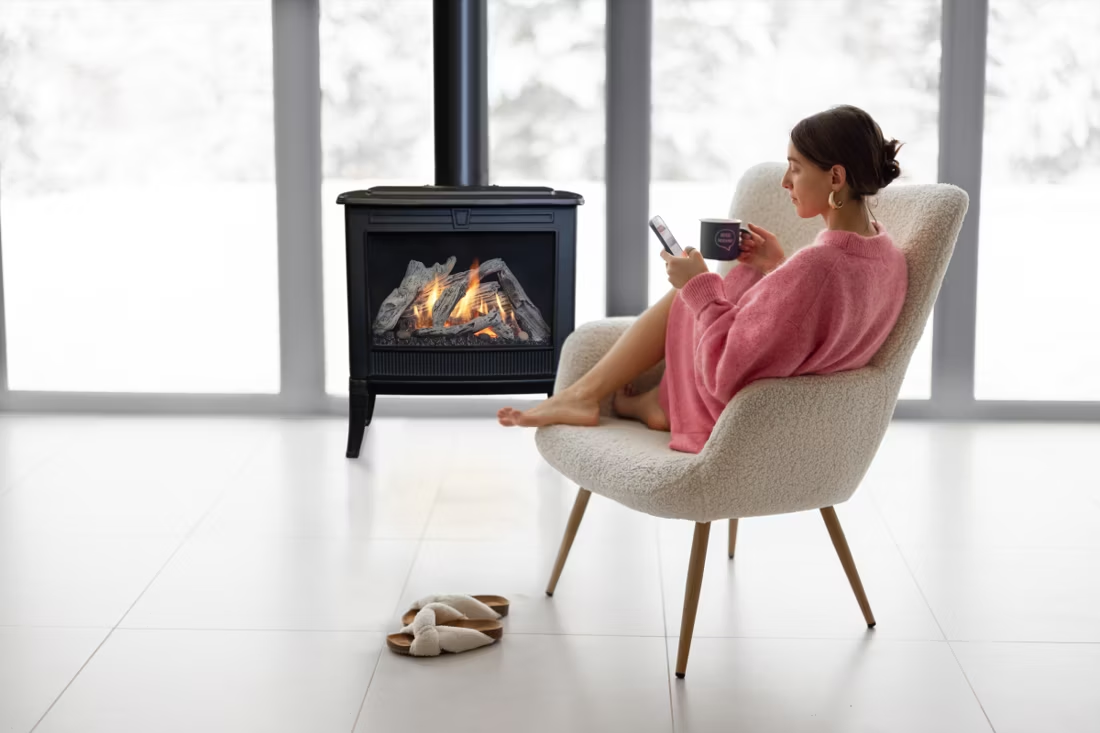
With a population under 6,500 spread across two county seats—Charleston and Sumner—plus small towns like Webb, Tutwiler, and Glendora, Tallahatchie County is rural enough that piped natural gas isn't a given outside a handful of town cores. Propane is the practical fuel for most homes here, delivered by tank and stored on-site, and it runs a gas fireplace, insert, or stove exactly the same way natural gas does. Either way, the appeal is the same: heat on demand, no wood to split or haul, and—with the right ignition system—a fireplace that still works when an ice storm knocks out the power.
Three steps. No salesperson until you're ready.
Tell us about your project
Your zip code, your situation, and the fuel you're leaning toward—or let the answers point you to one.
See what's actually available
The brands dealers within 100 miles genuinely carry—real options, never a catalog mirage.
Get your dealer & Project Guide
A trusted local dealer, plus the free Project Guide & Parts List that names every component of the job.
Frequently Asked Questions
How much does a gas fireplace installation cost in Tallahatchie County?
Most gas fireplace and insert installations in a rural Delta county like Tallahatchie run somewhere between $3,500 and $9,000, with the low end covering a direct-vent insert dropped into an existing masonry fireplace that already has gas or propane plumbed nearby. The higher end covers new construction or remodels where a fresh gas line has to be run, a propane tank needs to be set, or venting has to be built from scratch through a wall or roof. Because natural gas mains don't reach most of the county outside the Charleston and Sumner town cores, a propane tank installation is often part of the quote—factor that into your budget if you don't already have a tank on the property. A local dealer will give you a firm number after seeing your home.
Can I convert my existing wood fireplace to gas?
Yes, and it's a common project in older Delta farmhouses with a masonry fireplace that's rarely used because splitting and hauling oak or pine just isn't practical anymore. A gas insert typically uses your existing chimney as the venting path, with a stainless liner run down through it, and the conversion runs roughly $3,500 to $7,500 depending on the insert and whether you're running propane or natural gas. Homes already set up with a propane tank for a range or water heater are usually the easiest and least expensive conversions.
Should I use propane or natural gas for my fireplace in Tallahatchie County?
For most of Tallahatchie County, propane is the answer by default—piped natural gas service is limited to pockets within town limits in Charleston and Sumner, and even there it isn't universal. If your home already has a natural gas hookup for a furnace or water heater, adding a gas fireplace on the same line is straightforward and often cheaper than setting up propane. If you're outside town or don't already have gas service, a propane tank (either owned or leased from a regional supplier) is the standard path, and nearly every gas fireplace on the market can be configured to run on it. Your local dealer will ask which fuel you have access to before recommending a specific model.
Will my gas fireplace still work if the power goes out?
It can, depending on the ignition system. Units with intermittent pilot ignition (IPI) run on a small battery backup that kicks in automatically when the power drops, so the fireplace lights on demand just like it normally would. That matters in Tallahatchie County, where ice storms and severe spring weather can knock out power in rural areas for longer than in town. Valor's gas fireplaces go a step further—they generate their own electricity off the pilot's thermocouple, so there's no battery to remember to replace. Ask your dealer about the ignition system on any model you're considering, especially if you're out in the county away from Charleston or Sumner.
What's the difference between a gas fireplace, gas insert, and gas stove?
A gas fireplace is a fully built-in unit framed into a wall—the right choice for new construction or a major remodel. A gas insert is built to slide into an existing masonry fireplace opening, sealing it up and using the chimney as the vent path, which is the common route for older Delta homes with a fireplace that's gone cold. A gas stove is a freestanding cast-iron or steel unit that sits on a hearth pad, similar in footprint to a wood stove but running on propane or natural gas. For most Tallahatchie County homeowners with an existing fireplace, an insert is the simplest upgrade.
Do I need a permit to install a gas fireplace in Tallahatchie County?
Yes—new gas fireplace installations typically require both a building permit and sign-off on the gas line work, handled through the county building department, with offices split between the county's two seats, Charleston and Sumner. Most local hearth dealers coordinate this as part of the install, including the licensed gas-fitter work required for propane or natural gas line connections, so you're not left juggling separate trades and inspections yourself.
Should I get a vented or vent-free gas fireplace in a humid climate like this?
Vented (direct-vent) gas fireplaces draw combustion air from outside and exhaust it back outside through sealed venting—they're the safer, code-compliant choice everywhere, including Mississippi. Vent-free units burn fuel directly into the room and release some water vapor and combustion byproducts indoors, which is a real consideration in a humid, zone 3A climate like Tallahatchie County's, where excess indoor moisture can contribute to condensation and mold issues over a Delta summer and damp winter. Vent-free models are legal in Mississippi with proper room-sizing and oxygen depletion sensors, but most local dealers steer homeowners here toward direct-vent units for that reason. Ask about both when you talk to a dealer.
How often does a gas fireplace need to be serviced?
Plan on an annual inspection, ideally before the first cold snap each fall. A technician checks the burner, pilot assembly, gas connections, and venting, and cleans the glass and interior—a quicker job than a wood chimney sweep but just as important for safe operation. In a rural county like Tallahatchie, where dealers may cover a wide service area, it's worth scheduling early in the season rather than waiting for the first cold week, when service calls tend to back up.
Gas or wood—which makes more sense for a Tallahatchie County home?
Wood is still a natural fit here—oak, pine, and pecan are all common and locally available, and a wood stove or fireplace gives you heat that doesn't depend on a propane delivery or the power grid. But with only a modest heating season and winter lows that hover around freezing rather than deep into single digits the way they would in Fargo, North Dakota, most Tallahatchie County homes don't need wood as a primary heat source the way a harsher climate would demand. Gas wins on convenience: instant on-off heat, no hauling or splitting, and a cleaner look, especially for households that want supplemental warmth in a living room or den rather than a full-time heat source. Plenty of homes in the county end up with both—gas for everyday convenience, and a wood-burning option kept in reserve.
Can I put a TV above my fireplace?
Yes—with an asterisk. Fireplaces are hot and TVs don't like heat. Either put a mantel between them to deflect rising warmth, or choose a fireplace with heat-management technology that creates a cool zone on the wall above—the wall stays around 125 degrees, barely warm, while the room still gets full heat. If you like clean lines and don't want a mantel, heat management is the answer.
Is my gas fireplace wasting gas?
If it was installed more than 15 years ago, probably. Older gas fireplaces keep a standing pilot light burning all the time, and that little flame can cost a couple hundred dollars a year. Newer models use pilot-on-demand ignition—the pilot lights only when you use the fireplace and goes out when you turn it off.
Can I install a fireplace myself?
If you're putting a fire in your house on purpose, it's best to work with an expert. Unless you're genuinely experienced in framing, gas line, vent pipe, and the national code on clearances to combustibles, have a professional do it—and ideally the same company that sells you the fireplace, so warranty, service, and liability all live under one roof.
How much should I budget for a fireplace?
For an average home—covering the fireplace, the vent pipe, and basic installation—a budget between $3,900 and $5,500 gives you a lot of options across wood, gas, and pellet. By the time you add finish work, gas line, and electrical, the average complete installation lands between $5,000 and $12,000 all-in. In a remodel or new build, a good rule is to put about 2.5% of the total project cost toward the fireplace.
Stove and Fireplace Dealers in Tallahatchie County
Find your gas fireplace in Tallahatchie County.
Tell us a bit about your home and fuel setup—propane or natural gas—and we'll match you with a trusted local dealer and send over a free Project Guide & Parts List for your gas fireplace project.
Find Your Fireplace →