
Steady Heat for Haskell County Winters.
Clean, on-demand gas heat built for the wind-driven cold snaps of the southwest Kansas plains. Find the right unit and find a trusted local dealer.
Every Project Starts From One of These Five Situations
Reliable heat without the wood pile.
Sublette sits on the short-grass High Plains of Haskell County at just under 2,900 feet, where winter lows average around 20 degrees and the real challenge isn't depth of cold so much as wind. The winter heating load here is genuinely milder than the northern plains—Bismarck, North Dakota logs nearly double that—but a 30-mph January wind out of the northwest still drops the effective temperature fast, and homes here need heat that comes on instantly and holds steady through a multi-day cold spell.
This is short-grass prairie country, not timber country. Aside from scattered hedgerows of osage orange planted decades ago as windbreaks, there's little standing forest to supply cordwood, which is part of why wood stoves never took hold the way they did in wooded parts of the country. Gas fills that role instead. In-town properties in Sublette are typically closest to municipal or piped gas service, while farms and ranches spread across Haskell County more often run on propane delivered and stored on-site—either way, a properly sized gas fireplace or insert gives you heat at the flip of a switch, without hauling fuel or tending a fire during a ground blizzard.
Three steps. No salesperson until you're ready.
Tell us about your project
Your zip code, your situation, and the fuel you're leaning toward—or let the answers point you to one.
See what's actually available
The brands dealers within 100 miles genuinely carry—real options, never a catalog mirage.
Get your dealer & Project Guide
A trusted local dealer, plus the free Project Guide & Parts List that names every component of the job.
Frequently Asked Questions
How much does a gas fireplace installation cost in Sublette?
For a rural Kansas town this size, a straightforward gas insert or direct-vent fireplace installation typically falls between $3,800 and $8,500. Homes already piped for gas or already running a propane tank land on the lower end; the higher end covers new propane tank installation, a longer gas line run out to a detached hearth room, or venting work through a masonry chimney that needs a stainless liner. Because Sublette is small, most homeowners get their firm quote from a hearth or HVAC dealer based out of Garden City or Liberal, who will scope the gas line and venting during an in-home visit before quoting a final number.
Should I plan on natural gas or propane for my fireplace?
It depends on where in Haskell County you're located. In-town Sublette addresses are the most likely to sit near existing piped gas service, while outlying farms and acreages typically run on propane, with a tank set on the property and refilled by a regional propane supplier. Nearly every gas fireplace and insert sold today can be configured for either fuel—the installer swaps the orifice and regulates the pressure accordingly—so the fuel source shouldn't limit which unit you choose. If you're unsure what's already run to your house, that's one of the first things a local dealer will confirm before recommending a model.
Do I need a permit to install a gas fireplace in Sublette?
Most likely, yes. Given the size of Sublette, permitting for a new gas appliance and any associated gas line work generally runs through the Haskell County building and zoning office rather than a dedicated city building department. The gas line itself needs to be run by a licensed gas-fitter regardless of jurisdiction. In practice, the dealer who sells and installs your fireplace typically coordinates the permit and inspection as part of the job, so you're not chasing down paperwork on your own.
Will my gas fireplace still work if the power goes out?
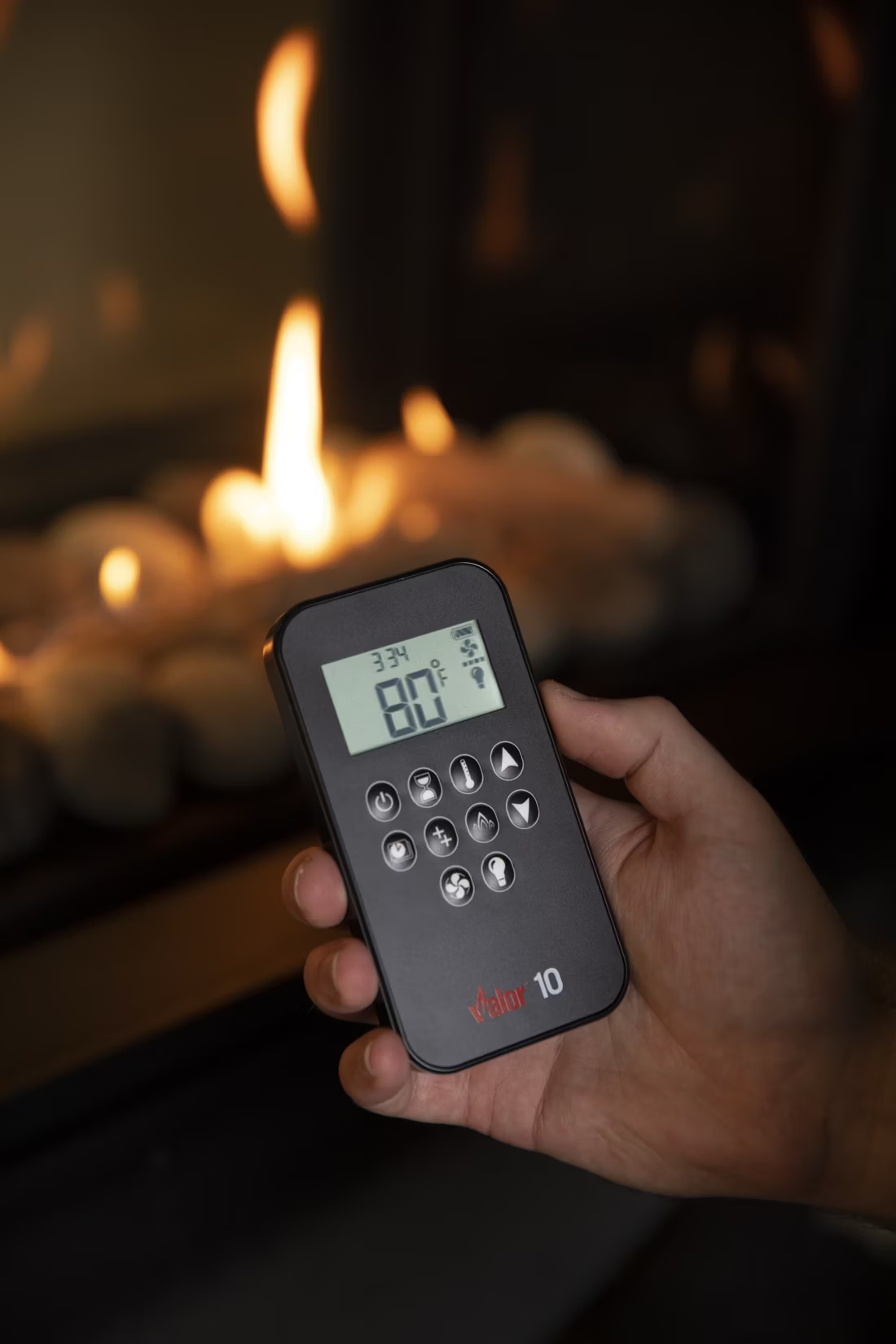
Most will, which matters here—a hard winter wind event or ice storm can knock rural electric service out for hours at a time. Gas fireplaces with intermittent pilot ignition (IPI) run on a small battery backup that kicks in automatically when the co-op power drops, so the unit lights and operates normally on batteries alone. Valor fireplaces go a step further: the pilot's thermocouple generates the small amount of electricity the unit needs to fire, so there's no battery to remember. For a Haskell County home where the nearest crew truck might be an hour out during a bad storm, that kind of self-sufficiency is worth asking about.
What's the difference between a gas fireplace, insert, and stove?
A gas fireplace is a fully built-in unit, framed into a wall—the standard choice for new construction or a remodel. A gas insert slides into an existing masonry fireplace opening and vents up through the existing chimney with a liner, which is the common upgrade path for older Sublette homes with a fireplace that was never much more than decorative. A gas stove is a freestanding, cast-iron-look unit that sits out on the floor, which works well in a smaller home or a room without an existing fireplace or a lot of wall space to frame into.
Vented or vent-free—which makes sense for a Sublette home?
Vented (direct-vent) gas fireplaces pull combustion air from outside and exhaust it back outside through sealed pipe, which keeps combustion byproducts out of your living space entirely. Vent-free units burn without any exterior venting and are legal in Kansas, but they release water vapor and small amounts of combustion gas into the room and come with strict rules on room size and ventilation. For a tightly built farmhouse or a newer energy-efficient home in Haskell County, a direct-vent unit is the safer, more universally recommended choice—it also tends to throw more usable heat, which matters more here than the installation simplicity of a vent-free unit.
Who services gas fireplaces near Sublette?
Because Sublette's population is under 1,500, dedicated hearth specialists are more likely based in Garden City or Liberal, both within reasonable driving distance, and most will service what they install as part of an annual maintenance visit. Expect to budget roughly $150 to $250 for a yearly inspection covering the burner, pilot assembly, venting, and gas connections. Given the drive time involved for a technician, it's worth scheduling that inspection in late summer or early fall, before the first hard cold front rolls through, rather than waiting until a unit acts up mid-winter.
What size gas fireplace do I need for a Haskell County home?
Sublette's winter heating load puts it in a moderate cold climate—noticeably milder than the northern plains, but a fireplace here still needs to hold its own against sustained wind chill, not just still-air cold. For a supplemental unit in a single living area, a smaller direct-vent fireplace in the 20,000–30,000 BTU range is usually enough. If you're leaning on it as a primary heat source for an older farmhouse with poor insulation, sizing up toward 35,000+ BTU with a larger footprint may make more sense. A local dealer will walk your square footage, ceiling height, and insulation before recommending a specific model—that's a step worth not skipping given how much wind exposure affects real-world heat loss out here.
Why gas instead of wood, pellet, or electric heat in Sublette?
Wood and pellet stoves are genuinely uncommon in this part of Kansas—the region is short-grass prairie with little natural forest, and even the pellet brands sold regionally (Lignetics, Indeck Energy Services) see limited local demand because there's no strong tradition of wood heat to build on. Electric is a real option too: Haskell County is served by a patchwork of rural cooperatives—CMS Electric Coop, Southern Pioneer Electric, and Pioneer Electric Coop—with residential rates that range widely, from about 11 cents to nearly 19 cents per kWh depending on which co-op serves your address. That spread makes electric heat a lot more expensive to run in some parts of the county than others. Gas sidesteps that variability, delivers more heat per dollar in most of Haskell County, and—with battery-backed ignition—keeps working through the power outages that come with plains windstorms.
Why is my open fireplace making my house colder?
Open fireplaces suck—literally. As the fire burns, it consumes air your furnace already paid to heat and pulls it out through the chimney, so the house is actually colder after the fire goes out than before you lit it. An insert fixes this: it seals the chimney, puts fixed glass across the front, and turns that hole in your house into a real heat source.
What's the difference between an insert and a zero-clearance fireplace?
An insert is a fireplace that slides into a pre-existing wood-burning fireplace—if you don't have one, there's nothing to insert it into. A zero-clearance fireplace is built into a framed wall, which makes it the answer for remodels and new construction. Simple test: existing masonry fireplace means insert; blank or framed wall means zero-clearance.
Does a fireplace add value to my home?
On average, a fireplace adds back to the home about the same amount you spent installing it. Add the monthly savings from heating the rooms you actually use instead of the whole house—often hundreds of dollars a year—and the value case is strong before you even count what a fire does for how your family uses the room.
How much should I budget for a fireplace?
For an average home—covering the fireplace, the vent pipe, and basic installation—a budget between $3,900 and $5,500 gives you a lot of options across wood, gas, and pellet. By the time you add finish work, gas line, and electrical, the average complete installation lands between $5,000 and $12,000 all-in. In a remodel or new build, a good rule is to put about 2.5% of the total project cost toward the fireplace.
Nearby Dealers
Hearth shops serving Sublette and the surrounding area. Every listing shows whether it is a WhyFire partner, a dealer we have verified as authorized for the brands we recommend, or a local business carrying hearth products. No manufacturer pays for placement. How we verify dealers →
We’ve paused dealer listings for this connection today. Enter your zip or postal code above to find dealers near you, or come back tomorrow.
Popular Gas Brands
Where each brand came from, what's inside it today, and every current model. No brand pays to be here. Not every dealer carries every brand, so enter your zip code to see what's sold near Sublette.
Kozy Heat
Kozy Heat was founded in 1976 by Dudley Hussong in Lakefield, Minnesota, and incorporated as Hussong Manufacturing Co., Inc. in 1978.
28 gas models →Fireplace Xtrordinair
Fireplace Xtrordinair, now often called FireplaceX, is the fireplace brand of Travis Industries, Inc., of Mukilteo, Washington.
25 gas models →Town & Country
Town & Country Fireplaces is the luxury gas fireplace brand of Pacific Energy Fireplace Products Ltd., of Duncan, British Columbia.
14 gas models →Lopi
Lopi is a wood, pellet, and gas stove brand founded by Kurt Rumens in Bellevue, Washington, in 1979.
7 gas models →Forge & Flame
Forge & Flame is the stove brand Hearth & Home Technologies introduced in August 2023 to bring Vermont Castings, Harman, and Quadra-Fire under one name.
6 gas models →Vermont Castings
Vermont Castings was founded in 1975 by Duncan Syme, the designer, and his brother-in-law Murray Howell, the business partner, in Randolph, Vermont.
6 gas models →Find your gas fireplace in Sublette.
Tell us a bit about your home and heating goals, and we'll put together a free Project Guide & Parts List—the right gas fireplace or insert, the exact venting and parts your install needs, and a trusted local dealer to install it.
Find Your Fireplace →