
Add instant, no-venting warmth to your Comanche County home.
No chimney, no gas line, no cutting and hauling wood—just plug it in. Find the right electric fireplace or insert for your Coldwater or Protection-area home and connect with a trusted local dealer.
Every Project Starts From One of These Five Situations
Simple heat for a spread-out county.
Comanche County covers roughly 790 square miles of south-central Kansas plains and sits in IECC climate zone 4A—winters that swing from mild to genuinely cold, with wind off the open country doing most of the damage to an under-insulated older farmhouse. With a population of about 1,255 spread across Coldwater, Protection, and the ranch land between them, most homes here are older single-family farmhouses or manufactured homes, and many sit well outside any natural gas main. That combination—older housing stock, no municipal gas, and long driveways—is exactly where an electric fireplace or insert earns its place: no venting, no gas line trenching, and a straightforward install that doesn't require touching the roof or the foundation.
Wood has deep roots here too—oak, hickory, and osage orange all grow locally and are common firewood species for the wood stoves and fireplaces already in a lot of Comanche County homes. Electric units usually enter the picture as the practical add-on: a bedroom, sunroom, or finished basement that the wood stove or central furnace doesn't reach efficiently, or a rental property where a landlord wants supplemental heat without maintenance obligations. It's not a whole-house solution, but as targeted, no-fuss zone heat for a specific room, it's hard to beat for a county this rural.
Three steps. No salesperson until you're ready.
Tell us about your project
Your zip code, your situation, and the fuel you're leaning toward—or let the answers point you to one.
See what's actually available
The brands dealers within 100 miles genuinely carry—real options, never a catalog mirage.
Get your dealer & Project Guide
A trusted local dealer, plus the free Project Guide & Parts List that names every component of the job.
Frequently Asked Questions
How much does an electric fireplace installation cost in Comanche County?
Plug-in electric inserts and freestanding units that use a standard 120-volt outlet typically run $300 to $900 installed, since there's no gas line or venting to run—most of the cost is the unit itself plus mounting. Built-in wall units or larger inserts that need a dedicated 20-amp circuit run higher, generally $1,200 to $2,500, once you factor in a licensed electrician to run new wiring—which is common in Comanche County's older farmhouses that weren't built with a lot of spare circuit capacity. A local dealer can tell you quickly which category your home falls into during a walkthrough.
Do I need a permit to install an electric fireplace in Comanche County?
A simple plug-in unit that draws from an existing outlet generally doesn't require a permit. If your install calls for a new dedicated circuit or any panel work, that falls under electrical permitting through the Comanche County Courthouse in Coldwater, and it needs to be pulled by a licensed electrician—not a DIY job. Most dealers who handle built-in electric fireplace installs will coordinate this permit as part of the job so you're not chasing it down yourself.
Will an electric fireplace heat my whole farmhouse?
No—and it's worth being upfront about that. Electric fireplaces are designed for zone heating, typically 400 to 1,500 square feet per unit depending on the model, and they perform best in a single room or open living area with a closed door or defined boundary. Many older Comanche County farmhouses have drafty additions, uninsulated walls, or rooms added on over the decades that don't hold heat well—an electric unit will make one of those rooms comfortable, but it isn't a replacement for your furnace or a wood stove on the coldest nights.
Electric vs. wood—which makes more sense for my home?
In a county where oak, hickory, and osage orange are all locally available and plenty of homes already have a wood stove or fireplace, wood remains the go-to for whole-house or primary heat, especially given how often rural power lines here take a hit from ice or high wind. Electric fireplaces shine as the supplemental piece—heating a specific room efficiently, running with a flip of a switch, and requiring zero cutting, stacking, or ash cleanup. A lot of Comanche County households end up running both: wood for the main heat source, electric for a bedroom or den that doesn't need a full-time fire.
Will my electric fireplace still work during a power outage?
No—an electric fireplace is entirely dependent on grid power, and rural Comanche County is served by a co-op electric system that, like most rural lines on the open plains, can go down during ice storms or high-wind events. If backup heat during an outage matters to you, plan on a wood stove or a propane appliance with a battery-backed ignition as your primary system, and treat the electric fireplace as the convenience heater for normal day-to-day use.
Where can I buy and install an electric fireplace near Comanche County?
Comanche County itself, with a population under 1,300 spread between Coldwater and Protection, doesn't support a dedicated hearth retailer of its own. Most homeowners here work with dealers based in nearby larger towns—Pratt, Medicine Lodge, or Dodge City are the common trip options—who serve the surrounding rural counties and are used to installs on farmhouses and manufactured homes. Find My Fireplace matches you with one of these trusted dealers rather than leaving you to guess which one actually covers your address.
What's the difference between a plug-in electric fireplace, a wall insert, and a mantel package?
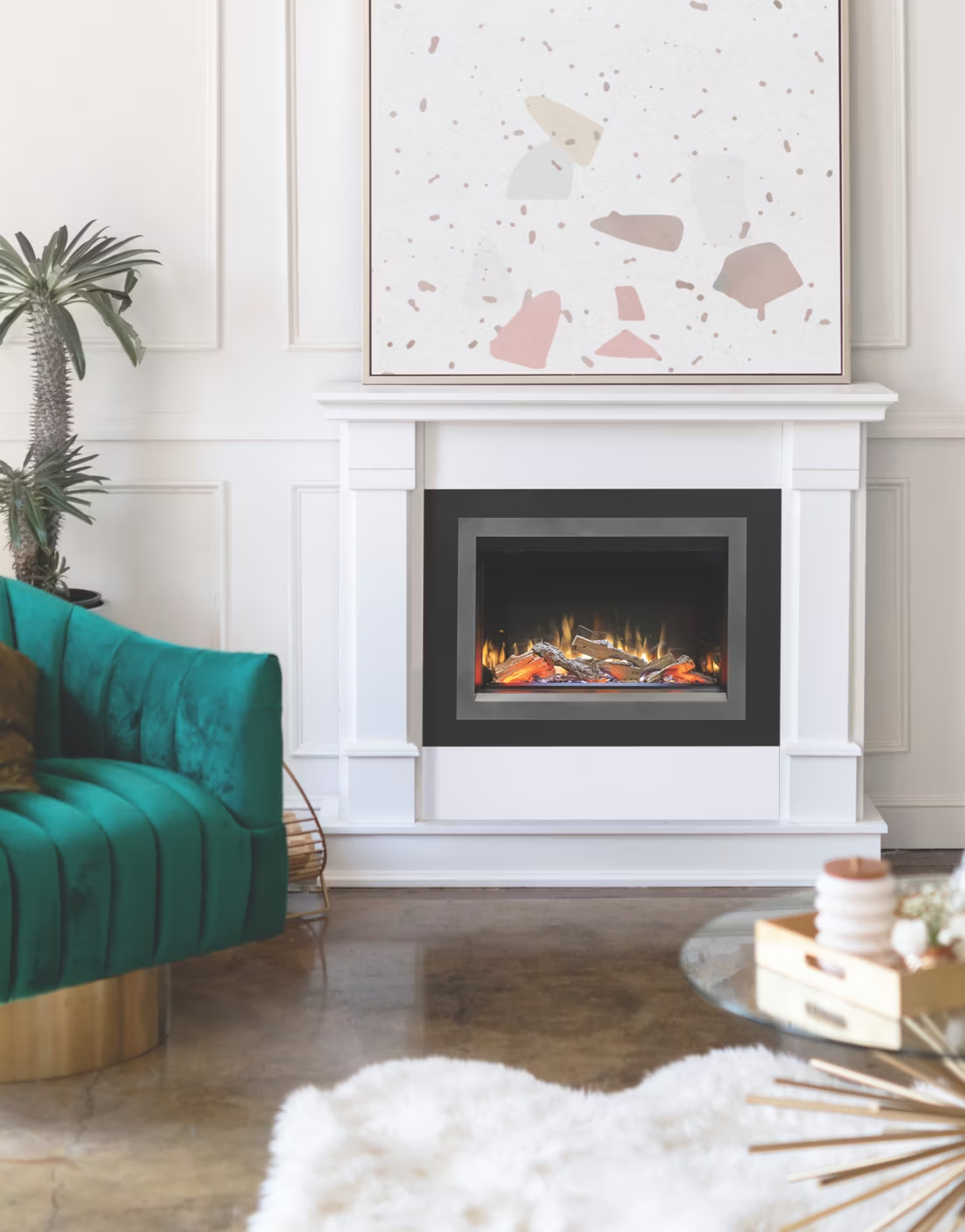
A plug-in insert drops into an existing fireplace opening or a simple frame and runs off a standard outlet—the easiest and cheapest option, and a good fit for retrofitting an old, unused masonry fireplace. A built-in wall unit recesses into the wall for a flush, more architectural look but usually needs a dedicated circuit and some framing work. A mantel package pairs an electric insert with a surrounding cabinet or mantel shelf, which is popular in manufactured and modular homes common throughout Comanche County since it doesn't require any wall modification at all.
Does my house have the electrical capacity for a larger electric fireplace?
It depends on the age of your panel and how much spare capacity it has—a real consideration in a county where a lot of the housing stock is decades old. Smaller plug-in units under 1,500 watts usually run fine on an existing circuit without issue. Larger built-in units drawing closer to the standard 1,500-watt max often need their own dedicated 20-amp circuit, which means an electrician evaluating your panel first. This is worth confirming before you buy a unit, not after—a local dealer or electrician can check your panel capacity in a short visit.
Electric vs. propane—which is the better fit for supplemental heat here?
Since Comanche County has no municipal natural gas service, propane is the common alternative to electric for homes wanting more heat output than an electric unit provides. Propane fireplaces and stoves put out more BTUs and can often run during a power outage with a battery-backed ignition system, but they require a propane tank, a supplier, and ongoing fuel deliveries. Electric skips all of that—no tank, no delivery schedule, no combustion byproducts—but it's capped at roughly 5,000 BTU-equivalent output and needs the grid to run. For a single room that just needs to feel warmer without another fuel account to manage, electric is usually the simpler answer.
Do electric fireplaces actually produce heat?
Yes—most put out around 4,800–5,000 BTUs from a standard outlet, which comfortably warms a bedroom, office, or den as a comfort-zone heater. What they won't do is carry a whole house the way wood, gas, or pellet can. Think of electric as ambiance-first with honest supplemental heat: flames on with no heat in July, flames plus warmth in January.
Can I put a TV above my fireplace?
Yes—with an asterisk. Fireplaces are hot and TVs don't like heat. Either put a mantel between them to deflect rising warmth, or choose a fireplace with heat-management technology that creates a cool zone on the wall above—the wall stays around 125 degrees, barely warm, while the room still gets full heat. If you like clean lines and don't want a mantel, heat management is the answer.
Does a fireplace add value to my home?
On average, a fireplace adds back to the home about the same amount you spent installing it. Add the monthly savings from heating the rooms you actually use instead of the whole house—often hundreds of dollars a year—and the value case is strong before you even count what a fire does for how your family uses the room.
How much should I budget for a fireplace?
For an average home—covering the fireplace, the vent pipe, and basic installation—a budget between $3,900 and $5,500 gives you a lot of options across wood, gas, and pellet. By the time you add finish work, gas line, and electrical, the average complete installation lands between $5,000 and $12,000 all-in. In a remodel or new build, a good rule is to put about 2.5% of the total project cost toward the fireplace.
Find your electric fireplace in Comanche County.
Tell us about your Comanche County home and we'll send a free Project Guide & Parts List—the right electric fireplace or insert for your space, matched with a trusted local dealer who can install it correctly the first time.
Find Your Fireplace →