
Find dependable pellet heat for Monona County's cold winters.
Thermostat-controlled heat for a county that sees roughly 6,845 heating degree days and winter lows averaging 8°F. Find the right pellet stove or insert and connect with a trusted local dealer serving Onawa, Mapleton, Whiting, and the rural stretches in between.
Every Project Starts From One of These Five Situations
Consistent, low-maintenance heat for a rural county.
Monona County sits along the Missouri River bluffs in western Iowa, a mix of farmland, river-bottom timber, and small towns anchored by Onawa. With a Climate Zone 5A designation, 6,845 heating degree days, and winter lows that average around 8°F, this is a long-heating-season county—the kind of place where a stove needs to run reliably from November through March, not just look nice for a few cold nights. The county's hardwood cover—oak, hickory, maple, and walnut—has kept plenty of local households in the firewood habit for generations, but a growing number of homeowners here are choosing pellet for the trade-off it offers: no splitting, no stacking, no daily hauling from the woodpile.
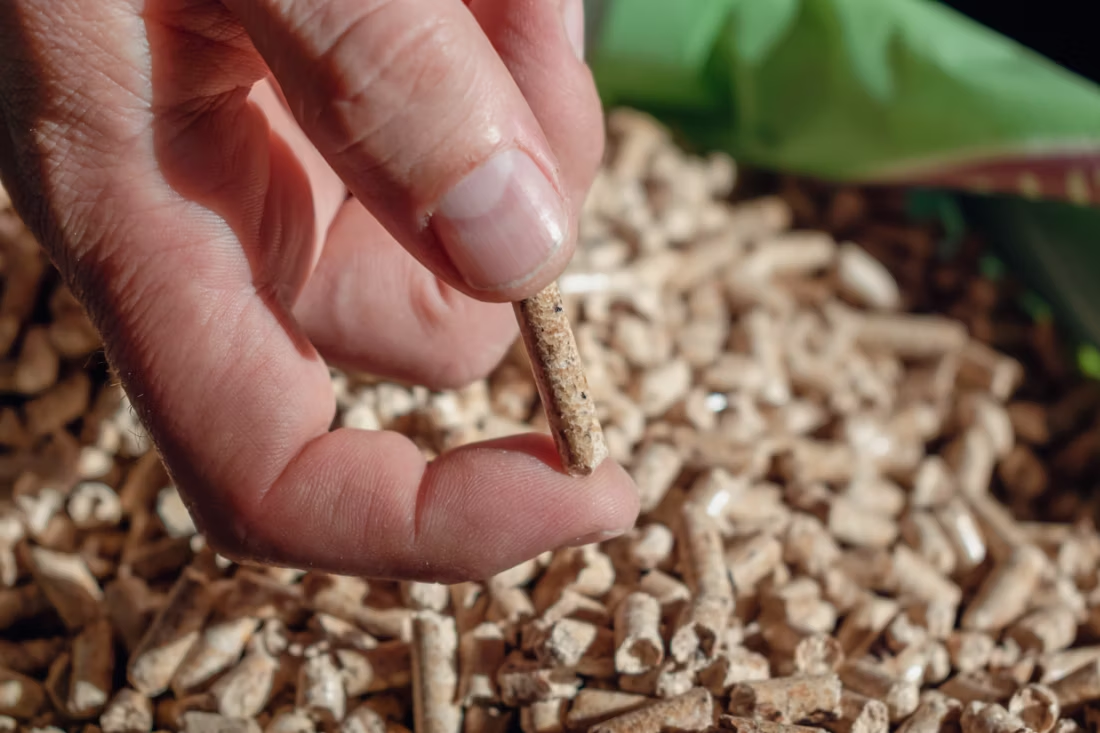
Pellet supply in this part of Iowa runs through regional producers like Lignetics, whose bagged hardwood and softwood pellets are widely distributed across the upper Midwest, along with industrial-scale biomass fuel from Indeck Energy Services. Monona County has no air quality non-attainment designations and no winter burn curtailment periods, which means pellet stoves here run on the homeowner's schedule rather than around local air-quality restrictions—a small but real advantage over counties where wood-burning appliances get shut down on inversion days. Combine that with a thermostat-controlled hopper feed and a HDD load north of 6,800, and it's easy to see why pellet has found a foothold alongside traditional wood heat in this county.
Three steps. No salesperson until you're ready.
Tell us about your project
Your zip code, your situation, and the fuel you're leaning toward—or let the answers point you to one.
See what's actually available
The brands dealers within 100 miles genuinely carry—real options, never a catalog mirage.
Get your dealer & Project Guide
A trusted local dealer, plus the free Project Guide & Parts List that names every component of the job.
Frequently Asked Questions
How much does a pellet stove installation cost in Monona County?
Most pellet stove installations in this part of Iowa—stove, PL venting through an exterior wall, hearth pad, and the dedicated electrical outlet the auger and blower require—run in the $3,000 to $6,000 range. Installing into an existing masonry fireplace as a pellet insert usually lands toward the lower half of that range if the fireplace opening doesn't need modification. Costs move higher when a home needs new electrical circuit work run to the stove location or when venting has to travel further than a simple through-wall path, which comes up more often in Monona County's older farmhouses than in newer town construction.
What size pellet stove do I need for my home?
With winter lows averaging 8°F and a heating load near 6,845 degree days, Monona County homes generally need to size toward the middle-to-larger end of the pellet stove range rather than the smallest units on the showroom floor. A small pellet stove (rated for roughly 1,000 sq ft) suits a single room or a well-insulated addition; a medium stove (1,000–1,800 sq ft) handles most main living areas in the county's ranch and farmhouse layouts; a large stove (1,800–2,300+ sq ft) is often the right call for older, less-insulated farmhouses trying to hold heat through a full Iowa winter. A local dealer will walk your square footage and insulation level before recommending a specific model.
Do I need a permit to install a pellet stove in Monona County?
Yes—new pellet stove installations typically require a building permit through the Monona County building department, and any new electrical circuit for the stove's auger and blower needs to meet code, usually pulled by a licensed electrician as part of the job. Most local hearth dealers handle the permit paperwork as part of the installation, so homeowners rarely have to coordinate it themselves. Because Monona County has no air-quality non-attainment status, there are no special emissions permits or burn-curtailment rules to navigate beyond the standard building permit process.
Pellet stove vs. wood stove—which makes more sense in Monona County?
Wood is deeply established here—oak, hickory, maple, and walnut from local river-bottom timber and farmstead windbreaks make for excellent firewood, and plenty of county households already have a supply chain for it. A wood stove also keeps running with zero electricity, which matters when a winter storm knocks out power. Pellet stoves trade that off for real convenience: load a hopper instead of splitting and stacking rounds, set a thermostat instead of tending coals, and get a cleaner, more consistent burn with less ash. For homes without an existing woodlot or the time for wood processing, pellet is usually the easier long-term fit. For homes that already burn wood and want backup heat that works when the grid doesn't, wood remains the safer bet.
What happens to my pellet stove during a power outage?
Pellet stoves depend on electricity to run the auger that feeds fuel and the blower that circulates heat—without power, the stove shuts down. This matters in a rural county like Monona, where winter storms can knock out power for hours at a stretch. Homeowners who want pellet convenience but also need outage resilience typically pair the stove with a small battery backup unit or a portable generator sized to run the auger and blower motor, which draw relatively little power. If reliable heat during outages is the top priority and a backup power source isn't in the plan, a wood stove is worth considering as either a primary or supplementary appliance.
Where can I buy pellet fuel near Monona County?
Lignetics is one of the more widely distributed pellet brands carried by farm and hardware stores across western Iowa, typically sold in 40-lb bags by the ton (roughly 50 bags per ton). Indeck Energy Services also supplies pellet fuel to the regional market, more often through bulk or commercial channels. Stock up early in the fall—pellet supply at rural retailers can run thin in a hard cold stretch, and buying a season's worth (typically 2–3 tons for a primary-heat home in this climate) ahead of the coldest months avoids scrambling in January. Pellets need to be stored dry and off a concrete floor; a damp bag turns to sawdust fast.
How long will a pellet stove run on one hopper load?
Hopper capacity varies by model, typically 40 to 130 pounds, and burn time on a full hopper runs anywhere from 24 to over 50 hours depending on the stove's size and the heat setting. For a Monona County home running a pellet stove through a full winter with 6,845 heating degree days, most owners refill once or twice a day on the coldest stretches and less often during milder shoulder-season weeks. Larger-hopper models reduce how often you're refilling, which some homeowners value enough to size up even beyond their strict square-footage need.
How much maintenance does a pellet stove need?
Pellet stoves need more frequent light maintenance than wood stoves but far less heavy cleaning. Plan on emptying the ash pan every few days during regular use, wiping the glass weekly, and vacuuming the burn pot and hopper area every couple of weeks to keep the auger feeding smoothly. An annual professional service—checking the exhaust blower, gaskets, and venting—is recommended before each heating season starts, similar to an annual furnace tune-up. Skipping this tends to show up as feed jams or uneven burns rather than dramatic failures, but it's still worth keeping on schedule.
Pellet stove vs. propane heat—which is better for a Monona County home?
Much of rural Monona County runs on propane for primary heating rather than natural gas, so the comparison that actually comes up locally is pellet versus propane rather than pellet versus gas fireplace. Propane furnaces and space heaters offer thermostat convenience with no fuel loading at all, but propane prices can spike hard during cold snaps when regional demand peaks—exactly the weeks a pellet stove is cheapest to run per BTU. Many homeowners here use a pellet stove as supplemental or zone heat in the main living area, letting it carry the bulk of the heating load in shoulder-season months and cutting propane use during the coldest stretches rather than replacing the furnace outright.
How often does a pellet stove need cleaning?
A clean pellet stove is a happy pellet stove. Plan on cleaning the burn pot about once a week when you're burning regularly—ash and clinkers gum up the air holes just like a pellet barbecue. Most pellet stove problems trace back to skipped cleaning that nobody explained up front. Some designs make it easy with a trapdoor burn pot: pull a lever and the gunk drops into the ash pan.
What's the difference between an insert and a zero-clearance fireplace?
An insert is a fireplace that slides into a pre-existing wood-burning fireplace—if you don't have one, there's nothing to insert it into. A zero-clearance fireplace is built into a framed wall, which makes it the answer for remodels and new construction. Simple test: existing masonry fireplace means insert; blank or framed wall means zero-clearance.
How much should I budget for a fireplace?
For an average home—covering the fireplace, the vent pipe, and basic installation—a budget between $3,900 and $5,500 gives you a lot of options across wood, gas, and pellet. By the time you add finish work, gas line, and electrical, the average complete installation lands between $5,000 and $12,000 all-in. In a remodel or new build, a good rule is to put about 2.5% of the total project cost toward the fireplace.
Can a fireplace actually lower my heating bill?
Yes—by creating a comfort zone. A furnace heats every square foot of the house just to warm the one room you're in; a gas fireplace on low burns roughly a sixth of the gas a typical furnace does. Set the furnace around 55–60 degrees as a baseline, then heat the rooms your family actually uses. Families who heat this way commonly save $20–$60 a month.
Pellet Brands Stocked Around Monona County
Manufacturers will point you to the nearest stocking dealer.
Find your pellet stove in Monona County.
Tell us about your home and we'll match you with a trusted local dealer and send over a free Project Guide & Parts List—the right pellet stove or insert for Monona County's winters, the exact parts including venting, and a dealer who can install it correctly.,
Find Your Fireplace →