
Warm up any room in Mitchell County—no chimney required.
Zone heat and real ambiance for Osage, St. Ansgar, Riceville, and the farms in between—without a flue, a gas line, or a mess of ash. Find the right unit and get matched with a trusted local dealer.
Every Project Starts From One of These Five Situations
Reliable heat for a hard winter climate—without the risks.
Mitchell County sits in climate zone 6A, with an average winter low around 6°F and roughly 7,745 heating degree days a year—a workload closer to Fargo, ND or Duluth, MN than most of the Midwest. Across a county of about 5,750 people spread between Osage, St. Ansgar, Riceville, and Stacyville, wood heat has deep roots—oak, hickory, maple, and walnut are all cut locally off farm windbreaks and timber stands—and propane furnaces carry most of the rest of the heating load. Electric fireplaces fit into that picture as a supplemental option, not a replacement for the furnace or the wood stove out in the machine shed.
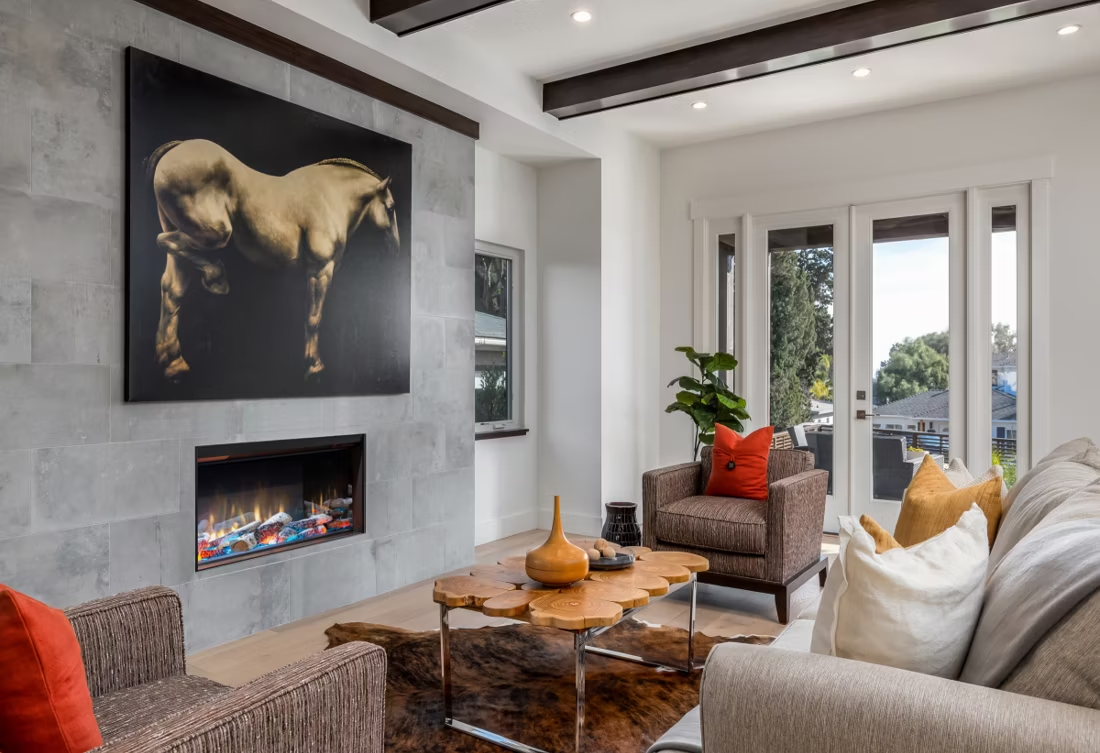
The appeal is flexibility: an electric insert can go into an old farmhouse fireplace opening that's structurally sound but not worth relining, a wall-mounted unit can add heat and light to a finished basement or a sunroom addition, and a freestanding electric stove works for renters or anyone who can't run a chimney through a rented space. There's no combustion, no clearance-to-combustibles requirement like a wood stove, and no gas line to run. The honest tradeoff: in a county with this many heating degree days, an electric unit alone won't carry a whole house through January, and it won't run at all if an ice storm takes down the power lines—which is worth planning around if you're relying on it as anything more than zone heat.
Three steps. No salesperson until you're ready.
Tell us about your project
Your zip code, your situation, and the fuel you're leaning toward—or let the answers point you to one.
See what's actually available
The brands dealers within 100 miles genuinely carry—real options, never a catalog mirage.
Get your dealer & Project Guide
A trusted local dealer, plus the free Project Guide & Parts List that names every component of the job.
Frequently Asked Questions
How much does an electric fireplace installation cost in Mitchell County?
Plug-in electric fireplaces and stoves that use a standard household outlet run on the low end—often under $1,000 installed, since there's no electrical work beyond plugging it in. Built-in wall units and larger inserts that need a dedicated 120V or 240V circuit run higher once you factor in an electrician's time to run new wiring, especially in older Mitchell County farmhouses where the existing panel may need a new breaker slot. Expect a wider range than gas or wood installs since so much depends on whether the electrical infrastructure is already in place. A local dealer can give you a firm number after seeing your panel and the install location.
Can an electric fireplace heat my whole home in Mitchell County's climate?
No—and any dealer telling you otherwise isn't being straight with you. Most electric fireplace inserts put out around 4,000 to 5,000 BTU on the heat setting, enough to comfortably warm a single room of 300 to 400 square feet, not a whole house facing 7,745 heating degree days a year. In Mitchell County, electric units work best as zone heat for a den, sunroom, or finished basement while your furnace or wood stove handles the main heating load. Think of it as a way to warm the room you're actually sitting in without running the furnace harder, not a way to cut it off.
Do I need a permit to install an electric fireplace in Mitchell County?
Plug-in units generally don't require a permit since there's no new wiring or structural work involved. If you're installing a built-in unit that requires a dedicated circuit, new wall framing, or an opening cut into existing cabinetry or a mantel surround, check with your local building and zoning office before starting—electrical work typically needs to be pulled by a licensed electrician regardless of the permit question. Most local dealers can tell you upfront whether your specific project crosses that line.
Will my electric fireplace work during a power outage?
No. Every electric fireplace, insert, or stove requires household power to run the heating element, blower, and flame-effect display—if the power goes out, it goes dark. That's a real consideration in rural Mitchell County, where ice storms and high winds can knock out lines for a day or more in the middle of winter. If you want heat that keeps working when the grid doesn't, a wood stove or a propane unit with a battery-backed ignition system is the better choice for that specific need. Plenty of homes here run electric for daily ambiance and convenience while keeping a wood stove or furnace as the outage-proof backup.
What's the difference between an electric fireplace, insert, and stove?
An electric fireplace is typically a built-in unit set into a wall or a mantel surround, often with a realistic flame display as the centerpiece of the room. An electric insert is sized to slide into an existing fireplace opening—a common fit for older Mitchell County farmhouses that have a masonry fireplace but a chimney that isn't worth relining for wood or gas use. An electric stove is a freestanding cabinet-style unit that mimics a wood stove's look without any venting at all, which makes it a good option for renters or anyone who might move the unit to a different room or home later.
Electric vs. wood—which is right for my home?
Wood is the traditional backbone of heating in Mitchell County—oak, hickory, maple, and walnut are all cut locally, a wood stove keeps running through a power outage, and the BTU output is real enough to serve as primary heat in a farmhouse. Electric offers none of that raw heating capacity, but it also comes with none of the ash, creosote, chimney maintenance, or clearance requirements. For a room where you want warmth and atmosphere without another appliance to tend—a basement rec room, a home office, a bedroom—electric is the simpler answer. For a workshop, a machine shed, or a home relying on backup heat through winter storms, wood still does the job electric can't.
Electric vs. gas—which is right for my home?
Propane is the common gas fuel across rural Mitchell County, and a vented propane fireplace or insert puts out real heat—often 20,000 to 30,000 BTU—enough to serve as legitimate supplemental or even primary heat in a room. Electric units top out around 5,000 BTU and are built for ambiance and light zone heating rather than serious warmth. What electric wins on is installation simplicity: no gas line, no propane tank, no venting to plan around, which makes it the more practical choice for a room addition, a rental unit, or a space where running gas line isn't worth the cost. If you need the room to genuinely get warm on a 6-degree morning, propane is the stronger option.
What size electric fireplace do I need?
Sizing an electric unit is really about the room, not the whole house. A 1,500-watt insert or wall unit (the standard output for most models) comfortably heats around 300 to 400 square feet with typical ceiling heights and insulation. For a larger open room, an oversized fireplace-only display with no meaningful heat boost is often the better call, since no single electric unit will heat a large great room on its own—you'd be better served pairing it with your existing furnace zone. A local dealer can walk your space and tell you honestly whether one unit will do the job or whether you're better off treating it as a visual and comfort feature rather than a heat source.
Are electric fireplaces safe for older farmhouses in Mitchell County?
In most respects, yes—there's no open flame, no combustion byproducts, and no clearance-to-combustibles requirement the way there is with a wood stove, which matters in older homes with tight floor plans and a lot of wood trim. The one thing worth checking first is the electrical panel: many older Mitchell County farmhouses have limited amperage or older wiring, and a built-in electric fireplace on a dedicated circuit may require a panel upgrade or new circuit run by a licensed electrician before installation. A plug-in unit sidesteps that issue entirely since it draws from an existing outlet, which is why it's often the simpler and safer starting point for an older home.
Can I put a TV above my fireplace?
Yes—with an asterisk. Fireplaces are hot and TVs don't like heat. Either put a mantel between them to deflect rising warmth, or choose a fireplace with heat-management technology that creates a cool zone on the wall above—the wall stays around 125 degrees, barely warm, while the room still gets full heat. If you like clean lines and don't want a mantel, heat management is the answer.
Does an electric fireplace need a vent or chimney?
No—that's its superpower. An electric fireplace needs a wall and an outlet, period. No vent pipe, no gas line, no clearances to design around, which is why it works in bedrooms, offices, apartments, and walls where venting a gas or wood unit would be impractical or impossible. Installation is typically the simplest and least expensive of any fireplace type.
How much should I budget for a fireplace?
For an average home—covering the fireplace, the vent pipe, and basic installation—a budget between $3,900 and $5,500 gives you a lot of options across wood, gas, and pellet. By the time you add finish work, gas line, and electrical, the average complete installation lands between $5,000 and $12,000 all-in. In a remodel or new build, a good rule is to put about 2.5% of the total project cost toward the fireplace.
Does a fireplace add value to my home?
On average, a fireplace adds back to the home about the same amount you spent installing it. Add the monthly savings from heating the rooms you actually use instead of the whole house—often hundreds of dollars a year—and the value case is strong before you even count what a fire does for how your family uses the room.
Stove and Fireplace Dealers in Mitchell County
Find your electric fireplace in Mitchell County.
Tell us a bit about your home and we'll put together a free Project Guide & Parts List for your electric fireplace project—the right unit, the parts you'll need, and a trusted local dealer to install it.
Find Your Fireplace →