
Supplemental warmth built for winters as tough as Minneapolis's.
St. Ansgar sits in climate zone 6A near the Minnesota line, where winter lows average just 6°F and stretches well below zero aren't rare. We'll help you find a trusted local dealer who can size an electric fireplace that actually earns its place in a home already leaning on propane or a co-op furnace for primary heat.
Every Project Starts From One of These Five Situations
Zone heat for a town that already fights the cold hard.
Mitchell County logs a winter heating season about as long and cold as Minneapolis's—and St. Ansgar's winter low average of 6°F means furnaces run from October clear through April most seasons. Homes in this corner of far-north Iowa typically lean on propane or a co-op-supplied furnace as the primary heat source; an electric fireplace here isn't meant to replace that system, it's meant to take the edge off a family room, a finished basement, or a sunroom addition without firing up the whole house for one occupied space. Unlike neighboring areas with wood lots thick in oak, hickory, maple, and walnut, wood and pellet fireplace inserts aren't a common install in St. Ansgar—most households after supplemental heat and real-flame ambiance go straight to electric instead.
Three different electric providers serve addresses around St. Ansgar—Interstate Power and Light Co, MiEnergy Cooperative, and Heartland Power Coop—and residential rates run from roughly 12.7 cents to nearly 18 cents per kWh depending on which one serves your road. That spread matters more than people expect: a 1,500-watt insert running a few hours a night costs meaningfully less on a Heartland Power Coop account than on Interstate Power and Light. A simple plug-in unit needs no permit at all, but a built-in insert wired to its own dedicated circuit is electrical work that should run through Mitchell County and be handled by a licensed electrician, not a weekend DIY project in a town this size where the inspector knows every contractor by name.
Three steps. No salesperson until you're ready.
Tell us about your project
Your zip code, your situation, and the fuel you're leaning toward—or let the answers point you to one.
See what's actually available
The brands dealers within 100 miles genuinely carry—real options, never a catalog mirage.
Get your dealer & Project Guide
A trusted local dealer, plus the free Project Guide & Parts List that names every component of the job.
Frequently Asked Questions
How much does an electric fireplace installation cost in St. Ansgar?
A plug-in insert or mantel package that uses an existing outlet typically runs $300 to $1,200 installed, since there's no new wiring involved—just the unit, the surround, and setup. A built-in wall unit or recessed insert that needs a dedicated 120V or 240V circuit runs higher, usually $1,500 to $4,000, because it means an electrician opening a wall and running new cable, plus a Mitchell County electrical permit for the new circuit. Rural service calls in this part of the county sometimes carry a modest travel charge, so it's worth asking your installer whether that's already folded into the quote.
Can an electric fireplace actually heat a room through a St. Ansgar winter?
For one room, yes—a typical 1,500-watt unit puts out about 5,000 BTU, enough to comfortably warm a family room or finished basement space while you're using it. It won't touch a whole house, though, and with St. Ansgar's winters running about as cold as Minneapolis's and lows around 6°F, you still need a real primary system, whether that's a propane furnace or ducted electric heat through one of the local co-ops. Think of the fireplace as zone heat for the room you're actually sitting in, not a furnace replacement for fighting the whole winter's cold.
Do I need a permit to install an electric fireplace in St. Ansgar?
A plug-in unit that draws on an existing outlet doesn't need a permit—it's no different than plugging in a space heater. A built-in insert or wall-mount that requires a new dedicated circuit does need an electrical permit through Mitchell County, and the wiring itself has to be done by a licensed electrician to meet code. Most hearth dealers who sell built-in electric units in this area coordinate the permit and the electrician as part of the installation so you're not managing two separate parties yourself.
What's the difference between an electric insert, a wall-mount, and a freestanding stove?
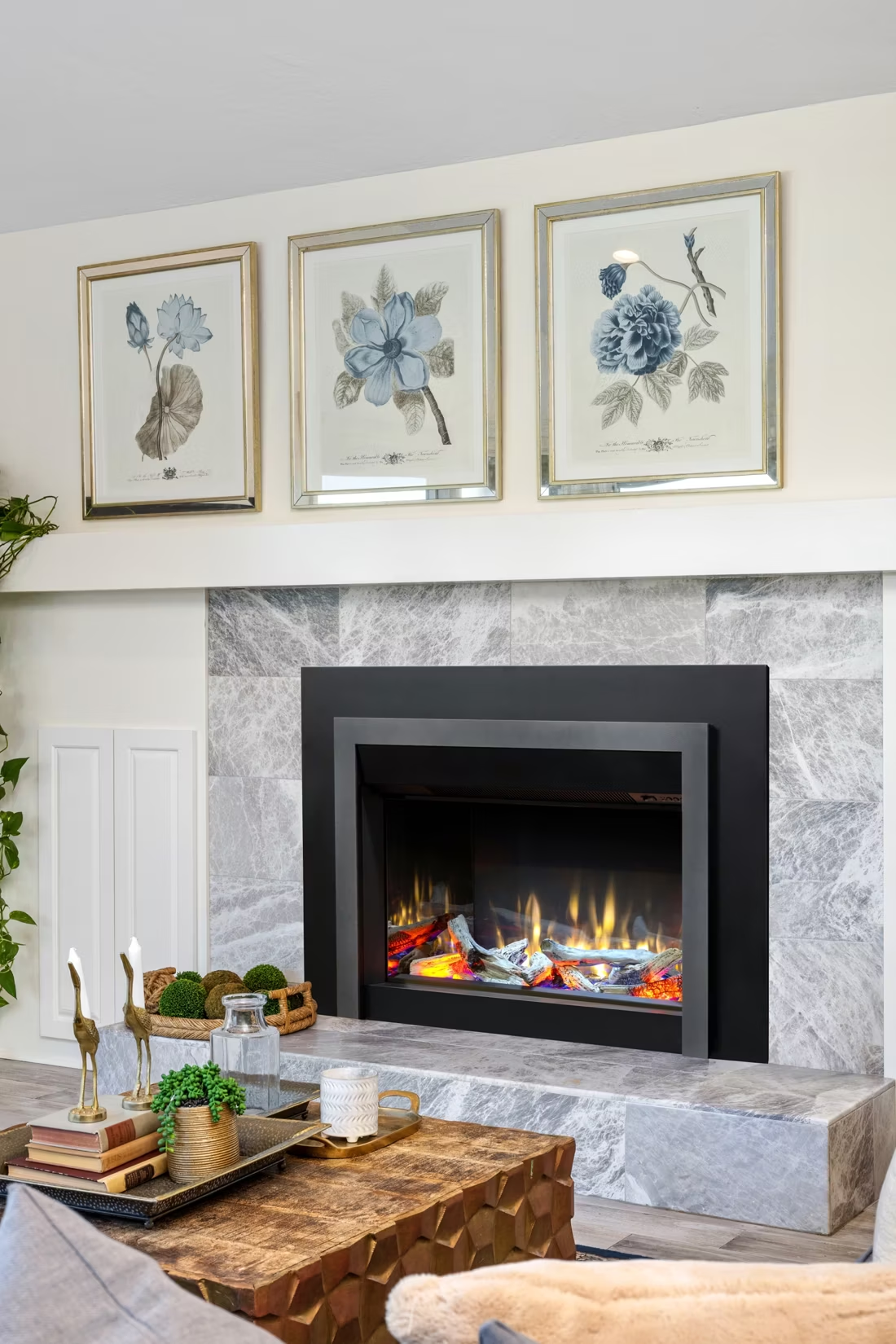
An electric insert slides into an existing fireplace opening, which is common in older St. Ansgar farmhouses that still have a masonry firebox from decades back—it reuses the opening without needing a chimney for venting, since electric units don't vent at all. A wall-mount hangs flush on any interior wall, popular in newer additions or ranch homes without an existing fireplace. A freestanding electric stove sits on the floor like a wood stove would, which some homeowners prefer for the cabin-style look without the cordwood. All three plug into standard household power or a dedicated circuit, and none require venting or a chimney.
Does it matter which electric utility serves my address when I'm choosing a fireplace?
It affects your running cost more than your equipment choice. Interstate Power and Light Co, MiEnergy Cooperative, and Heartland Power Coop all serve different addresses around St. Ansgar at noticeably different rates—from about 12.7 cents per kWh on the low end to nearly 18 cents on the high end. A 1,500-watt fireplace run four hours a night costs roughly $2.50 to $3.60 a month at the cheaper rate and closer to $4 a month at the pricier one—not a huge gap per unit, but worth knowing before you decide how often you'll run it as daily supplemental heat versus occasional ambiance.
What's the best electric fireplace for a cold Iowa winter like St. Ansgar's?
Look for a model with a true heater core rated near 1,500 watts and a thermostat, not just a flame-effect light show—brands like Dimplex and Napoleon that local hearth dealers in this region carry build both into one unit. For a finished basement or an addition that tends to run cooler than the rest of the house, that combination lets you dial in real heat on the coldest nights and run flame-only ambiance the rest of the time, which keeps your electric bill from creeping up during a seven-month heating season.
Electric vs. propane—which makes more sense for supplemental heat here?
Propane keeps working during a power outage, which matters in rural Mitchell County where ice storms occasionally take down lines for a day or more—a real consideration if you're relying on supplemental heat rather than just ambiance. Electric, on the other hand, needs no fuel delivery, no venting, and no tank, and it installs almost anywhere in a weekend. Most St. Ansgar homeowners we hear about keep propane as the backbone system and add electric specifically for the rooms where instant, no-mess warmth matters more than outage resilience.
Are there rebates for efficient electric heating appliances through my local co-op?
MiEnergy Cooperative and Heartland Power Coop both periodically run member efficiency programs, and rebates for electric heating equipment show up in those cycles from time to time, though availability shifts year to year. It's worth a call to whichever provider serves your address before you buy—a $50 or $100 rebate on an efficient insert isn't guaranteed, but it costs nothing to ask, and your local dealer may already know what's currently being offered.
When's the best time of year to schedule an electric fireplace install in St. Ansgar?
Late summer through early fall, before furnace season hits in earnest. Once temperatures drop and HVAC emergency calls start stacking up across Mitchell County, electricians and installers get booked out, and a fireplace install—not an emergency—ends up waiting behind furnace repairs. Getting it done in September means it's ready to use the first cold night rather than sitting half-wired while you wait for an opening.
Can I put a TV above my fireplace?
Yes—with an asterisk. Fireplaces are hot and TVs don't like heat. Either put a mantel between them to deflect rising warmth, or choose a fireplace with heat-management technology that creates a cool zone on the wall above—the wall stays around 125 degrees, barely warm, while the room still gets full heat. If you like clean lines and don't want a mantel, heat management is the answer.
How much does an electric fireplace cost to run?
With the heater on, a typical unit draws about 1,500 watts—at average electric rates that's roughly 20 cents an hour. Run the flame effect alone and it costs pennies; the flames are LED-driven and use about as much power as a light bulb. There's no pilot light, no fuel delivery, and essentially no maintenance.
Does a fireplace add value to my home?
On average, a fireplace adds back to the home about the same amount you spent installing it. Add the monthly savings from heating the rooms you actually use instead of the whole house—often hundreds of dollars a year—and the value case is strong before you even count what a fire does for how your family uses the room.
What is an in-home preview and do I need one?
It's a visit where a hearth professional measures your space, confirms the model you picked actually works in your home, and walks the specs—framing, gas line, venting, finish work—before anything is ordered. Some details you just can't know until you see the house. Never make a down payment without one; it's the single most-skipped step that burns buyers.
Nearby Dealers
Hearth shops serving St. Ansgar and the surrounding area. Every listing shows whether it is a WhyFire partner, a dealer we have verified as authorized for the brands we recommend, or a local business carrying hearth products. No manufacturer pays for placement. How we verify dealers →
We’ve paused dealer listings for this connection today. Enter your zip or postal code above to find dealers near you, or come back tomorrow.
Popular Electric Brands
Where each brand came from, what's inside it today, and every current model. No brand pays to be here. Not every dealer carries every brand, so enter your zip code to see what's sold near St. Ansgar.
Fireplace Xtrordinair
Fireplace Xtrordinair, now often called FireplaceX, is the fireplace brand of Travis Industries, Inc., of Mukilteo, Washington.
5 electric models →DaVinci
DaVinci Custom Fireplaces is a brand of Travis Industries, Inc., of Mukilteo, Washington, the company behind Lopi and Fireplace Xtrordinair.
5 electric models →Kozy Heat
Kozy Heat was founded in 1976 by Dudley Hussong in Lakefield, Minnesota, and incorporated as Hussong Manufacturing Co., Inc. in 1978.
3 electric models →Forge & Flame
Forge & Flame is the stove brand Hearth & Home Technologies introduced in August 2023 to bring Vermont Castings, Harman, and Quadra-Fire under one name.
1 electric model →Electric Service in St. Ansgar
An electric fireplace's heater draws about 1,500 watts—pennies per hour at local rates.
Interstate Power And Light Co
Mienergy Cooperative
Heartland Power Coop
Get your free Project Guide & Parts List for a St. Ansgar electric fireplace.
Tell us about your home, which co-op or utility serves your address, and where you want the extra warmth, and we'll help you find a trusted local dealer and send a free Project Guide & Parts List with the exact unit, circuit requirements, and install plan your project needs.
Find Your Fireplace →