
Zone Heat and Real Ambiance—Without Touching Your Ductwork.
No gas line, no chimney, no venting—just plug in or wire up and go. Find the right electric fireplace for your Shorewood home and connect with a trusted local dealer.
Every Project Starts From One of These Five Situations
The easiest upgrade for a Will County home.
Shorewood sits in Will County along the Des Plaines River, at about 619 feet elevation, where winters bring a long, demanding heating season and average lows around 17°F—cold enough to rival Madison, WI for stretches of January. Most of Shorewood's housing stock is newer subdivision construction from the last few decades: two-story homes with finished basements, bonus rooms, and additions that were never built with a masonry chimney or a gas line run to the family room. That's exactly the gap electric fireplaces fill.
With Commonwealth Edison as the local utility at roughly 13.4 cents per kWh, an electric fireplace or insert gives you real supplemental zone heat and the look of a fire in a room your furnace ducts don't quite reach—a finished lower level, a converted den, a primary bedroom—without cutting into drywall for venting or scheduling a gas-fitter. For homes in HOA-governed subdivisions where exterior venting or solid-fuel appliances raise questions, electric is usually the path of least resistance.
Three steps. No salesperson until you're ready.
Tell us about your project
Your zip code, your situation, and the fuel you're leaning toward—or let the answers point you to one.
See what's actually available
The brands dealers within 100 miles genuinely carry—real options, never a catalog mirage.
Get your dealer & Project Guide
A trusted local dealer, plus the free Project Guide & Parts List that names every component of the job.
Frequently Asked Questions
How much does an electric fireplace installation cost in Shorewood?
A plug-in electric insert or freestanding unit typically runs $200 to $800 installed, since it just needs a standard 120V outlet and a few minutes of setup—no electrician required in most cases. A built-in wall unit or mantel package with a recessed, flush-mount look runs $1,500 to $4,000, and that figure usually includes framing, a TV surround if you want one, and a dedicated 20-amp circuit run by a licensed electrician, which typically adds $300 to $600 on its own. Local dealers will size the unit to your room and quote the electrical work together so you're not coordinating two separate contractors.
How much does it cost to run an electric fireplace on my ComEd bill?
Most electric fireplaces draw about 1,500 watts on the heat setting, which works out to 1.5 kWh per hour. At ComEd's residential rate of roughly $0.1339 per kWh, that's about 20 cents an hour to run on high heat—closer to a nickel or two on flame-only mode with the heater off. Running one for four hours a night through a Will County winter adds up to somewhere around $20 to $25 a month, which is why most homeowners here use them as targeted zone heat in one room rather than trying to heat the whole house.
Do I need a permit to install an electric fireplace in Shorewood?
A plug-in unit that runs off an existing outlet doesn't require a permit—it's treated like any other appliance. If you're installing a built-in electric fireplace that needs a new dedicated circuit, the electrical work should be pulled as a permit through the Village of Shorewood Building Department and performed by a licensed electrician, both for safety and so it doesn't complicate a future home sale. There's no combustion involved and no venting to inspect, which is a big part of why electric permitting in Shorewood is simpler than gas or wood.
Can an electric fireplace actually heat a room, or is it just for looks?
A typical unit puts out about 5,000 BTU from its 1,500-watt heater, which is enough to noticeably warm a 300 to 500 square foot room—a finished basement rec room, a home office, or a primary bedroom. It won't replace your furnace on a 17°F January morning across the whole house, but as supplemental zone heat for the room you're actually sitting in, it does real work and lets you turn the thermostat down elsewhere. If you're trying to heat a larger open-concept space, talk to a local dealer about a higher-output insert or a second unit rather than oversizing one box.
What's the difference between an electric insert and a built-in electric fireplace?
An electric insert is a self-contained unit designed to drop into an existing opening—a fireplace surround, an entertainment center cutout, or a mantel frame—and plugs into a standard outlet. A built-in electric fireplace is installed into the wall itself, flush with the drywall, usually wired to a dedicated circuit and often paired with a TV mount above it for a clean, linear look. For a Shorewood home without an existing fireplace opening, most homeowners go the built-in route in a new construction or remodel scenario; the insert style is the faster, lower-cost option for retrofitting an existing space.
Is an electric fireplace a good fit for a finished basement?
Yes, and it's one of the most common installs we see for Will County homes. Because there's no combustion, there's no need for outside combustion air or a vent path to the exterior—both of which are genuinely difficult to run in a below-grade room. An electric unit just needs power, which makes it a straightforward addition to a basement rec room or guest suite that a gas or wood option would complicate significantly.
How does electric compare to gas for a Shorewood home?
Gas fireplaces put out real, substantial heat (typically 20,000+ BTU) and can serve as genuine supplemental heat during a cold snap, but they require a gas line and proper venting, which pushes install costs into the $4,500-plus range for a new run. Electric fireplaces max out around 5,000 BTU of heat but install in an afternoon with no gas line, no venting, and a fraction of the cost. For a Shorewood family room that's already served well by the furnace and just wants ambiance plus a little zone warmth, electric is usually the simpler, less expensive answer. For a converted garage or addition that needs to actually replace lost heat, gas is worth a look.
Why don't more Shorewood homes have wood or pellet stoves?
It's less about the wood itself—oak, hickory, walnut, and maple are all common regionally—and more about the housing stock. Most Shorewood subdivisions were built without masonry chimneys, and many are governed by HOA covenants that restrict solid-fuel appliances and exterior venting changes. Pellet stoves face a similar issue: they need a hopper, a vent, and a spot for bulk fuel storage that doesn't fit most finished-basement or great-room layouts here. Electric sidesteps all of that, which is a big reason it's become the default choice for Shorewood homeowners who want fireplace ambiance without a construction project.
Will an electric fireplace still work during a power outage?
No—an electric fireplace needs power to run, so it will go dark along with everything else if ComEd service drops. That's a real consideration for Will County winters, where ice storms occasionally knock out power for hours at a time. If backup heat during an outage is a priority alongside everyday ambiance, it's worth having a local dealer walk you through a gas option as well, since a properly equipped gas fireplace can run on battery backup ignition. For everyday zone heat and looks, though, electric remains the simplest and lowest-cost option on the table.
Can I put a TV above my fireplace?
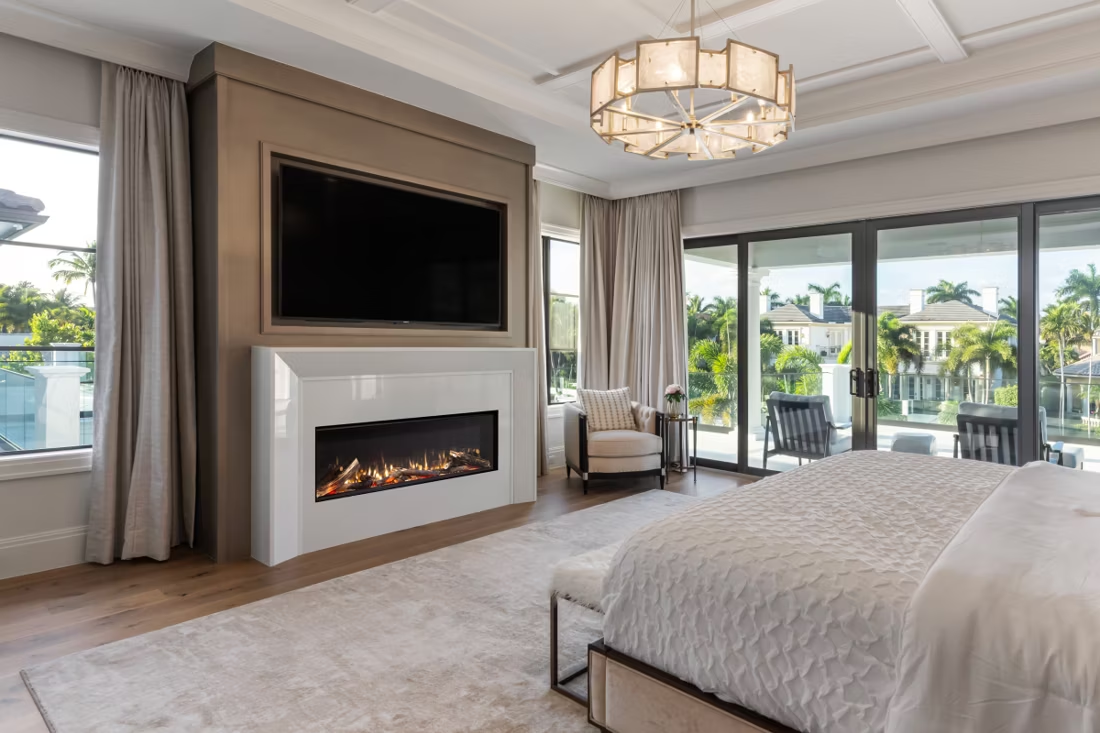
Yes—with an asterisk. Fireplaces are hot and TVs don't like heat. Either put a mantel between them to deflect rising warmth, or choose a fireplace with heat-management technology that creates a cool zone on the wall above—the wall stays around 125 degrees, barely warm, while the room still gets full heat. If you like clean lines and don't want a mantel, heat management is the answer.
Do electric fireplaces actually produce heat?
Yes—most put out around 4,800–5,000 BTUs from a standard outlet, which comfortably warms a bedroom, office, or den as a comfort-zone heater. What they won't do is carry a whole house the way wood, gas, or pellet can. Think of electric as ambiance-first with honest supplemental heat: flames on with no heat in July, flames plus warmth in January.
How much should I budget for a fireplace?
For an average home—covering the fireplace, the vent pipe, and basic installation—a budget between $3,900 and $5,500 gives you a lot of options across wood, gas, and pellet. By the time you add finish work, gas line, and electrical, the average complete installation lands between $5,000 and $12,000 all-in. In a remodel or new build, a good rule is to put about 2.5% of the total project cost toward the fireplace.
Can I install a fireplace myself?
If you're putting a fire in your house on purpose, it's best to work with an expert. Unless you're genuinely experienced in framing, gas line, vent pipe, and the national code on clearances to combustibles, have a professional do it—and ideally the same company that sells you the fireplace, so warranty, service, and liability all live under one roof.
Nearby Dealers
Hearth shops serving Shorewood and the surrounding area. Every listing shows whether it is a WhyFire partner, a dealer we have verified as authorized for the brands we recommend, or a local business carrying hearth products. No manufacturer pays for placement. How we verify dealers →
A Cozy Fireplace
A Fireplace Store And More
A Cozy Fireplace
Electric Service in Shorewood
An electric fireplace's heater draws about 1,500 watts—pennies per hour at local rates.
Commonwealth Edison Co
Find your electric fireplace in Shorewood.
Tell us a bit about your home and we'll put together a free Project Guide & Parts List—the right unit, the electrical work it needs, and a trusted local Shorewood dealer to install it.
Find Your Fireplace →