
Instant Heat for Kane County's Coldest Nights.
Prestbury's golf-course homes face winters as long and cold as Madison, WI's. Find the right direct-vent gas fireplace or insert, and get matched with a trusted local dealer who can size and install it correctly.
Every Project Starts From One of These Five Situations
Built for gas heat from day one.
Prestbury is a planned golf-course community in Sugar Grove Township, Kane County, with roughly 2,100 residents around zip code 60554. Sitting at about 715 feet elevation in climate zone 5A, the area sees winter lows averaging near 15°F through a long, cold continental Midwest winter—a pattern comparable to what homeowners deal with in Madison, WI. Wood-burning fireplaces are largely absent here; most Prestbury homes were built in the 1990s and 2000s with gas already specified as the standard hearth fuel, and pellet appliances never gained a foothold in this kind of subdivision either.
ComEd handles electric service throughout the area, and Kane County communities like Sugar Grove are typically served by Nicor Gas for natural gas distribution—so most Prestbury homes already have a gas line run to the house, which keeps installation straightforward. A direct-vent gas fireplace or insert delivers real, thermostat-controlled heat at the flip of a switch, works as zone heat alongside central HVAC on the coldest nights, and—with the right ignition system—can keep running during a winter power outage.
Three steps. No salesperson until you're ready.
Tell us about your project
Your zip code, your situation, and the fuel you're leaning toward—or let the answers point you to one.
See what's actually available
The brands dealers within 100 miles genuinely carry—real options, never a catalog mirage.
Get your dealer & Project Guide
A trusted local dealer, plus the free Project Guide & Parts List that names every component of the job.
Frequently Asked Questions
How much does a gas fireplace installation cost in Prestbury?
Most gas fireplace and insert installations in Prestbury run between roughly $4,500 and $10,000, and many homes here land toward the lower-to-middle end of that range because the majority of Prestbury houses were built already plumbed for natural gas as part of the original subdivision construction. Costs climb when a project needs a new gas line extension, additional framing for a built-in unit, or venting through a masonry chase rather than a simple through-wall route. A local dealer will give you a firm number after seeing your specific fireplace location and gas service.
Can I convert an existing wood-burning fireplace to gas in Prestbury?
It's possible, though wood-burning fireplaces are uncommon in Prestbury to begin with—most homes in this golf-course community were built with gas fireplaces or gas-ready fireboxes already in place. For the occasional older masonry fireplace in the area, a direct-vent gas insert can be installed into the existing opening with a stainless liner run up the flue, typically in the $4,500-$9,000 range depending on the insert and any gas line work needed. Because your home already has natural gas service through the local utility, most of that cost goes toward the unit and venting rather than new fuel infrastructure.
Do I need natural gas, or should I plan for propane?
If your Prestbury home already has a natural gas meter—and most do, given the area's build era—sticking with natural gas is simplest and cheapest to run long-term. Nicor Gas is the typical natural gas provider across this part of Kane County. A small number of properties on the edges of the development or on larger lots outside the main gas distribution grid may rely on propane instead, which requires either an existing tank or a new tank setup through a local propane supplier. Nearly all gas fireplace models can be configured for either fuel—your installer sets the orifice and regulator to match.
Will my gas fireplace still work if the power goes out?
Most direct-vent gas fireplaces with intermittent pilot ignition (IPI) include a battery backup—typically a few AA batteries inside the unit—that keeps the igniter and controls working when ComEd service drops during a winter storm. The fireplace lights and runs normally off the batteries until power is restored, as long as you keep them fresh. Some brands, including Valor, go a step further with pilot systems that generate their own electricity through the thermocouple, so there's no battery to maintain at all. Ask your local dealer which ignition system a given model uses—for a climate with winters as long and cold as this one, it's worth knowing before a storm hits.
What's the difference between a gas fireplace, gas insert, and gas stove?
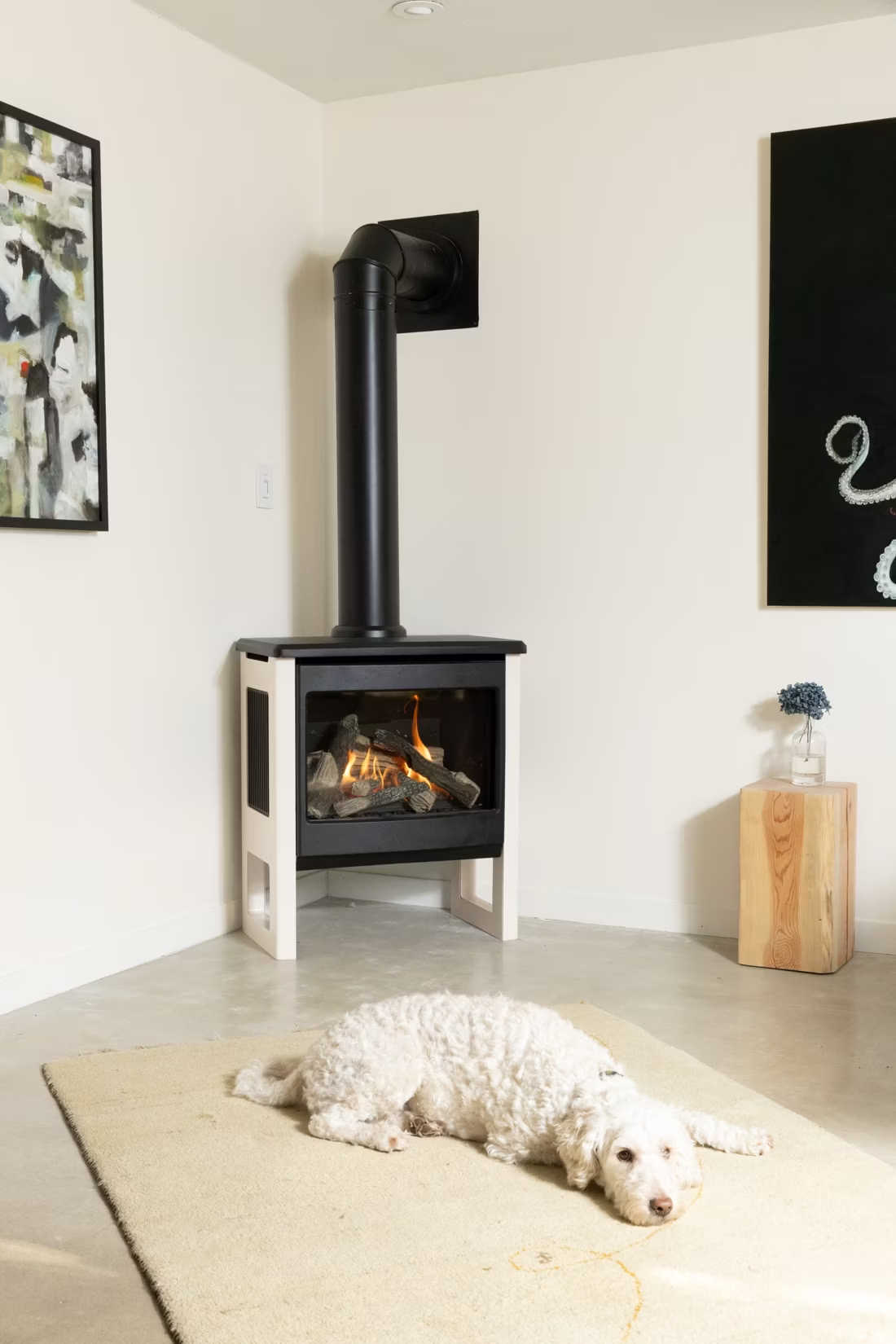
A gas fireplace is a fully built-in unit framed into a wall—common in Prestbury's newer construction with great rooms designed around a fireplace feature wall. A gas insert is sized to slide into an existing masonry firebox, which applies to the handful of older fireplaces in the area. A gas stove is a freestanding cabinet-style unit that sits on the floor and vents out a nearby wall, a good option for a finished basement or three-season room that doesn't have a fireplace opening at all. Most Prestbury homeowners replacing an aging factory-built gas fireplace are simply swapping in a newer built-in unit of the same type.
Do I need a permit to install a gas fireplace in Prestbury?
Yes. Depending on whether your address falls under unincorporated Kane County or an annexed portion of the Village of Sugar Grove, you'll need a building permit and gas line permit through either the Kane County Building Division or the Village of Sugar Grove Building Department. The gas connection work itself needs a licensed gas-fitter. Most established hearth dealers pull these permits as part of the installation, coordinating the gas line, venting, and inspection so you're not managing separate trades yourself.
Should I get a vented or vent-free gas fireplace?
Vented (direct-vent) gas fireplaces draw combustion air from outside and exhaust it back outside through sealed venting—they're the standard choice and what most local dealers install in Prestbury. Vent-free units burn directly into the room and are legal in Illinois under specific room-size and ventilation rules, but they release some combustion byproducts indoors. Given the area's long, cold heating season and the amount of time these fireplaces run each winter, direct-vent units are the more common and generally recommended option for full-time use rather than occasional ambiance.
How often does a gas fireplace need to be serviced?
Plan on an annual inspection, ideally before the heating season starts. A technician checks the burner, pilot or IPI ignition, venting, and gas connections, and cleans the glass and interior—a straightforward visit that typically runs $150 to $250 in the Kane County area. This matters more than it might seem in a climate with such a long, cold heating season, since these units log a lot of run hours between October and April.
Gas fireplace vs. electric fireplace—which makes more sense for my home?
Gas delivers real, substantial heat output—enough to serve as genuine supplemental heat on a 15°F night—and with the right ignition system it can keep running during a power outage. Electric fireplaces and inserts are cheaper to install (often $400-$1,200), require no gas line or venting, and run efficiently off ComEd power at Illinois's residential rate of roughly $0.134 per kWh, but they're strictly ambiance and light supplemental warmth, and they stop working the moment the power does. For a primary living space in Prestbury where you want real heat on cold nights, gas is usually the better fit; for a bedroom, basement, or secondary room where looks matter more than BTUs, electric can be the simpler answer.
Why is a fireplace insert so efficient?
An insert does two things: it seals the chimney completely, so you stop losing air you already paid to heat, and it radiates warmth into the room through the firebox and glass. Most add a heat-exchange fan that pulls cool room air underneath, wraps it around the hot firebox, and pushes it back out warm. Your home is more efficient before you've even lit the first fire.
What's the difference between an insert and a zero-clearance fireplace?
An insert is a fireplace that slides into a pre-existing wood-burning fireplace—if you don't have one, there's nothing to insert it into. A zero-clearance fireplace is built into a framed wall, which makes it the answer for remodels and new construction. Simple test: existing masonry fireplace means insert; blank or framed wall means zero-clearance.
How much should I budget for a fireplace?
For an average home—covering the fireplace, the vent pipe, and basic installation—a budget between $3,900 and $5,500 gives you a lot of options across wood, gas, and pellet. By the time you add finish work, gas line, and electrical, the average complete installation lands between $5,000 and $12,000 all-in. In a remodel or new build, a good rule is to put about 2.5% of the total project cost toward the fireplace.
Can a fireplace actually lower my heating bill?
Yes—by creating a comfort zone. A furnace heats every square foot of the house just to warm the one room you're in; a gas fireplace on low burns roughly a sixth of the gas a typical furnace does. Set the furnace around 55–60 degrees as a baseline, then heat the rooms your family actually uses. Families who heat this way commonly save $20–$60 a month.
Nearby Dealers
Hearth shops serving Prestbury and the surrounding area. Every listing shows whether it is a WhyFire partner, a dealer we have verified as authorized for the brands we recommend, or a local business carrying hearth products. No manufacturer pays for placement. How we verify dealers →
A Cozy Fireplace
A Fireplace Store And More
Ember Glow
Find your gas fireplace in Prestbury.
Tell us a bit about your home and we'll match you with the right gas fireplace, insert, or stove, plus a free Project Guide & Parts List—the exact parts, vent kit, and a recommended local Kane County dealer for your project.
Find Your Fireplace →