
Trade the drafty fireplace for instant gas heat in Lisle.
DuPage County winters push well below freezing for months at a time. Find the right gas fireplace or insert for your Lisle home, and get matched with a trusted local dealer who can actually install it.
Every Project Starts From One of These Five Situations
Clean gas heat built for Chicago-suburb winters.
Lisle sits at roughly 670 feet in the DuPage County flatlands, where average winter lows hover around 17°F and the area endures a long, cold winter season—a cold-climate load in the same range as Madison, Wisconsin. Lisle's housing stock, much of it built from the 1960s through the 1990s around the tech and research corridor near Argonne and the College of DuPage, includes plenty of builder-grade masonry fireplaces that were never designed for serious heat output.
Nicor Gas serves nearly all of Lisle, which is part of why gas fireplaces and inserts are the default upgrade path here rather than propane tanks or standalone wood setups. A direct-vent gas insert or built-in unit gives you real, on-demand heat at the flip of a switch—useful for supplementing a furnace on the coldest January nights, and for keeping a room warm without running ductwork harder than it needs to. ComEd handles electric service locally, which matters for ignition systems and battery backup during winter outages.
Three steps. No salesperson until you're ready.
Tell us about your project
Your zip code, your situation, and the fuel you're leaning toward—or let the answers point you to one.
See what's actually available
The brands dealers within 100 miles genuinely carry—real options, never a catalog mirage.
Get your dealer & Project Guide
A trusted local dealer, plus the free Project Guide & Parts List that names every component of the job.
Frequently Asked Questions
How much does a gas fireplace installation cost in Lisle?
Most gas fireplace and insert installations in the Lisle area run somewhere between roughly $4,000 and $10,000, depending on the unit and how much gas line or venting work is involved. Slipping a direct-vent gas insert into an existing masonry fireplace with a gas line already nearby sits toward the lower end. A new built-in gas fireplace for a remodel—with framing, venting through an exterior wall, and a fresh Nicor Gas line run—lands in the middle to upper range. Add a Village of Lisle building permit fee, typically in the $100–$300 range, and most local dealers fold that into the project quote.
Can I convert my existing wood-burning fireplace to gas?
Yes, and it's a common project in Lisle given how many homes here have builder-grade masonry fireplaces from the 60s through 90s that rarely got used for real wood fires. The simplest option is a vented gas log set dropped into the existing firebox, running $2,500–$6,000 installed. For more heat output and better efficiency, a full gas insert with a stainless liner run up the existing chimney typically costs $4,500–$9,000. Either way, a licensed installer needs to confirm the flue and firebox can safely support the conversion before work starts.
Do I need to worry about propane, or is natural gas standard in Lisle?
Natural gas is the default here—Nicor Gas provides service to nearly every neighborhood in Lisle, so if your home already has a gas furnace, water heater, or range, adding a gas fireplace usually just means extending an existing line. Propane setups are uncommon in this part of DuPage County and mostly show up on rural properties outside municipal gas territory, which isn't really a Lisle scenario. Most fireplace models sold locally are configured for natural gas by default, with propane conversion kits available if you ever need one.
Will my gas fireplace still work if the power goes out?
It depends on the ignition system. Units with intermittent pilot ignition (IPI) run on a small battery backup—usually AA batteries inside the unit—that keeps the fireplace lighting on demand even when ComEd service drops during an ice storm or summer thunderstorm outage. The batteries need periodic replacement to stay ready. Valor fireplaces take a different approach: their pilot assembly generates its own electricity through a thermocouple, so there's no battery to forget. For a Lisle home where winter outages can mean a cold house for a day or more, that's worth asking your local dealer about directly.
What's the difference between a gas fireplace, gas insert, and gas stove?
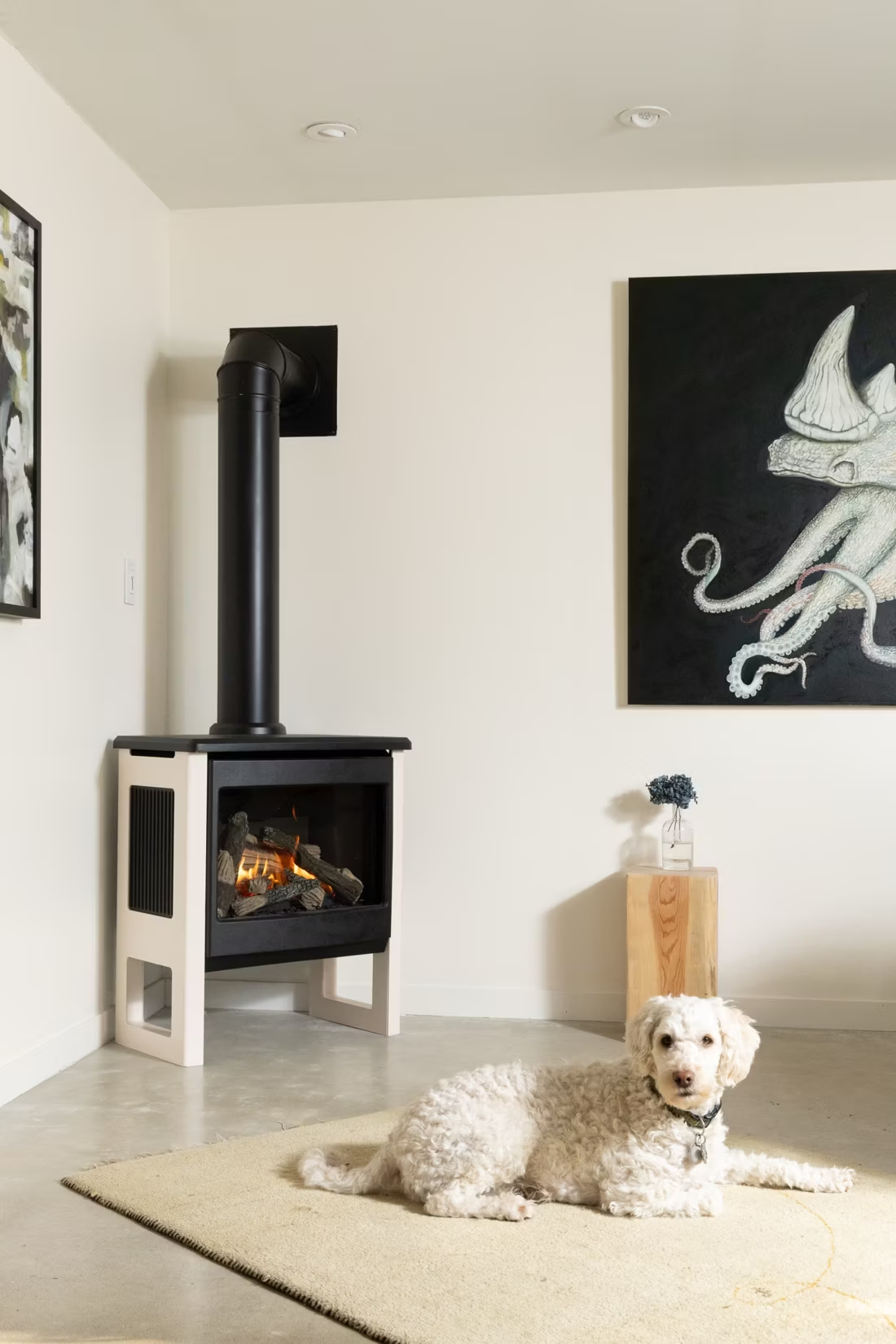
A gas fireplace is a fully built-in unit framed into a wall—the standard choice for new construction or a full remodel. A gas insert is built to slide into an existing masonry firebox, using your current chimney (lined) as the vent path, which is why it's so common in Lisle's older housing stock. A gas stove is a freestanding cabinet-style unit that sits on the floor and vents through a wall or existing flue, often chosen for basements, additions, or three-season rooms without an existing fireplace. For most Lisle homeowners with an underused wood fireplace, an insert is the straightforward upgrade.
Do I need a permit to install a gas fireplace in Lisle?
Yes—the Village of Lisle Building Division requires a permit for gas fireplace installations, and any new or extended gas line needs to be run by a licensed plumber or gas-fitter coordinated with Nicor Gas. Most established hearth dealers handle the permit application and inspection scheduling as part of the install, so you're not chasing down separate trades yourself. Skipping the permit isn't worth the risk—it can complicate insurance claims and resale disclosures down the line.
Are vent-free gas fireplaces allowed in Illinois?
Vent-free (unvented) gas fireplaces are legal in Illinois but come with strict room-size minimums, oxygen depletion sensors, and ventilation rules, since they release combustion byproducts directly into the room. Vented direct-vent units, by contrast, pull outside air for combustion and exhaust everything back outside through a sealed vent pipe—they're the more universally recommended option and the one most Lisle dealers install by default. For a well-insulated suburban home, a direct-vent gas fireplace or insert delivers real heat without any indoor air quality tradeoffs.
How often does a gas fireplace need to be serviced?
Plan on an annual inspection, ideally in early fall before the heating season ramps up. A technician checks the burner, pilot assembly, gas connections, and venting, and cleans the glass and interior components. This is a much smaller job than chimney sweeping for a wood-burning system, but it matters—a dirty pilot or misaligned burner is the most common cause of a gas fireplace that won't light reliably on a cold January morning. Local service techs in the Lisle area typically charge $150–$250 for a standard annual inspection.
Gas vs. electric fireplace—which makes more sense for a Lisle home?
Wood-burning setups are genuinely uncommon here—Lisle's lot sizes, HOA rules in many subdivisions, and easy access to Nicor Gas service mean most homeowners skip cordwood entirely. That leaves the real choice as gas versus electric. Gas delivers meaningful heat output and works during a power outage with the right ignition system, which matters given how ComEd service can blink during winter storms. Electric fireplaces, running on ComEd power at roughly 13.4 cents per kWh, need no venting or gas line at all, install almost anywhere, and are a common fit for townhomes and condo units near the Metra line or the College of DuPage where running new gas isn't practical. For a primary heat source in a single-family Lisle home, gas usually wins; for supplemental ambiance in a room where venting is impractical, electric is often the simpler call.
What's the difference between an insert and a zero-clearance fireplace?
An insert is a fireplace that slides into a pre-existing wood-burning fireplace—if you don't have one, there's nothing to insert it into. A zero-clearance fireplace is built into a framed wall, which makes it the answer for remodels and new construction. Simple test: existing masonry fireplace means insert; blank or framed wall means zero-clearance.
Why is my open fireplace making my house colder?
Open fireplaces suck—literally. As the fire burns, it consumes air your furnace already paid to heat and pulls it out through the chimney, so the house is actually colder after the fire goes out than before you lit it. An insert fixes this: it seals the chimney, puts fixed glass across the front, and turns that hole in your house into a real heat source.
Can a fireplace actually lower my heating bill?
Yes—by creating a comfort zone. A furnace heats every square foot of the house just to warm the one room you're in; a gas fireplace on low burns roughly a sixth of the gas a typical furnace does. Set the furnace around 55–60 degrees as a baseline, then heat the rooms your family actually uses. Families who heat this way commonly save $20–$60 a month.
Can I install a fireplace myself?
If you're putting a fire in your house on purpose, it's best to work with an expert. Unless you're genuinely experienced in framing, gas line, vent pipe, and the national code on clearances to combustibles, have a professional do it—and ideally the same company that sells you the fireplace, so warranty, service, and liability all live under one roof.
Nearby Dealers
Hearth shops serving Lisle and the surrounding area. Every listing shows whether it is a WhyFire partner, a dealer we have verified as authorized for the brands we recommend, or a local business carrying hearth products. No manufacturer pays for placement. How we verify dealers →
A Fireplace Store And More
A Cozy Fireplace
Ember Glow
A Cozy Fireplace
Urban Rooftops
Find your gas fireplace in Lisle.
Tell us about your home and we'll match you with a trusted local dealer and send over a free Project Guide & Parts List—the exact parts, vent kit, and installer recommendation for your Lisle gas fireplace project.
Find Your Fireplace →