
Keep Your Family Warm and Safe—No Matter What
Lindenhurst sees winters as cold as Madison, Wisconsin, yet this Lake County suburb runs almost entirely on natural gas and ComEd electric. Wood stoves still have a place here—as backup heat, cabin-style ambiance, or a Chain O'Lakes weekend-house feature.
Every Project Starts From One of These Five Situations
Lindenhurst Runs on Gas and Electric—Wood Is the Niche Choice.
With winters as cold as Madison, Wisconsin, a few hundred miles north, Lindenhurst's climate is genuinely cold—and the average winter low of 15°F would justify a serious heating appliance almost anywhere. But Lindenhurst isn't a rural wood-heat community. It's a developed Lake County suburb near the Chain O'Lakes, built out with municipal utilities, subdivision covenants, and small-to-midsize lots where natural gas and Commonwealth Edison electric service handle nearly all home heating.
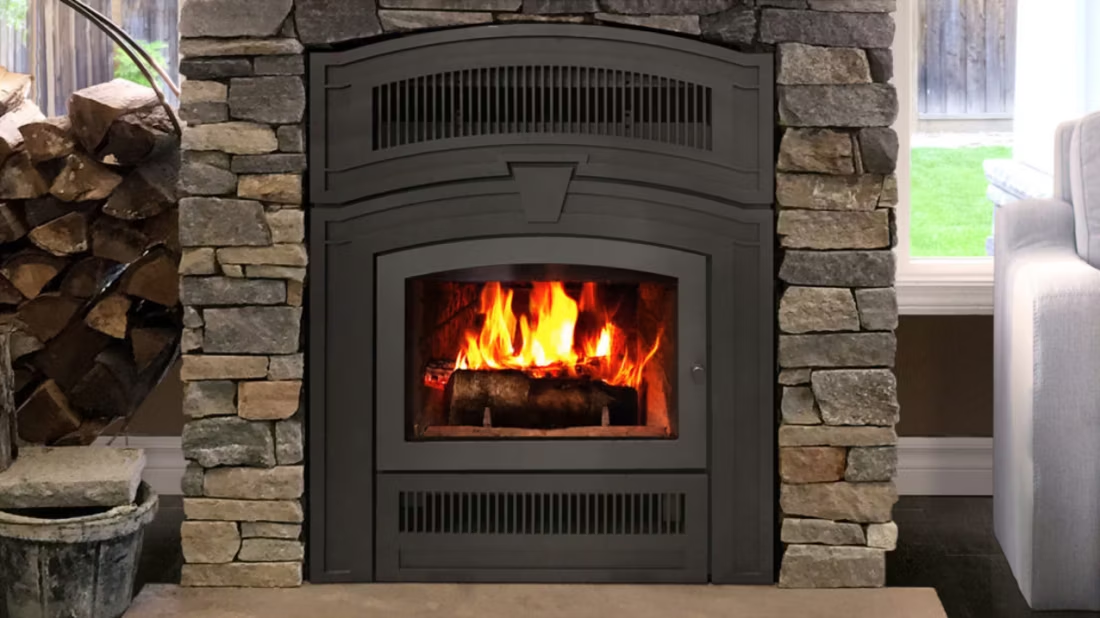
That's why wood fuel shows up here as a genuinely rare choice rather than a mainstream option. A handful of Lindenhurst homeowners still install wood stoves or inserts—often in older homes with existing masonry fireplaces, on larger wooded lots near Sun Lake or Deep Lake Road, or as an emergency backup for the ComEd outages that occasionally follow Midwest ice storms. If that's you, oak, hickory, walnut, and maple are the seasoned firewood species you'll find locally, and a certified hearth dealer willing to work on a low-volume solid-fuel installation is worth seeking out specifically.
Three steps. No salesperson until you're ready.
Tell us about your project
Your zip code, your situation, and the fuel you're leaning toward—or let the answers point you to one.
See what's actually available
The brands dealers within 100 miles genuinely carry—real options, never a catalog mirage.
Get your dealer & Project Guide
A trusted local dealer, plus the free Project Guide & Parts List that names every component of the job.
Frequently Asked Questions
Are wood stoves actually installed in Lindenhurst, or is this mostly a gas-and-electric town?
It's mostly a gas-and-electric town. Natural gas and Commonwealth Edison electric service cover the overwhelming majority of home heating in Lindenhurst, and most hearth retailers serving Lake County stock far more gas inserts than wood stoves. That said, wood installations do happen—typically in older homes with an existing masonry chimney, on larger lots away from subdivision cores, or for homeowners who specifically want emergency heat that doesn't depend on the grid. It's a real option, just not the default one here the way it is in more rural, forested parts of northern Illinois or Wisconsin.
What does a wood stove or insert installation cost in Lindenhurst?
Because solid-fuel installs are infrequent in this market, pricing isn't as standardized as it is for the gas work most local installers do every week. Expect quotes in line with the broader Chicago-area range, roughly $4,000 to $9,000 depending on whether you're inserting into an existing masonry fireplace or building a full chimney system from scratch. Get two or three quotes—with low installation volume, pricing can vary more between dealers here than it would in a wood-heavy market, and it's worth confirming the installer has actually done a wood-burning appliance before, not just gas inserts.
Where do I buy firewood in Lindenhurst?
Since Lindenhurst isn't near public forest land with cutting permits, firewood here comes from local tree services, landscaping companies, and seasonal firewood suppliers around Lake County who sell seasoned oak, hickory, walnut, and maple by the face cord or full cord. Local tree removal work—especially after storm damage—is also a common (and sometimes free) source if you're willing to split and season it yourself. Whatever the source, insist on wood seasoned at least six to twelve months; unseasoned wood burns poorly and creates far more creosote in a chimney that already sees infrequent use.
Do I need a permit to install a wood stove in Lindenhurst?
Yes. Any new wood-burning appliance install requires a building permit through your local Village of Lindenhurst or Lake County building department, and the stove needs to meet current EPA emissions standards. Because wood installs are uncommon here, it's worth calling ahead to confirm the specific inspection process—some suburban building departments handle solid-fuel appliance permits less frequently than they do furnace or water heater permits, so timelines can run a bit longer than you'd expect for routine gas work.
Why don't more homes in Lindenhurst use wood heat, given how cold the winters get?
The cold is real—Lindenhurst's winters, as cold as Madison, Wisconsin, would support wood heat just fine from a climate standpoint. The limiting factor is infrastructure and land use, not weather. Commonwealth Edison electric and natural gas service reach nearly every home in the village, subdivision covenants in many newer developments restrict exterior wood storage or solid-fuel appliances, and lot sizes in most of Lindenhurst don't leave much room for stacking and seasoning cords of firewood the way a rural acreage would. Wood heat still works well on the borders of town near the lakes, just not as the default choice in the denser subdivisions.
Should I consider a pellet stove instead of a wood stove?
Pellet stoves are also uncommon in Lindenhurst for similar reasons—this is a gas-and-electric market, not a solid-fuel one. That said, pellets have an edge in a suburban setting: no cutting, splitting, or seasoning, and regional bagged pellets from producers like Indeck Energy Services, Lignetics, and Somerset Pellet Fuel are available through Midwest hearth and hardware retailers. The tradeoff is that pellet stoves need electricity to run the auger and blower, so they won't function during a ComEd outage the way a wood stove will. If backup heat during power loss is your main goal, wood still wins; if convenience matters more, pellet is worth a look.
Will my HOA or subdivision allow a wood stove installation?
Check before you buy anything. A number of Lindenhurst subdivisions, particularly newer developments near the Chain O'Lakes corridor, have covenants that restrict exterior chimney additions, wood storage, or solid-fuel appliances altogether. Older neighborhoods and homes on larger, unrestricted lots typically have more flexibility. This is one of the first questions a good local hearth dealer will ask, since it can affect whether a project is feasible before they even quote the venting work.
Does a wood stove make sense for my Lindenhurst home?
It depends on what you're solving for. If you want a backup heat source that keeps working when ComEd power goes out during an ice storm, a wood stove is one of the few heating appliances that doesn't need electricity to run. If you have an older home with an existing masonry fireplace, or a larger lot near the lakes where firewood storage isn't an issue, wood can make real sense. If you're in a newer subdivision with covenant restrictions and no existing chimney, the cost and hassle usually outweigh the benefit—a gas insert or electric fireplace will get you comparable ambiance with far less complication.
Wood vs. gas—which fits Lindenhurst better?
For the vast majority of Lindenhurst homes, gas is the better fit: natural gas service is widely available, installation is more standardized, and local dealers have far more experience with gas inserts and fireplaces than with solid fuel. Wood makes sense in narrower circumstances—homes with an existing chimney, larger unrestricted lots, or households that specifically want heat that survives a power outage. If you're weighing both, it's worth talking to a local dealer about a gas fireplace for daily use with a wood stove reserved for backup, rather than treating it as an either-or choice.
Why won't my new wood stove get going like my old one?
New wood stoves are 70%+ efficient, so far less heat goes up the flue—which also means less draft to get a fire established. The rule: build a genuinely hot fire for about 45 minutes before you choke it down. Skip that and you get smoke in the room, creosote in the chimney, and a fire that never takes off. Most performance complaints trace straight back to this.
What's the difference between an insert and a zero-clearance fireplace?
An insert is a fireplace that slides into a pre-existing wood-burning fireplace—if you don't have one, there's nothing to insert it into. A zero-clearance fireplace is built into a framed wall, which makes it the answer for remodels and new construction. Simple test: existing masonry fireplace means insert; blank or framed wall means zero-clearance.
How much should I budget for a fireplace?
For an average home—covering the fireplace, the vent pipe, and basic installation—a budget between $3,900 and $5,500 gives you a lot of options across wood, gas, and pellet. By the time you add finish work, gas line, and electrical, the average complete installation lands between $5,000 and $12,000 all-in. In a remodel or new build, a good rule is to put about 2.5% of the total project cost toward the fireplace.
What is an in-home preview and do I need one?
It's a visit where a hearth professional measures your space, confirms the model you picked actually works in your home, and walks the specs—framing, gas line, venting, finish work—before anything is ordered. Some details you just can't know until you see the house. Never make a down payment without one; it's the single most-skipped step that burns buyers.
Nearby Dealers
Hearth shops serving Lindenhurst and the surrounding area. Every listing shows whether it is a WhyFire partner, a dealer we have verified as authorized for the brands we recommend, or a local business carrying hearth products. No manufacturer pays for placement. How we verify dealers →
Smokin' Deal Bbq
Fireplaces Plus
Fireplace And Patio
Alaskan Fireplace Co
Jhb Group, Inc.
General Masonry Supply
Lakes Brick & Block
Find your wood fireplace in Lindenhurst.
Tell us about your home and we'll confirm whether wood heat makes sense for your situation, then match you with a local dealer and send over a free Project Guide & Parts List—including the vent kit and installer recommendation—for your Lindenhurst project.
Find Your Fireplace →