
Keep Your Family Warm and Safe—No Matter What
Upcountry Maui rarely needs radiant wood heat, but a handful of homeowners still choose a wood stove or fireplace for ambiance, design, or a cool-evening retreat on the slopes of Haleakala.
Every Project Starts From One of These Five Situations
Makawao's upcountry climate rarely calls for a wood stove.
Makawao sits at 1,628 feet on the slopes of Haleakala, upcountry Maui's old paniolo town, where the air is noticeably cooler than the beach towns below. Even so, the average winter low here is 53°F, and the town has only a light, brief need for heat each year—a fraction of what a mainland cold-climate city like Duluth, MN or Burlington, VT sees in a single January. There's simply very little heating load to justify a wood-burning appliance as a primary heat source, and almost no homes in Makawao are built around one.
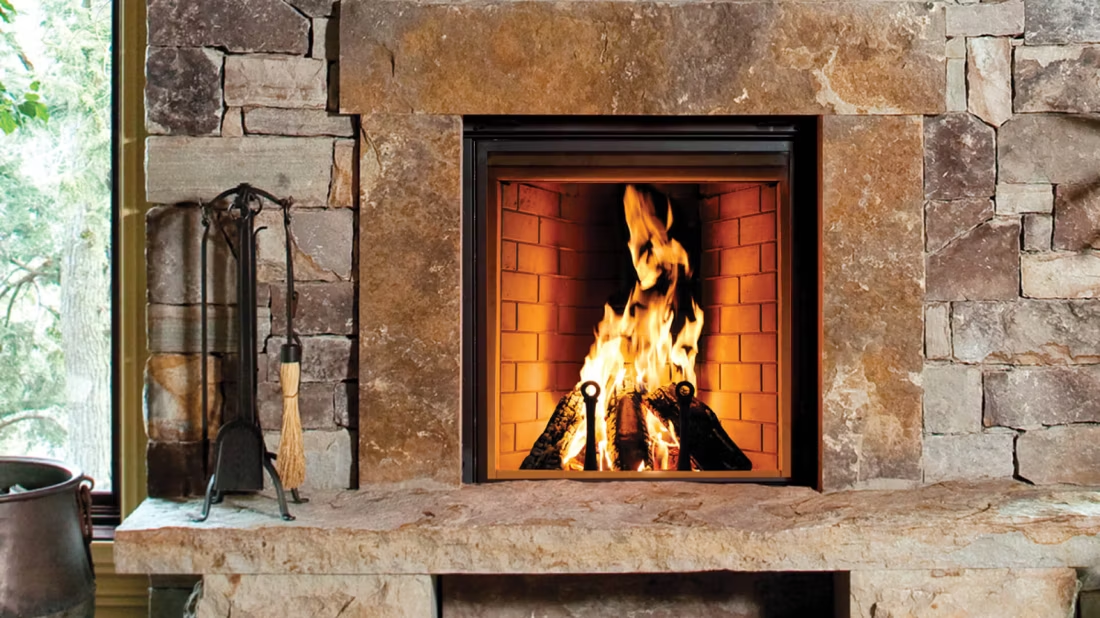
That said, wood fireplaces do show up occasionally—usually in homes designed with a fireplace as a focal point, in upcountry vacation rentals trying to evoke a cozy mountain-cabin feel, or in the handful of houses at Makawao's higher elevations where evenings genuinely turn brisk during Maui's short winter. Local hardwoods like koa and ohia are prized far more for furniture, flooring, and cultural woodworking than for firewood, and eucalyptus—a fast-growing introduced species common on Maui—is the more realistic option if someone wants to burn wood at all. Given Maui's punishing electric rates (Maui Electric charges roughly $0.44 per kWh, among the highest in the country) and the absence of a piped natural gas grid on the island, some homeowners look at wood as an off-grid backup option, even if year-round convenience still favors gas or electric.
Three steps. No salesperson until you're ready.
Tell us about your project
Your zip code, your situation, and the fuel you're leaning toward—or let the answers point you to one.
See what's actually available
The brands dealers within 100 miles genuinely carry—real options, never a catalog mirage.
Get your dealer & Project Guide
A trusted local dealer, plus the free Project Guide & Parts List that names every component of the job.
Frequently Asked Questions
Does it actually get cold enough in Makawao to need a wood stove?
Not in the way a mainland cold-climate home does. Makawao's average winter low is 53°F, and the town's light, brief need for heat each year is a small fraction of what places like Bozeman, MT or Fargo, ND log in a single month. Even at 1,628 feet on Haleakala's slopes, Makawao's coolest nights rarely justify a wood stove as a heat source. Most people who install one here are after the look, the ritual, or the ambiance rather than actual warmth.
Why would anyone install a wood fireplace in Maui at all?
The handful of Makawao homeowners who do it usually fall into one of a few categories: a design-forward home built around a fireplace as a visual anchor, an upcountry vacation rental trying to create a cozy mountain-town feel that fits Makawao's paniolo character, or a homeowner at one of the higher elevations near Olinda or Kula who genuinely feels the cooler evenings during Maui's brief winter. It's a lifestyle and design choice here far more often than a heating necessity.
What wood species are available locally if I want to burn wood?
Koa and ohia—Maui's two best-known native hardwoods—are almost never used as firewood. Koa is prized (and expensive) for furniture, ukuleles, and cultural carving, and ohia holds deep cultural significance in Hawaiian tradition, so burning either would be an unusual and costly choice. Eucalyptus, an introduced species that grows quickly across upcountry Maui, is the more realistic option for anyone set on burning wood, though supply is inconsistent and there's no established commercial firewood market on the island the way there is in mainland wood-heating regions.
How much does a wood stove installation cost in Makawao?
There isn't a well-established local price baseline the way there is in cold-climate markets, simply because so few homes install wood-burning appliances here. Expect to pay a premium over mainland pricing for both the unit and shipping to Maui, plus chimney and hearth work performed by one of the island's limited pool of qualified installers. Because volume is low, getting a firm, in-home quote from a local dealer familiar with Maui County code and shipping logistics matters more here than in markets where pricing is more standardized.
Do I need a permit to install a wood stove in Maui County?
Yes—a building permit is required regardless of climate, and in Makawao that means going through the Maui County Department of Public Works. The permitting requirements themselves (clearances, hearth specifications, chimney construction) don't change based on how often you'll actually use the appliance, so plan on the same code review a wood stove would face in any U.S. jurisdiction. A local installer experienced with the county's process can save you the back-and-forth of a first-time filing.
Is firewood easy to find in Makawao?
Not in the way it is on the mainland. There's no established cord-wood delivery industry on Maui, and most upcountry properties don't have the kind of surrounding forest land that supports self-cut permits the way a national forest does in the Pacific Northwest or Rockies. Anyone installing a wood stove here should plan on sourcing eucalyptus or other locally available wood through informal channels, tree-trimming services, or small-scale sellers rather than a retail firewood supplier.
What are people using for heat and fireplace ambiance instead of wood in Makawao?
Gas is the more common choice for anyone who wants a real flame without the sourcing headaches of wood. Since Maui has no piped natural gas grid, gas fireplaces here run on propane, typically delivered and tanked by local suppliers. Electric fireplaces are also popular for pure ambiance, though it's worth noting Maui Electric's residential rate runs around $0.44 per kWh—among the highest in the country—so a unit's efficiency and run-time matter more here than on the mainland.
Are there any air quality restrictions on wood burning in Makawao?
No—Makawao and Maui County have no wood smoke air quality restrictions, non-attainment designations, or winter burn bans of the kind you'd find in places like Klamath Falls, OR or much of the Pacific Northwest. The absence of restrictions isn't a signal that wood heat is common here, though—it simply reflects that so few homes burn wood that air quality regulators haven't needed to address it.
Wood vs. gas or electric—which actually makes sense for a Makawao home?
For nearly every Makawao homeowner, gas or electric is the more practical choice. A propane fireplace delivers instant, consistent flame without the sourcing challenges of wood on an island with no established firewood trade, and an electric fireplace offers ambiance with zero venting or fuel logistics at all—a real advantage given how uncommon true wood-burning installs are here. Wood only makes sense if you specifically want the ritual of a real fire, are building a design-forward home around it, or are creating a vacation-rental aesthetic where the crackle and look of a wood fire is part of the draw rather than the heat itself.
Why won't my new wood stove get going like my old one?
New wood stoves are 70%+ efficient, so far less heat goes up the flue—which also means less draft to get a fire established. The rule: build a genuinely hot fire for about 45 minutes before you choke it down. Skip that and you get smoke in the room, creosote in the chimney, and a fire that never takes off. Most performance complaints trace straight back to this.
What's the difference between an insert and a zero-clearance fireplace?
An insert is a fireplace that slides into a pre-existing wood-burning fireplace—if you don't have one, there's nothing to insert it into. A zero-clearance fireplace is built into a framed wall, which makes it the answer for remodels and new construction. Simple test: existing masonry fireplace means insert; blank or framed wall means zero-clearance.
Can a fireplace actually lower my heating bill?
Yes—by creating a comfort zone. A furnace heats every square foot of the house just to warm the one room you're in; a gas fireplace on low burns roughly a sixth of the gas a typical furnace does. Set the furnace around 55–60 degrees as a baseline, then heat the rooms your family actually uses. Families who heat this way commonly save $20–$60 a month.
What is an in-home preview and do I need one?
It's a visit where a hearth professional measures your space, confirms the model you picked actually works in your home, and walks the specs—framing, gas line, venting, finish work—before anything is ordered. Some details you just can't know until you see the house. Never make a down payment without one; it's the single most-skipped step that burns buyers.
Nearby Dealers
Hearth shops serving Makawao and the surrounding area. Every listing shows whether it is a WhyFire partner, a dealer we have verified as authorized for the brands we recommend, or a local business carrying hearth products. No manufacturer pays for placement. How we verify dealers →
Island Pool And Spa Supply
Hawaii Fireplace – Wailuku
Find out what's realistic for your Makawao home.
Tell us about your project and we'll put together a free Project Guide & Parts List—including the right vent kit and a trusted local dealer who can install a wood-burning fireplace or stove correctly in Makawao.
Find Your Fireplace →