
Gas fireplace comfort for Hawaiian Ocean View's cool upland evenings.
At 2,314 feet on the slopes above the Kona coast, Hawaiian Ocean View doesn't need a furnace—but a well-chosen gas fireplace still earns its keep on breezy nights and during grid outages. We'll match you with a trusted local dealer who knows propane, not natural gas, is the fuel here.
Every Project Starts From One of These Five Situations
Built for ambiance and backup, not survival heat.
Hawaiian Ocean View sits at roughly 2,314 feet on the southern flank of Mauna Loa, where the average winter low hovers around 54°F and the area sees an almost nonexistent heating season. For comparison, a place like International Falls, Minnesota endures a long, brutal heating season that runs most of the year—this is a different universe of heating need. Nobody here is sizing a stove to survive a cold snap. What draws HOVE homeowners to gas fireplaces instead is the trade-wind chill on clear nights, the cooler evenings during Hawaiʻi's brief "winter" months, and the simple appeal of a real flame in a living room without hauling wood.
There's no natural gas utility serving Hawaiian Ocean View or anywhere else on this side of the island—Hawaii Electric Light Co. supplies electricity, but gas appliances here run on propane, delivered by tank or exchanged through local suppliers. That's actually a good fit: a lot of HOVE homes are already off-grid or running on solar-plus-battery systems because of the subdivision's remote, unincorporated layout, and many already use propane for water heaters and ranges. With HELCO's residential rate sitting near 48 cents per kWh—among the highest in the country—a propane fireplace with a battery-backup ignition system also functions as a genuinely useful backup heat and light source when the grid drops, which it does periodically out here.
Three steps. No salesperson until you're ready.
Tell us about your project
Your zip code, your situation, and the fuel you're leaning toward—or let the answers point you to one.
See what's actually available
The brands dealers within 100 miles genuinely carry—real options, never a catalog mirage.
Get your dealer & Project Guide
A trusted local dealer, plus the free Project Guide & Parts List that names every component of the job.
Frequently Asked Questions
How much does a gas fireplace installation cost in Hawaiian Ocean View?
Because everything on this end of the island runs on propane rather than piped natural gas, expect a typical installation to run somewhere in the $4,000 to $9,000 range, depending on the unit, whether a new propane tank needs to be set and plumbed, and the venting path. Shipping and freight to the Big Island add a real premium to both the appliance and any specialty venting material compared to mainland pricing, so it's worth getting a firm quote from a local dealer rather than budgeting off a mainland number. Homes that already have a propane tank and line in place for a water heater or range will land on the lower end.
Can I get natural gas in Hawaiian Ocean View, or is it propane only?
Propane only. There's no natural gas main serving Hawaiian Ocean View or the surrounding South Kona/Kaʻū area—Hawaii's limited natural gas infrastructure is concentrated on Oʻahu. Every gas fireplace, stove, or insert installed here runs on propane, either from a refillable tank set on your property or an exchange-tank arrangement through a local propane supplier. Your installer will size and configure the appliance's orifice for propane specifically, since it's a different setup than a natural-gas-rated unit.
Do I actually need a fireplace for heat in Hawaiian Ocean View?
Realistically, no—not for survival heat. With average winter lows around 54°F and a heating season that's barely there, HOVE homes almost never need supplemental heat the way a mainland winter home does. Most homeowners here install a gas fireplace for the ambiance of a real flame, for the occasional cool, windy evening common at this elevation, or as a reliable backup heat and light source during a power outage on an off-grid or solar-battery system. It's a legitimate, popular choice locally—just for different reasons than in a cold climate.
Will a gas fireplace work if my power is out or I'm off-grid?
Yes, and this is one of the biggest draws for HOVE homeowners specifically, since a large share of the subdivision runs on solar, catchment water, and off-grid or unreliable HELCO service. Units with standing pilot or IPI ignition and a battery backup will light and run without house power. Valor fireplaces go a step further—their pilot assembly generates its own electricity through the thermocouple, so there's no battery to remember at all. For a home relying on solar batteries that can run low during cloudy stretches, a gas fireplace that doesn't touch your electrical system is a genuine advantage.
Do I need a permit to install a gas fireplace in Hawaiian Ocean View?
Yes—new gas fireplace and propane installations in unincorporated Hawaii County, which covers Hawaiian Ocean View, go through the County of Hawaiʻi Department of Public Works, Building Division. Propane tank placement also has to meet setback requirements from structures and property lines. Most local hearth dealers and propane suppliers coordinate this permitting and tank-setting inspection as part of the install, which is worth confirming up front given how spread out services are on this side of the island.
Vented or vent-free—what's more practical for a HOVE home?
Vented, direct-vent propane units are the safer and more universally code-compliant choice, and they're what most local installers recommend regardless of climate. Vent-free propane units are technically permitted in Hawaii under specific room-sizing and ventilation rules, but many HOVE homes are open-plan, single-wall construction with limited mechanical ventilation, which makes strict compliance with vent-free sizing rules harder to guarantee. Given how mild the climate is here—heat output isn't the priority, ambiance is—a smaller direct-vent unit does the job without the indoor air quality tradeoffs of a vent-free model.
Should I get a gas insert, a built-in fireplace, or a freestanding stove?
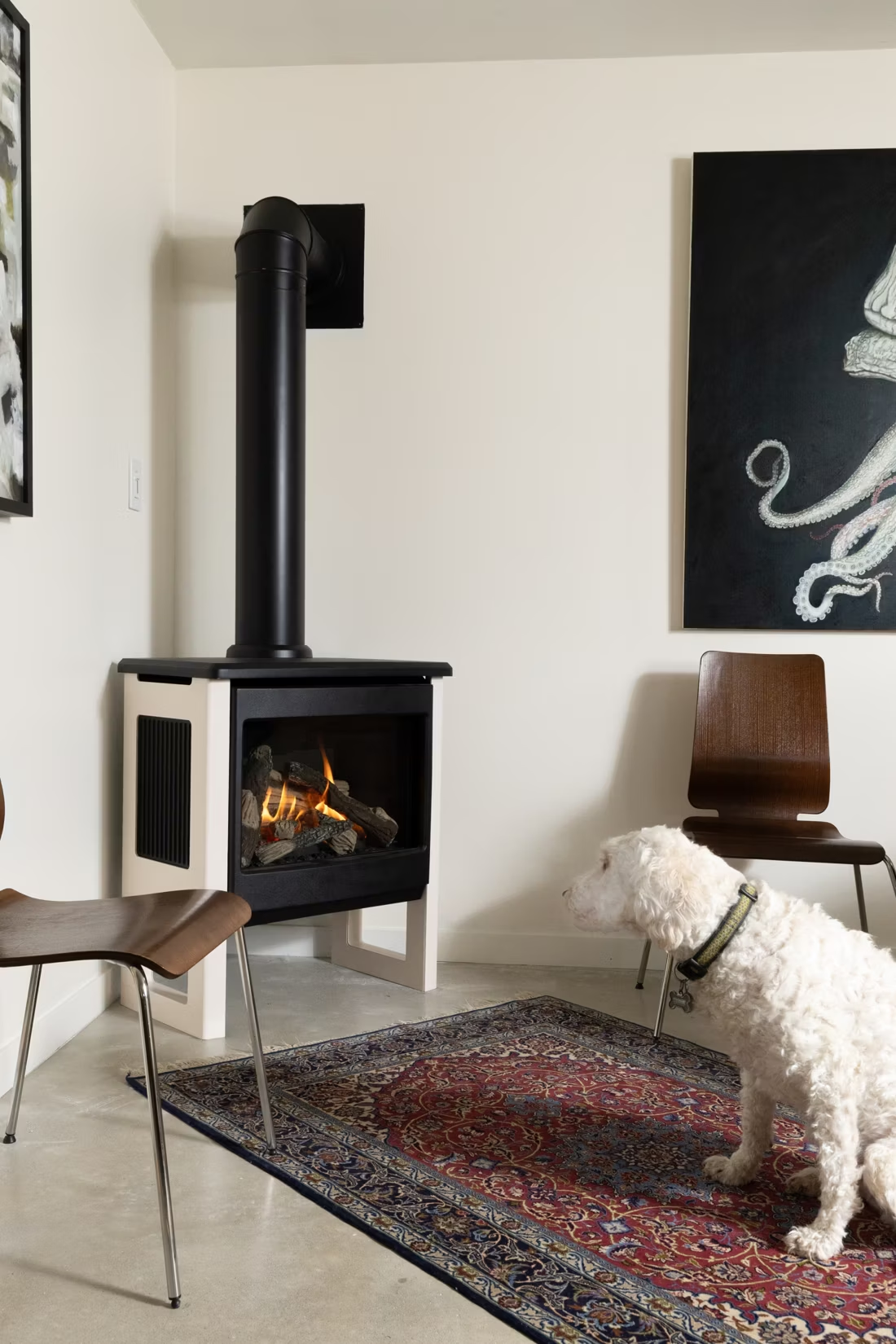
Most homes in Hawaiian Ocean View are newer, slab-on-grade construction without an existing masonry fireplace to retrofit, so the insert route that's common in older mainland homes usually isn't relevant here. A built-in direct-vent gas fireplace works well for new construction or a remodel where you're framing a hearth wall. A freestanding gas stove is often the simpler, lower-cost option for a HOVE home—it needs less framing, sits on a simple hearth pad, and vents straight through an exterior wall, which suits the area's typical one-story, open-plan layouts.
How often does a gas fireplace need servicing out here?
Plan on an annual inspection, same as anywhere—but pay attention to corrosion. The combination of salt air off the coast and occasional volcanic gas (vog) drifting through South Kona can be harder on metal fireplace components and propane fittings than a typical mainland install. A technician will check the burner, pilot assembly, propane connections, and venting, and clean the glass. Because service techs are based mainly in Kona or Hilo, expect a trip charge factored into the visit given HOVE's distance from either town.
Gas vs. wood—does wood heat make sense in Hawaiian Ocean View?
Not really, for heating purposes—with such a mild heating season, a wood stove would sit unused most of the time, even though eucalyptus, ʻōhiʻa, and koa are all available locally as firewood species. A small number of homeowners on the island do install wood stoves for the look and ritual of a real wood fire or for off-grid properties that value fuel independence, but for the vast majority of HOVE homes, a propane gas fireplace makes more sense: no wood storage or hauling, instant on-off operation for occasional cool evenings, and battery-backup ignition options for outages. Gas is the practical choice here; wood is the niche one.
Why is my open fireplace making my house colder?
Open fireplaces suck—literally. As the fire burns, it consumes air your furnace already paid to heat and pulls it out through the chimney, so the house is actually colder after the fire goes out than before you lit it. An insert fixes this: it seals the chimney, puts fixed glass across the front, and turns that hole in your house into a real heat source.
Does a gas fireplace work when the power is out?
Yes—modern gas fireplaces have a battery backup for the ignition system that lasts for weeks, so no power equals no problem. Your furnace can't say that: no electricity, no blower, no heat. It's one of the most common reasons families add a fireplace, and worth confirming on any model you're considering.
How much should I budget for a fireplace?
For an average home—covering the fireplace, the vent pipe, and basic installation—a budget between $3,900 and $5,500 gives you a lot of options across wood, gas, and pellet. By the time you add finish work, gas line, and electrical, the average complete installation lands between $5,000 and $12,000 all-in. In a remodel or new build, a good rule is to put about 2.5% of the total project cost toward the fireplace.
Does a fireplace add value to my home?
On average, a fireplace adds back to the home about the same amount you spent installing it. Add the monthly savings from heating the rooms you actually use instead of the whole house—often hundreds of dollars a year—and the value case is strong before you even count what a fire does for how your family uses the room.
Nearby Dealers
Hearth shops serving Hawaiian Ocean View and the surrounding area. Every listing shows whether it is a WhyFire partner, a dealer we have verified as authorized for the brands we recommend, or a local business carrying hearth products. No manufacturer pays for placement. How we verify dealers →
Island Pool & Spa Supply
Fireplace & Home Center
Hawaii Fireplace – Kamuela
Find your gas fireplace in Hawaiian Ocean View.
Tell us a bit about your home and we'll put together a free Project Guide & Parts List—the right propane fireplace or stove, the exact vent kit, and a trusted local dealer who installs it correctly on this side of the island.
Find Your Fireplace →