
Find your fireplace across Hawai'i County—from Hilo's coast to Volcano's cool uplands.
Gas and electric fireplaces are the standard choice across the Big Island, with a small niche for wood and pellet stoves in the cooler upcountry around Volcano Village and Waimea. Find the right unit for your elevation and connect with a trusted local retailer.
Every Project Starts From One of These Five Situations
Tropical coastlines, upcountry chill: hearth needs across Hawai'i County.
Hawai'i County covers more than 4,000 square miles and spans sea level all the way to the 13,803-foot summit of Mauna Kea, which puts nearly every heating scenario the island will ever see somewhere on that single mountain. Climate zone 1A and a county-wide average winter low of 61°F add up to just 6 heating degree days a year—for comparison, a place like Duluth, MN logs closer to 9,000 in a single winter. For most residents along the Hilo side, the Kona coast, and the Kohala coast, a fireplace is about ambiance, not heat. The exception is upcountry: Volcano Village, at roughly 3,700-4,000 feet near Hawai'i Volcanoes National Park, and the ranching town of Waimea both run 15-20 degrees cooler than the coast, with real chilly evenings that make a working fireplace genuinely useful a few months a year.
What you'll find on this hub: hearth retailers, service technicians, and fuel suppliers serving every community on the island—Hilo, Kailua-Kona, Waimea, Volcano, Pahoa, Captain Cook, Naalehu, Honoka'a, and the Waikoloa and Kohala coast resort areas. Pick your fuel below to drill into specifics. Gas and electric cover the vast majority of installations here; wood and pellet are real options for upcountry homes, but we'll tell you honestly where they fit and where they don't.
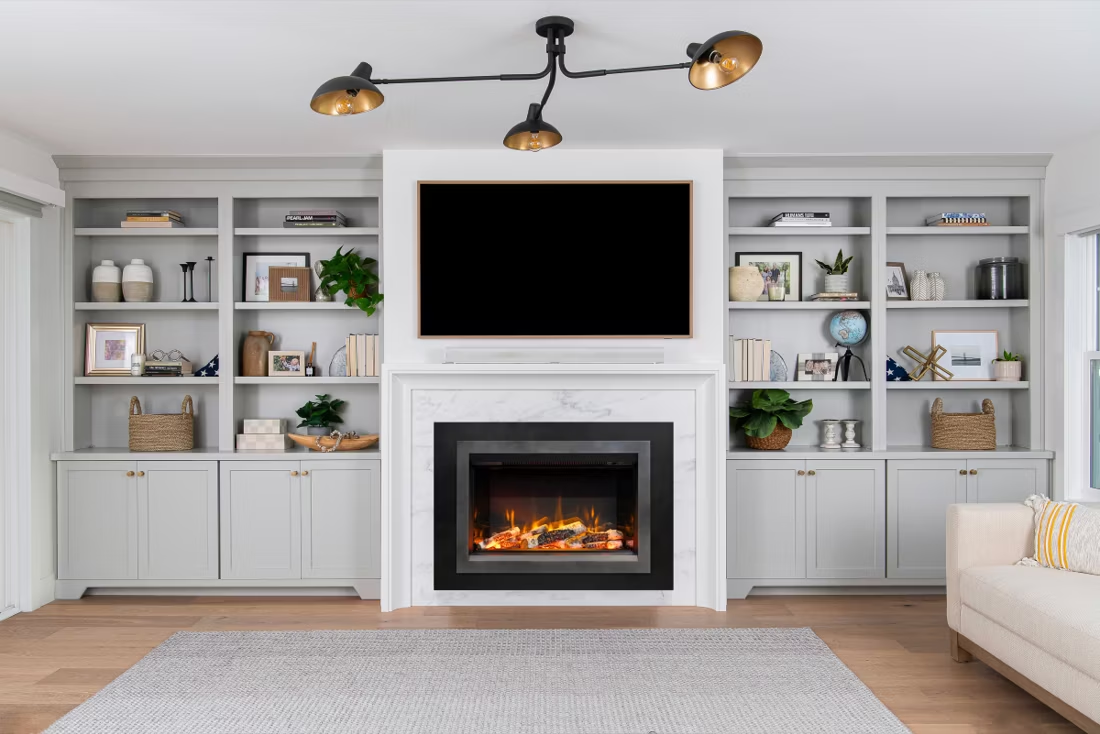
Four fuels. One honest answer for Hawaii County.
Three steps. No salesperson until you're ready.
Tell us about your project
Your zip code, your situation, and the fuel you're leaning toward—or let the answers point you to one.
See what's actually available
The brands dealers within 100 miles genuinely carry—real options, never a catalog mirage.
Get your dealer & Project Guide
A trusted local dealer, plus the free Project Guide & Parts List that names every component of the job.
Frequently Asked Questions
Which fuel works best for a fireplace in Hawai'i County?
Gas is the standard choice here—propane-fueled fireplaces and inserts (there's no piped natural gas system on the island, so every gas unit runs on tank or bulk propane) give homeowners in Kona, Hilo, and Waikoloa a controllable, ambiance-first fire without smoke or firewood storage. Electric fireplaces are just as common, especially in condos and multi-family buildings where open flame is restricted—HELCO service is reliable island-wide, so a plug-in or built-in electric unit works anywhere. Wood is rare: with only 6 heating degree days a year county-wide, almost nobody needs wood heat, though a small number of households in the cooler uplands around Volcano Village or Waimea burn eucalyptus or ohia on an occasional cool evening, mostly for ambiance. Pellet stoves are rarer still—Lignetics is the only regional brand distributed here, and it typically arrives by container shipment, which adds cost most homeowners skip in favor of gas or electric.
Do wood-burning fireplaces make sense in Hawai'i County?
For most of the island, not as a heat source. Hawai'i County's climate zone 1A and 61°F average winter low mean whole-house heating is essentially a non-issue—compare that to International Falls, MN, which can log over 10,000 heating degree days in a single winter against Hawai'i County's 6 for the whole year. Where wood does show up is the cooler upcountry pockets: Volcano Village near Hawai'i Volcanoes National Park, and ranching country around Waimea, where elevation knocks the temperature down enough that a real fire on a chilly evening has genuine appeal. Eucalyptus and ohia are what people actually burn there; koa is prized enough as a hardwood that most owners save it for furniture rather than firewood. If you're set on a wood stove, a local retailer can tell you honestly whether your elevation and use case justify it, or whether gas or electric will serve you better.
Do I need a permit to install a gas or electric fireplace in Hawai'i County?
Yes for gas—installations require a building permit through the County of Hawai'i Department of Public Works, Building Division, plus a licensed plumber or gas fitter to run and connect the propane line, since there's no municipal natural gas system on the island. Electric fireplaces that plug into an existing outlet usually don't need a permit; built-in electric units requiring new wiring or a dedicated circuit do, and should go through a licensed electrician. Wood stove installations, though rare, still require a permit and correctly sized venting—that matters here because local inspectors see far fewer wood installations in a given year than gas or electric ones. Retailers who install regularly on the island typically handle the permit paperwork as part of the job.
What does fireplace installation cost across fuel types in Hawai'i County?
Gas fireplace or insert installation typically runs $4,000-$9,000, driven mostly by how far the propane line has to run and whether you're converting an existing masonry fireplace or building new. Electric fireplace installs are the most affordable entry point—$200-$2,500 for the unit, plus $300-$1,000 in labor for anything beyond a plug-and-play wall unit. Wood stove installs, where they happen, run $4,500-$8,000 given the need for a full insulated chimney system, which is uncommon inventory for island retailers and sometimes has to be special-ordered. Pellet stove installs are rare enough that pricing isn't standardized locally—expect a premium over mainland pricing once shipping for the unit and Lignetics fuel is factored in.
How much does it cost to run an electric fireplace given Hawai'i's electricity rates?
HELCO (Hawaii Electric Light Company) serves the whole island, and Hawai'i's electricity rates are among the highest in the country, largely because the state imports most of its generation fuel. That matters when comparing gas and electric for regular use: an electric fireplace run for ambiance a few evenings a week costs relatively little, but using one as a primary heat source—relevant mainly for upcountry Volcano or Waimea homes—shows up on your HELCO bill more than a propane appliance would for equivalent heat output. Most homeowners here treat electric fireplaces as a low-commitment ambiance feature rather than a heating strategy, which keeps the operating-cost concern mostly theoretical.
Why are pellet stoves so rare in Hawai'i County, and are they even available?
Pellet stoves are the rarest fireplace category on the island. Lignetics is the only regional brand with any distribution here, and because pellets are typically shipped in by container rather than produced locally, supply is limited and pricing runs higher than on the mainland. Combined with heating needs that are close to zero across most of the county, pellet stoves make sense for very few households—mostly those in the Volcano or Waimea uplands who want the wood-stove aesthetic without splitting logs, and who are willing to plan fuel orders well in advance. For nearly everyone else on the island, gas or electric fireplaces cover the ambiance and occasional-heat use case more practically.
What is an in-home preview and do I need one?
It's a visit where a hearth professional measures your space, confirms the model you picked actually works in your home, and walks the specs—framing, gas line, venting, finish work—before anything is ordered. Some details you just can't know until you see the house. Never make a down payment without one; it's the single most-skipped step that burns buyers.
Does a fireplace add value to my home?
On average, a fireplace adds back to the home about the same amount you spent installing it. Add the monthly savings from heating the rooms you actually use instead of the whole house—often hundreds of dollars a year—and the value case is strong before you even count what a fire does for how your family uses the room.
Can a fireplace actually lower my heating bill?
Yes—by creating a comfort zone. A furnace heats every square foot of the house just to warm the one room you're in; a gas fireplace on low burns roughly a sixth of the gas a typical furnace does. Set the furnace around 55–60 degrees as a baseline, then heat the rooms your family actually uses. Families who heat this way commonly save $20–$60 a month.
How much should I budget for a fireplace?
For an average home—covering the fireplace, the vent pipe, and basic installation—a budget between $3,900 and $5,500 gives you a lot of options across wood, gas, and pellet. By the time you add finish work, gas line, and electrical, the average complete installation lands between $5,000 and $12,000 all-in. In a remodel or new build, a good rule is to put about 2.5% of the total project cost toward the fireplace.
Stove and Fireplace Dealers in Hawaii County
Listings include WhyFire partner dealers, dealers we have verified as authorized for the brands we recommend, and established local businesses that carry hearth products. Every listing shows which one it is. The ones marked Preferred run on WhyFire's software, so they can show you real pricing and book your appointment right here. No manufacturer pays for placement. How we verify dealers →
Fireplace & Home Center
Hawaii Fireplace – Kamuela
Island Pool & Spa Supply
Find your fireplace in Hawai'i County.
Get matched with a trusted local dealer serving your part of the island and receive a free Project Guide & Parts List—the exact parts, venting, and recommended installer for your gas, electric, wood, or pellet project in Hawai'i County.
Find Your Fireplace →