
Reliable warmth for Murray County's mild but real winters.
From Chatsworth to the ridgelines near Fort Mountain State Park, gas fireplaces give Murray County homes instant, no-hassle heat without a wood pile. Find the right unit and get matched with a trusted local dealer.
Every Project Starts From One of These Five Situations
Instant heat without the wood pile.
Murray County sits in the Blue Ridge foothills of northwest Georgia, anchored by Chatsworth and stretching up toward Fort Mountain State Park and the southern edge of the Cohutta Wilderness. At around 6,400 residents spread across a mix of small-town streets and rural acreage, it's a place where oak, pine, and hickory firewood is easy to come by—but it's also a place where winters, while milder than the mountains further north, still bite. Climate zone 4A and roughly 3,346 heating degree days mean average lows near 30°F, with colder nights common at the higher elevations near Fort Mountain and Carters Lake. That's a fraction of what a place like Burlington, Vermont sees each winter, but it's still enough cold-weather demand to make supplemental heat a real consideration in most homes.
Natural gas service in Murray County is limited mostly to in-town customers around Chatsworth through Atmos Energy—most of the county's rural homes and second properties near the wilderness area run on propane instead. Either fuel works fine for a modern direct-vent gas fireplace or insert, and that's exactly why gas has become a popular option here: no hauling or splitting oak and hickory, no ash to clean up, and heat at the flip of a switch for homes where convenience matters as much as ambiance. A trusted local dealer can tell you quickly whether your property has access to natural gas or needs a propane setup, and size the right unit for your space.
Three steps. No salesperson until you're ready.
Tell us about your project
Your zip code, your situation, and the fuel you're leaning toward—or let the answers point you to one.
See what's actually available
The brands dealers within 100 miles genuinely carry—real options, never a catalog mirage.
Get your dealer & Project Guide
A trusted local dealer, plus the free Project Guide & Parts List that names every component of the job.
Frequently Asked Questions
How much does a gas fireplace installation cost in Murray County?
A typical gas fireplace or insert installation in Murray County runs roughly $3,500 to $8,000, depending on the unit, whether you're on natural gas (Atmos Energy service is limited mostly to in-town Chatsworth) or propane, and how much venting and gas line work is required. A direct-vent insert going into an existing masonry fireplace with gas already run to the house tends to land on the lower end. New construction, or a fresh propane tank setup for a rural property near Fort Mountain or Carters Lake, pushes toward the higher end once line runs and venting are factored in. A local dealer will give you a firm number after seeing your home.
Can I convert my existing wood fireplace to gas?
Yes, and it's a common project for older Murray County homes that already have a masonry fireplace built around locally cut oak or hickory as the original fuel. A gas insert typically slides into that existing firebox, using a stainless liner run through your current chimney for venting. Costs usually run $3,500 to $7,000 depending on whether the home is on propane or has natural gas access through Atmos Energy, and whether new gas line work is needed. The conversion keeps the look of the original hearth while removing the need to source and split firewood every winter.
Do I need natural gas, or can I use propane for a gas fireplace?
Either works fine. Atmos Energy provides natural gas service to parts of Chatsworth, but most of Murray County—including the rural stretches out toward Eton and the Cohutta Wilderness foothills—doesn't have natural gas mains, so propane is the standard fuel. Most gas fireplace and insert models can be configured for either fuel with the correct orifice and regulator. If you're outside a natural gas service area, your local dealer will help coordinate a propane tank installation with a regional propane supplier as part of the project.
Will my gas fireplace still work if the power goes out?
Most modern gas fireplaces will, yes. Units with intermittent pilot ignition (IPI) run on a small battery backup that kicks in automatically when power drops, so the fireplace lights and operates normally off battery power. Valor fireplaces take a slightly different approach—their pilot generates its own electricity through a thermocouple, so there's no battery to maintain at all. For Murray County's rural stretches, where storm-related outages can knock out power for a day or more, that kind of self-powered backup is worth asking your local dealer about directly.
What's the difference between a gas fireplace, gas insert, and gas stove?
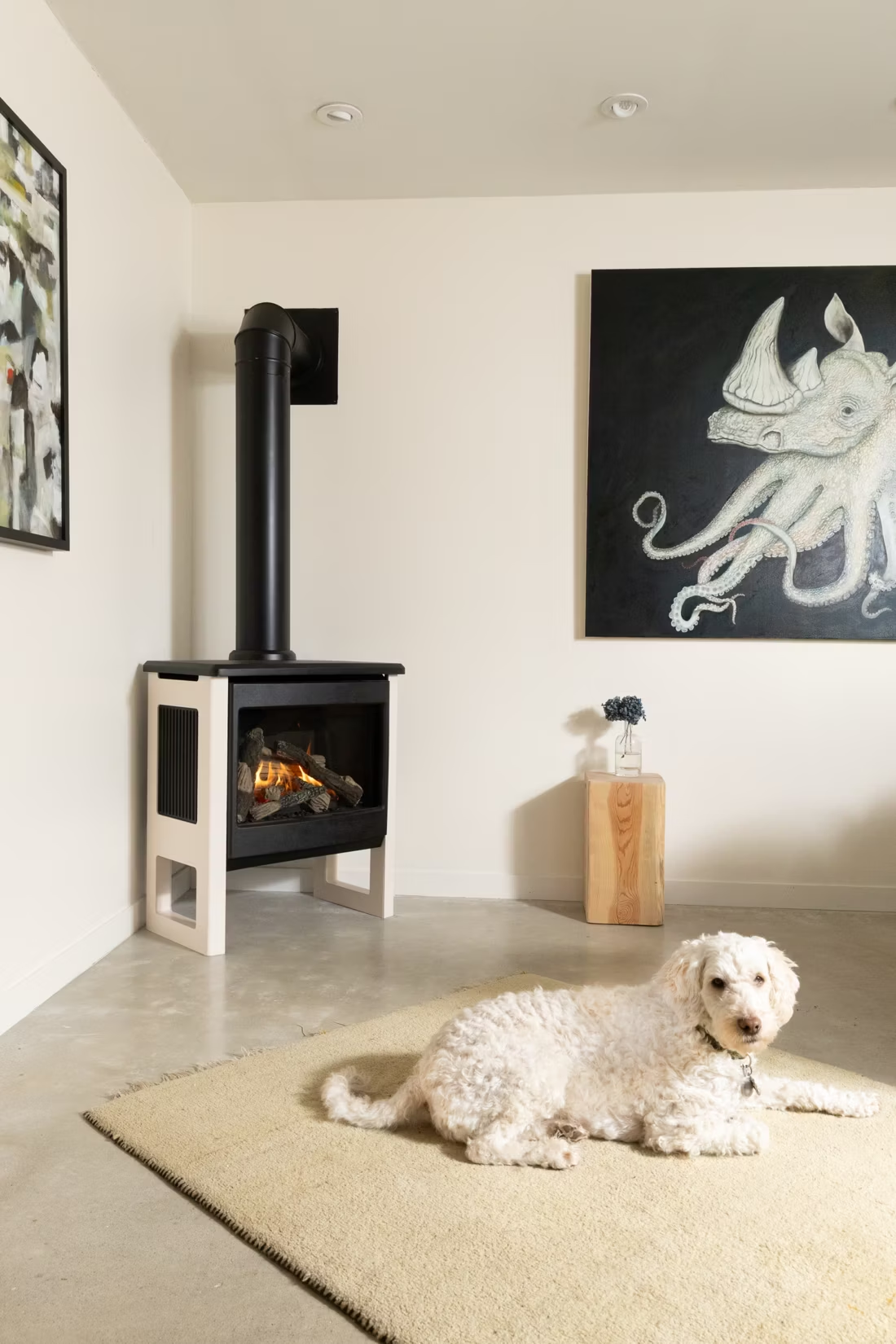
A gas fireplace is a fully built-in unit framed into a wall—the right call for new construction or a remodel without an existing hearth. A gas insert is built to slide into an existing masonry fireplace, sealing it up and using the current chimney as a vent path, which is a natural fit for many of Murray County's older homes with a working chimney but a smoky, inefficient open hearth. A gas stove is freestanding, sitting on the floor like a wood stove would, and works well in a room without any existing fireplace opening. For most Murray County homeowners upgrading an existing fireplace, an insert is the simplest and most cost-effective route.
Do I need a permit to install a gas fireplace in Murray County?
Yes—new gas fireplace and insert installations require both a building permit through Murray County's building and development office and a gas permit for the line work, which has to be done by a licensed gas-fitter. Most reputable local dealers handle the permitting and inspection scheduling as part of the installation, so you're not left coordinating separate trades. This matters more in propane setups too, since tank placement and line runs have their own setback and inspection requirements.
What's the difference between vented and vent-free gas fireplaces?
Vented gas fireplaces—direct-vent or B-vent—pull combustion air from outside and exhaust the byproducts back outside through a sealed pipe. Vent-free (or "ventless") units burn fuel directly into the room without any outside venting, which is more efficient on paper but releases some water vapor and trace combustion gases into your living space. Georgia allows vent-free units, but they come with strict room-sizing rules and oxygen depletion sensors that limit where they can go—a small bedroom or tightly sealed room usually isn't a candidate. In Murray County, direct-vent units are the more common choice, especially in homes with vaulted ceilings or larger open living spaces near Fort Mountain-area properties. Ask a local dealer which option fits your specific room.
How often should my gas fireplace be serviced?
Plan on an annual inspection, even though gas units need far less attention than a wood stove chimney. A technician checks the burner, pilot assembly, gas connections, and venting, and cleans the glass and interior—usually a $125 to $200 visit. This matters even more for propane-fueled units in Murray County's rural areas, where a service call might mean scheduling further ahead than it would for an in-town Chatsworth home on natural gas.
Gas vs. wood—which is right for my Murray County home?
Wood still has real advantages here—oak, pine, and hickory are all abundant locally, Cherokee National Forest cutting permits run about $20 per cord during the May-to-October season, and a wood stove keeps working when the power's out. Gas trades that self-sufficiency for convenience: instant on-off heat, no splitting or hauling firewood, and a cleaner-looking hearth. For full-time Murray County residents who want zone heat without the upkeep, or second-home owners near Carters Lake who want a fireplace that's ready the moment they walk in, gas is usually the better fit. Plenty of local homes keep both—gas for daily convenience, a wood stove or insert for backup heat during outages.
What's the difference between an insert and a zero-clearance fireplace?
An insert is a fireplace that slides into a pre-existing wood-burning fireplace—if you don't have one, there's nothing to insert it into. A zero-clearance fireplace is built into a framed wall, which makes it the answer for remodels and new construction. Simple test: existing masonry fireplace means insert; blank or framed wall means zero-clearance.
What does it take to replace an existing fireplace?
Fireplaces are like icebergs—bigger behind the wall than in front of it. Replacement means removing the surrounding tile or stone (the finish material laps onto the fireplace face), pulling the old unit, setting the new one in the same enclosure, and re-finishing the wall. A hearth professional can determine what's behind your wall without demolition during an in-home preview.
Can a fireplace actually lower my heating bill?
Yes—by creating a comfort zone. A furnace heats every square foot of the house just to warm the one room you're in; a gas fireplace on low burns roughly a sixth of the gas a typical furnace does. Set the furnace around 55–60 degrees as a baseline, then heat the rooms your family actually uses. Families who heat this way commonly save $20–$60 a month.
How much should I budget for a fireplace?
For an average home—covering the fireplace, the vent pipe, and basic installation—a budget between $3,900 and $5,500 gives you a lot of options across wood, gas, and pellet. By the time you add finish work, gas line, and electrical, the average complete installation lands between $5,000 and $12,000 all-in. In a remodel or new build, a good rule is to put about 2.5% of the total project cost toward the fireplace.
Find your gas fireplace in Murray County.
Tell us a bit about your home and we'll put together a free Project Guide & Parts List—the right gas fireplace or insert, the exact parts including the vent kit, and a trusted local Murray County dealer to install it.
Find Your Fireplace →