
Add Real Ambiance to Your Dalton Home—No Chimney Required.
With winter lows averaging 31°F, Dalton doesn't need a cord-fed furnace—it needs supplemental warmth and a good-looking flame. Find the right electric unit and connect with a trusted local dealer.
Every Project Starts From One of These Five Situations
Mild winters, modest heating needs—electric fits perfectly.
Dalton sits at 769 feet in the foothills of northwest Georgia's Appalachian ridgeline, in climate zone 4A. With only 3,151 heating degree days a year and winter lows that average 31°F, this is nothing like the deep-cold demands of a place like Duluth, MN, where a home might need a wood stove running around the clock for months. Dalton's carpet-industry homes and newer subdivisions alike are typically heated by central heat pumps or gas furnaces already—what most homeowners here are shopping for is a fireplace that adds ambiance and takes the edge off a cold snap in one room, not a primary heat source for the whole house.
That's exactly where electric fireplaces earn their keep. Electric service in Whitfield County comes from three different providers depending on where you live—Georgia Power, North Georgia EMC, and Dalton Utilities—with residential rates ranging from about $0.1007/kWh with Dalton Utilities up to $0.1549/kWh with Georgia Power. Because electric units draw far less power than a central HVAC system and need no gas line, no chimney, and in most cases no venting at all, they're the simplest fireplace project available in Dalton: plug in a freestanding or wall-mounted unit, or have an electrician run a dedicated circuit for a built-in insert, and you're done.
Three steps. No salesperson until you're ready.
Tell us about your project
Your zip code, your situation, and the fuel you're leaning toward—or let the answers point you to one.
See what's actually available
The brands dealers within 100 miles genuinely carry—real options, never a catalog mirage.
Get your dealer & Project Guide
A trusted local dealer, plus the free Project Guide & Parts List that names every component of the job.
Frequently Asked Questions
How much does an electric fireplace installation cost in Dalton?
Most plug-in freestanding or wall-mounted electric fireplaces in Dalton run $300 to $1,500 installed, since they simply plug into a standard household outlet. Built-in electric inserts or linear wall units that require a dedicated 20-amp circuit run higher, typically $800 to $2,500, once you factor in electrician labor to run new wiring and any wall framing or mantel surround work. Because there's no gas line, no chimney, and no combustion venting involved, electric is consistently the least expensive fireplace category to install in Whitfield County.
Do I need a permit to install an electric fireplace in Dalton?
A plug-in electric fireplace that uses an existing outlet typically doesn't require any permit—it's treated like any other appliance. If you're having a built-in insert wired to a new dedicated circuit, that electrical work generally requires a permit through the City of Dalton or Whitfield County building department, depending on your address, since it involves running new wiring inside the walls. Your installing electrician or the retailer coordinating the job will usually pull that permit for you.
Will an electric fireplace actually heat my room, or is it just for looks?
Most electric fireplace inserts put out 5,000 to 9,000 BTUs, which is enough to noticeably warm a single room—a den, bedroom, or home office—especially given how mild Dalton's winters are, with lows averaging around 31°F rather than the sustained sub-freezing stretches you'd see farther north. What electric won't do is replace your home's central heat pump or furnace as a whole-house heat source. Think of it as effective, thermostat-controlled zone heat for the room you're actually using, paired with genuine flame ambiance, rather than a backup system for a winter power outage.
Which electric utility serves my part of Dalton, and does it affect running costs?
Whitfield County is split between three providers—Georgia Power, North Georgia EMC, and Dalton Utilities—and which one serves your address depends on where you live in or around the city. Rates vary meaningfully: Dalton Utilities customers pay around $0.1007/kWh, North Georgia EMC customers around $0.1218/kWh, and Georgia Power customers around $0.1549/kWh. In practice this makes little difference to fireplace operating cost either way—a typical 1,500-watt electric fireplace run for a few hours costs somewhere between a dime and a quarter depending on your provider—but it's worth checking your utility bill to know which rate applies to you.
What's the difference between an electric fireplace insert and a wall-mounted or freestanding unit?
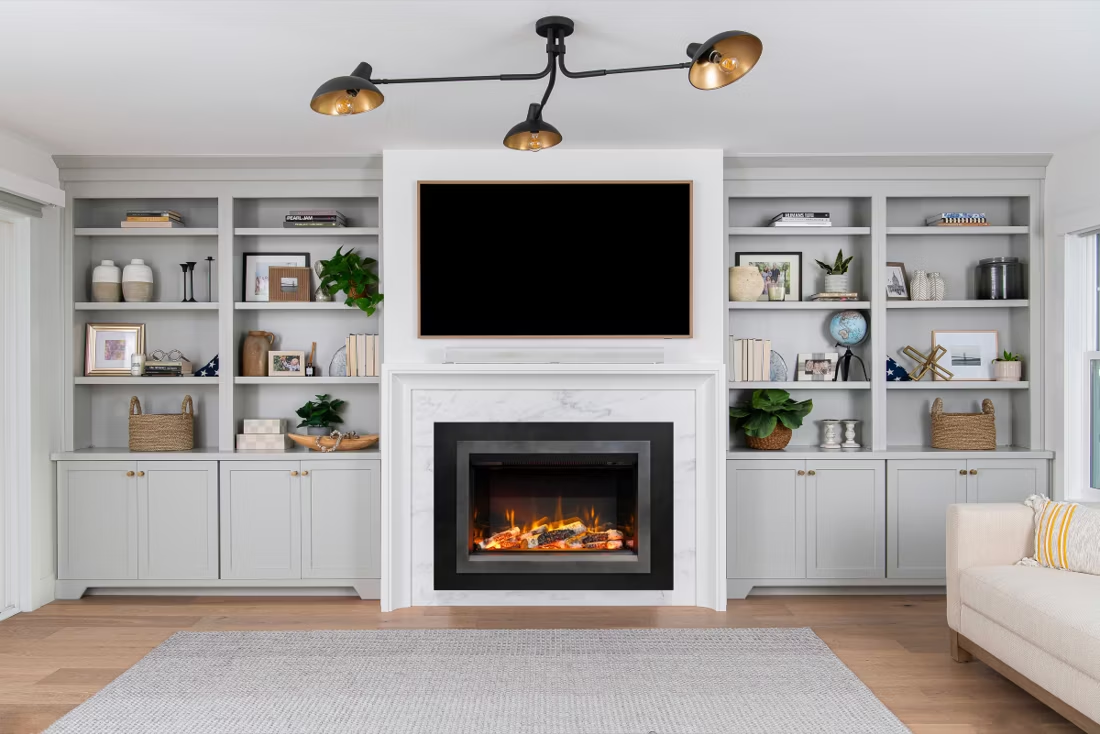
An electric insert is built to slide into an existing fireplace opening or a zero-clearance frame, replacing a wood-burning firebox (or an unused masonry opening) with a flush, finished look. A wall-mounted unit hangs on the wall like a piece of art or a TV, popular in newer Dalton builds for a modern linear-flame look above a media console. A freestanding unit is a standalone cabinet or stove-style piece that can be moved from room to room and needs nothing more than a nearby outlet—the easiest option for renters or anyone not ready to commit to a permanent installation.
Can I install an electric fireplace in an apartment or rental in Dalton?
Yes, and it's one of the more common uses for electric fireplaces in Dalton given the city's large rental and manufactured-housing population tied to the carpet industry workforce. A plug-in freestanding or wall-mounted electric fireplace needs no venting, no gas line, and no permanent alteration to the property—it plugs into a standard outlet and can go with you when you move. It's the one fireplace category that genuinely works for renters without landlord approval for construction.
Why don't more homes in Dalton use wood or pellet stoves?
Dalton's climate simply doesn't demand it. With only 3,151 heating degree days a year and winter lows averaging 31°F, most homes here are adequately served by a central heat pump, and wood or pellet stoves as a primary heat source are uncommon. Cutting permits are available through the Cherokee National Forest for about $20 a cord during the May-to-October season, and some rural Whitfield County households do burn local oak, pine, and hickory for occasional ambiance, but it's a small niche rather than the norm you'd find in a colder, wood-permit-heavy region. Electric fills that same ambiance role for most Dalton homeowners without the smoke, ash, or chimney maintenance.
How does electric compare to gas fireplaces for heating in Dalton homes?
Gas fireplaces put out significantly more heat per unit—typically 20,000 to 40,000 BTUs versus 5,000 to 9,000 for electric—and can genuinely take the chill off a large room during one of Dalton's occasional cold snaps. But gas installation runs considerably more, since it usually involves a gas line, venting, and a larger project scope, while electric needs only an outlet or a simple dedicated circuit. For homeowners who want real supplemental heat and are already on natural gas, gas is worth considering. For homeowners who mainly want flame ambiance with a modest heat boost and the simplest possible install, electric is usually the better fit in a mild climate like Dalton's.
What size electric fireplace do I need for my Dalton home?
For a typical bedroom or home office in the 150-250 square foot range, a 30 to 40-inch electric insert or wall-mounted unit is usually plenty. Larger great rooms or open-concept living areas common in Dalton's newer subdivisions often call for a 50 to 60-inch linear unit to properly fill a feature wall and provide noticeably more heat output. Because electric fireplaces are sized more around visual scale and room layout than raw BTU need, a local dealer can help you match the width to your wall and mantel plans during a quick in-home or showroom consultation.
Can I put a TV above my fireplace?
Yes—with an asterisk. Fireplaces are hot and TVs don't like heat. Either put a mantel between them to deflect rising warmth, or choose a fireplace with heat-management technology that creates a cool zone on the wall above—the wall stays around 125 degrees, barely warm, while the room still gets full heat. If you like clean lines and don't want a mantel, heat management is the answer.
Do electric fireplaces actually produce heat?
Yes—most put out around 4,800–5,000 BTUs from a standard outlet, which comfortably warms a bedroom, office, or den as a comfort-zone heater. What they won't do is carry a whole house the way wood, gas, or pellet can. Think of electric as ambiance-first with honest supplemental heat: flames on with no heat in July, flames plus warmth in January.
How much should I budget for a fireplace?
For an average home—covering the fireplace, the vent pipe, and basic installation—a budget between $3,900 and $5,500 gives you a lot of options across wood, gas, and pellet. By the time you add finish work, gas line, and electrical, the average complete installation lands between $5,000 and $12,000 all-in. In a remodel or new build, a good rule is to put about 2.5% of the total project cost toward the fireplace.
What is an in-home preview and do I need one?
It's a visit where a hearth professional measures your space, confirms the model you picked actually works in your home, and walks the specs—framing, gas line, venting, finish work—before anything is ordered. Some details you just can't know until you see the house. Never make a down payment without one; it's the single most-skipped step that burns buyers.
Electric Service in Dalton
An electric fireplace's heater draws about 1,500 watts—pennies per hour at local rates.
Georgia Power Co
North Georgia Elec Member Corp
Dalton Utilities
Find your electric fireplace in Dalton.
Tell us a bit about your home and we'll put together a free Project Guide & Parts List for your Dalton electric fireplace project—the right unit, the exact parts, and a trusted local dealer to install it.
Find Your Fireplace →