
Warm up a Chattahoochee Valley home—no chimney required.
For Fort Gaines and the rest of Clay County, an electric fireplace or insert gives you real warmth on the occasional cold night without a flue, a gas line, or major construction. Find the right unit and connect with a trusted local dealer.
Every Project Starts From One of These Five Situations
Georgia's least crowded county calls for simple, flexible heat.
Clay County is one of the smallest counties in Georgia by population—around 1,330 people spread across the county seat of Fort Gaines and the farmland and timberland running along the Chattahoochee River and Lake George W. Andrews. The climate here falls in IECC zone 3A, the warm-humid Southeast: long mild autumns, short winters, and cold snaps that dip into the 20s a handful of nights a year rather than sustained deep freezes. That climate profile is exactly where electric fireplaces earn their keep—supplemental heat and fire ambiance for the nights that call for it, without the commitment of a wood-burning system built for a much colder region.
Much of Clay County's housing stock is a mix of older river-town homes near Fort Gaines with existing masonry fireplaces and manufactured or modular homes on rural lots—both common patterns across southwest Georgia. Neither situation typically has piped natural gas nearby, and running propane or a wood chimney is often more project than a homeowner wants for occasional-use heat. An electric insert dropped into an old masonry opening, or a freestanding electric stove plugged into a standard outlet, solves that cleanly: no venting, no combustion byproducts, and in most cases no inspection beyond basic electrical safety.
Three steps. No salesperson until you're ready.
Tell us about your project
Your zip code, your situation, and the fuel you're leaning toward—or let the answers point you to one.
See what's actually available
The brands dealers within 100 miles genuinely carry—real options, never a catalog mirage.
Get your dealer & Project Guide
A trusted local dealer, plus the free Project Guide & Parts List that names every component of the job.
Frequently Asked Questions
How much does an electric fireplace installation cost in Clay County?
Electric is the least expensive hearth option available, and that holds true in Clay County. A plug-in insert or freestanding stove that runs on a standard 120V outlet typically costs a few hundred dollars for the unit plus minimal labor if any wiring changes are needed. A built-in electric fireplace or a unit requiring a dedicated 240V circuit runs higher once an electrician is involved—usually still well under what a gas or wood project costs. Because there's no chimney, gas line, or masonry work, most electric installs in Fort Gaines and the surrounding county are done in a single visit.
Do I need a permit or an electrician to install an electric fireplace?
Plug-in electric fireplaces and inserts that use a standard outlet generally don't require a building permit—you're not adding venting or combustion equipment, so there's nothing for Clay County's building office to inspect on the appliance itself. If you're installing a built-in unit that needs a new 240V circuit or a dedicated outlet, a licensed electrician should run that wiring, and depending on the scope that work may need its own electrical permit. Your local dealer can tell you which category your chosen unit falls into before you buy.
Are electric fireplaces a good fit for manufactured and mobile homes?
Yes, and it's one of the more common installs in this part of southwest Georgia. Manufactured and modular homes are common throughout Clay County's rural areas, and most manufacturers explicitly restrict or prohibit wood or gas venting through their roof and wall systems. Electric fireplaces sidestep that problem entirely—no penetration through the roof or exterior wall, no clearance-to-combustibles concerns beyond the unit's own listing, and a straightforward plug-in or simple hardwire setup that works within manufactured housing electrical codes.
Can I put an electric insert into my existing wood fireplace?
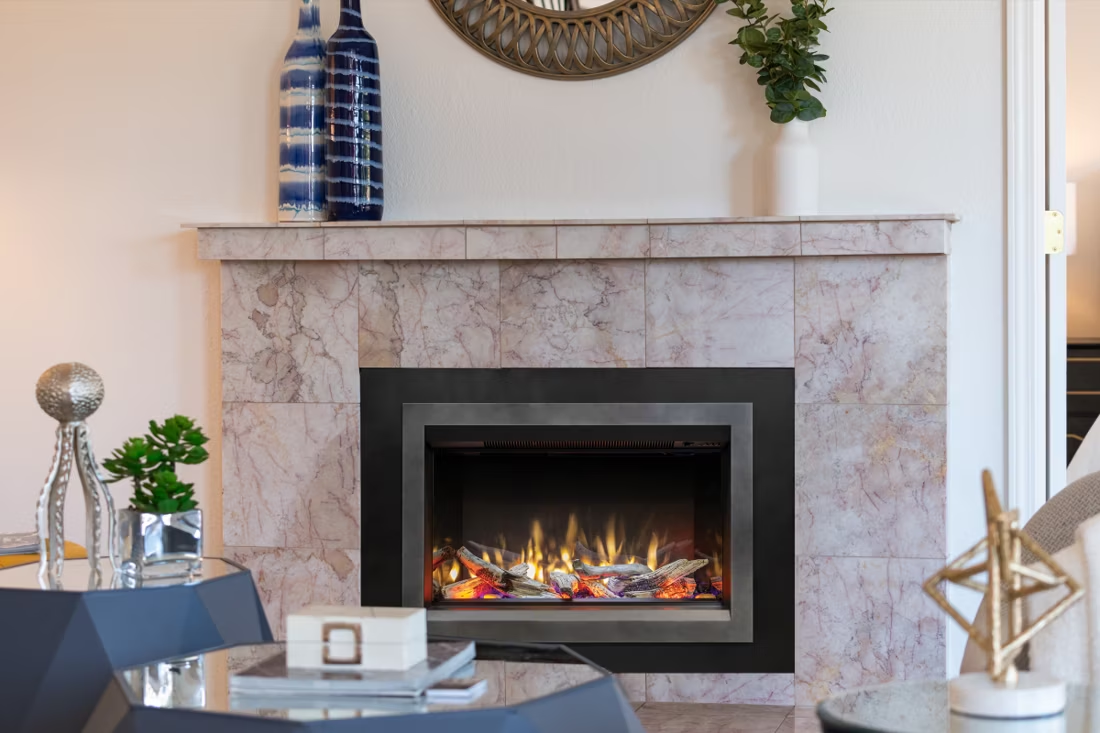
Absolutely, and it's a popular option for the older homes around Fort Gaines with an existing masonry fireplace that's rarely used for wood. An electric insert slides into the existing opening, uses the mantel and surround you already have, and typically just needs a nearby outlet—no chimney liner, no venting work, and no impact on the fireplace's appearance from the room. It's a fast way to get a working, controllable heat source and flame effect out of a fireplace that would otherwise sit unused.
How much does it cost to run an electric fireplace in Clay County?
Running costs depend on the unit's wattage and your local electric rate, but a typical 1,500-watt electric fireplace running on high draws roughly 1.5 kWh per hour. Given Clay County's mild winters—short cold periods rather than months of sustained heating demand—most households use these units for supplemental warmth in one or two rooms on cold nights rather than as a whole-home heat source, which keeps the seasonal electric cost modest compared to running central heat harder.
Will my electric fireplace work during a power outage?
No—this is worth being direct about. Electric fireplaces require grid power to run the heating element, blower, and flame effect, so they won't provide heat or light during an outage unless you're running a generator. If backup heat during storm-related outages matters to you—a real consideration in rural Clay County, where restoration times can run longer than in town—a gas or propane unit with battery-backed ignition is a better complement, with the electric fireplace serving as your everyday, no-hassle option the rest of the time.
Electric vs. gas—which is right for my Clay County home?
Gas fireplaces (typically propane in Clay County, since piped natural gas is limited outside Fort Gaines) put out real heat output and can include battery-backed ignition that keeps working in an outage—a meaningful advantage for rural properties. Electric fireplaces cost less to buy and install, need no venting or gas line, and work anywhere there's an outlet, but they're supplemental heaters rather than a whole-home solution and they go dark with the power. For a primary living space where you want dependable heat and outage resilience, gas usually wins. For a bedroom, den, or an old fireplace opening you just want to bring back to life with minimal fuss, electric is often the simpler answer.
Can an electric fireplace actually heat a room, or is it just for looks?
Most electric fireplaces include a real heating element—typically a 1,500-watt unit capable of warming a single room of 400 to 1,000 square feet, depending on ceiling height and insulation. That's plenty for the kind of cold-snap heating Clay County actually needs given its mild zone 3A climate. The flame effect can also be run independently of the heater, so you get ambiance in warmer months without adding unwanted heat to the room—a genuinely useful feature in a Georgia summer.
What should I look for in a local electric fireplace dealer near Fort Gaines?
Because there's no combustion equipment, chimney, or gas line involved, the biggest variable in an electric fireplace project is simply picking the right size and style unit and making sure any wiring work is done to code. A trusted local dealer will size the unit to your room, confirm whether your circuit needs an electrician, and make sure the insert or built-in unit fits your existing opening or framing correctly—details that are easy to get wrong ordering sight-unseen from a big-box store.
Do electric fireplaces actually produce heat?
Yes—most put out around 4,800–5,000 BTUs from a standard outlet, which comfortably warms a bedroom, office, or den as a comfort-zone heater. What they won't do is carry a whole house the way wood, gas, or pellet can. Think of electric as ambiance-first with honest supplemental heat: flames on with no heat in July, flames plus warmth in January.
Can I put a TV above my fireplace?
Yes—with an asterisk. Fireplaces are hot and TVs don't like heat. Either put a mantel between them to deflect rising warmth, or choose a fireplace with heat-management technology that creates a cool zone on the wall above—the wall stays around 125 degrees, barely warm, while the room still gets full heat. If you like clean lines and don't want a mantel, heat management is the answer.
How much should I budget for a fireplace?
For an average home—covering the fireplace, the vent pipe, and basic installation—a budget between $3,900 and $5,500 gives you a lot of options across wood, gas, and pellet. By the time you add finish work, gas line, and electrical, the average complete installation lands between $5,000 and $12,000 all-in. In a remodel or new build, a good rule is to put about 2.5% of the total project cost toward the fireplace.
What is an in-home preview and do I need one?
It's a visit where a hearth professional measures your space, confirms the model you picked actually works in your home, and walks the specs—framing, gas line, venting, finish work—before anything is ordered. Some details you just can't know until you see the house. Never make a down payment without one; it's the single most-skipped step that burns buyers.
Find your electric fireplace in Clay County.
Tell us a bit about your home and we'll match you with the right electric fireplace, insert, or stove, plus a free Project Guide & Parts List with your recommended local dealer.
Find Your Fireplace →