
Keep Your Family Warm and Safe—No Matter What
With only 434 heating degree days a year and winter lows averaging 53°F, Town 'n' Country rarely needs supplemental heat. The homeowners who still want a wood fireplace here are after the look and the feel of a real fire—and I can match you with a local dealer who installs it correctly.
Every Project Starts From One of These Five Situations
434 heating degree days a year changes the whole equation.
Town 'n' Country sits at 9 feet of elevation on the west side of the Tampa Bay area, squarely in climate zone 2A, where winter lows average 53°F and a hard freeze is a genuine rarity rather than a seasonal event. Compare that to a place like International Falls, Minnesota, which racks up over 10,000 heating degree days most winters—this stretch of Hillsborough County logs just 434. That gap is the honest reason wood stoves and wood-burning fireplaces are uncommon here: there's simply no sustained cold to heat against. Most local heating load is handled by heat pumps and electric systems through Tampa Electric or Duke Energy Florida, not cordwood.
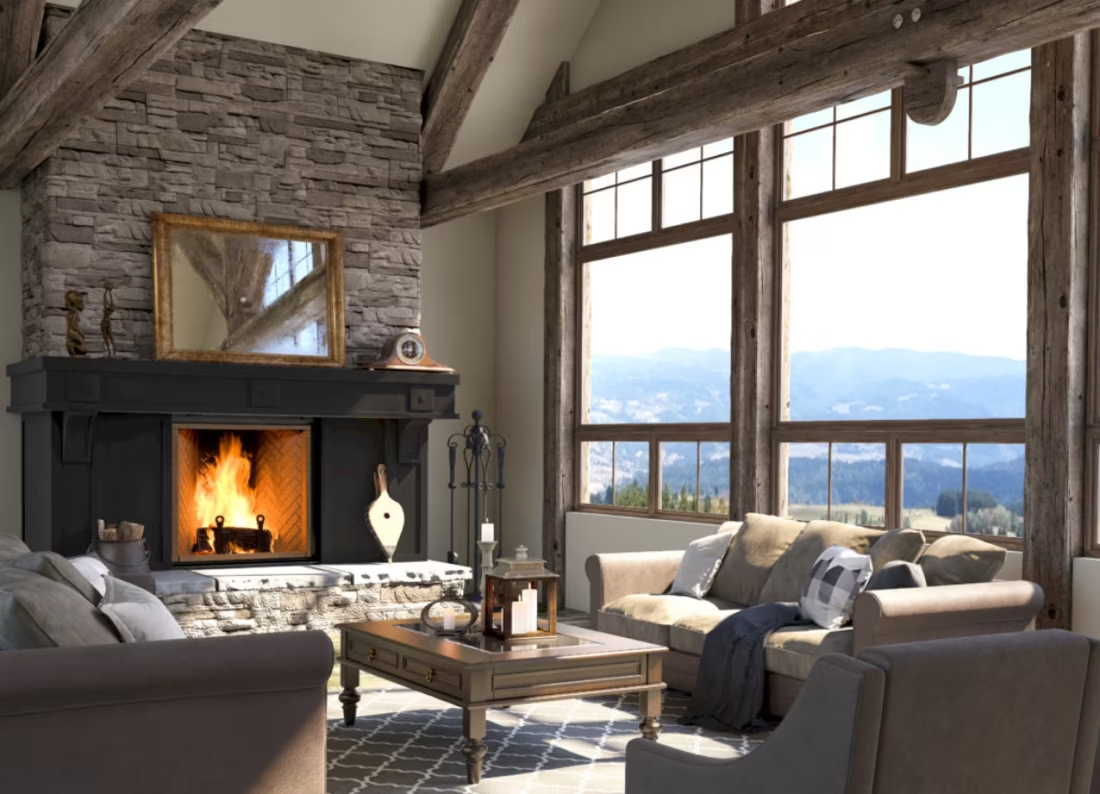
That said, a wood fireplace isn't off the table—it's just installed for a different reason than in a cold-climate state. Some homeowners want the ambiance of a real fire for the handful of nights each winter that dip into the 30s or 40s, others are recreating a fireplace they had up north, and some like having a heat source that doesn't depend on the grid during hurricane season. Local wood tends to be oak, mahogany, or pine—often storm-felled trees processed by local tree services rather than cut under a forestry permit, since there's no national forest land nearby issuing cutting permits the way there is out west. If you go this route, plan on seasoning oak or mahogany longer than you might expect; Florida's humidity slows drying time well past the 6-12 months you'd budget in a drier climate.
Three steps. No salesperson until you're ready.
Tell us about your project
Your zip code, your situation, and the fuel you're leaning toward—or let the answers point you to one.
See what's actually available
The brands dealers within 100 miles genuinely carry—real options, never a catalog mirage.
Get your dealer & Project Guide
A trusted local dealer, plus the free Project Guide & Parts List that names every component of the job.
Frequently Asked Questions
IGNORE
IGNORE
IGNORE
IGNORE
IGNORE
IGNORE
IGNORE
IGNORE
IGNORE
IGNORE
IGNORE
IGNORE
IGNORE
IGNORE
IGNORE
IGNORE
IGNORE
IGNORE
Why won't my new wood stove get going like my old one?
New wood stoves are 70%+ efficient, so far less heat goes up the flue—which also means less draft to get a fire established. The rule: build a genuinely hot fire for about 45 minutes before you choke it down. Skip that and you get smoke in the room, creosote in the chimney, and a fire that never takes off. Most performance complaints trace straight back to this.
Why is a fireplace insert so efficient?
An insert does two things: it seals the chimney completely, so you stop losing air you already paid to heat, and it radiates warmth into the room through the firebox and glass. Most add a heat-exchange fan that pulls cool room air underneath, wraps it around the hot firebox, and pushes it back out warm. Your home is more efficient before you've even lit the first fire.
Can a fireplace actually lower my heating bill?
Yes—by creating a comfort zone. A furnace heats every square foot of the house just to warm the one room you're in; a gas fireplace on low burns roughly a sixth of the gas a typical furnace does. Set the furnace around 55–60 degrees as a baseline, then heat the rooms your family actually uses. Families who heat this way commonly save $20–$60 a month.
What is an in-home preview and do I need one?
It's a visit where a hearth professional measures your space, confirms the model you picked actually works in your home, and walks the specs—framing, gas line, venting, finish work—before anything is ordered. Some details you just can't know until you see the house. Never make a down payment without one; it's the single most-skipped step that burns buyers.
Nearby Dealers
Hearth shops serving Town 'n' Country and the surrounding area.